
Every business wants more website visitors, but traffic alone does not guarantee growth. A website can attract thousands of visitors every month and still struggle to generate leads, sales, or meaningful engagement. The real challenge lies in turning those visitors into customers. This is where conversion rate optimization testing becomes one of the most valuable tools in digital marketing.
Conversion Rate Optimization (CRO) testing helps businesses identify what works, what doesn’t, and what changes can improve customer actions on a website. Instead of relying on assumptions, CRO testing uses real user behavior and data to uncover opportunities for growth. Whether your goal is increasing purchases, generating leads, encouraging sign-ups, or improving customer retention, systematic testing can significantly impact your bottom line.
In this guide, you’ll learn how conversion rate optimization testing works, why it matters, and how to implement effective testing strategies that drive revenue growth.
Understanding Conversion Rate Optimization Testing
Conversion rate optimization testing is the process of experimenting with different website elements to determine which variations produce better results. A conversion can be any desired action a visitor takes, such as completing a purchase, submitting a contact form, downloading a resource, or subscribing to a newsletter.
Rather than making website changes based on personal opinions or industry trends alone, CRO testing relies on measurable data. Businesses create hypotheses, test different versions of web pages, and analyze performance to determine which changes improve conversion rates.
This scientific approach minimizes guesswork and allows organizations to make informed decisions that directly contribute to revenue growth.
Why Conversion Rate Optimization Testing Matters
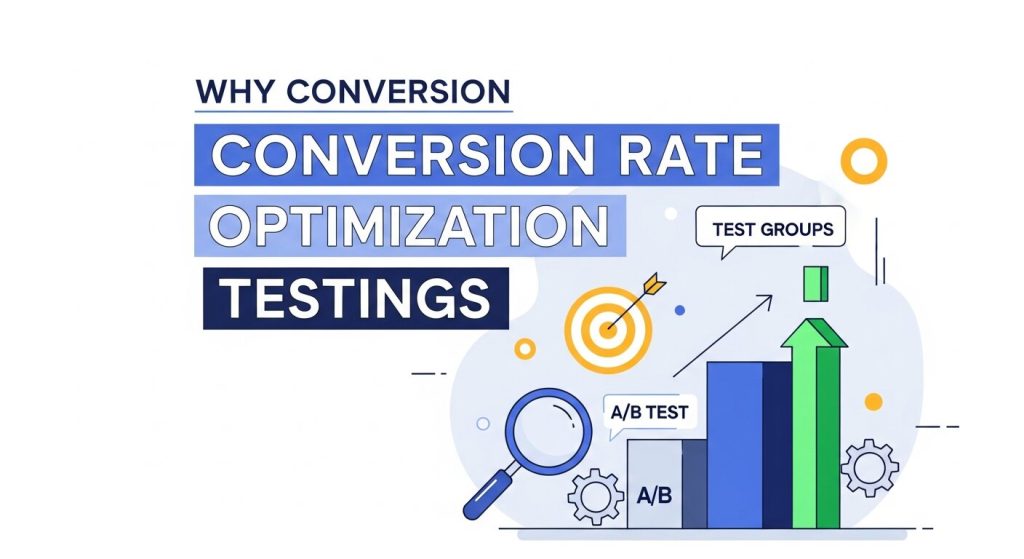 Many businesses invest heavily in attracting website traffic through advertising, content marketing, and search engine optimization. However, increasing traffic often requires substantial ongoing investment.
Improving conversion rates allows businesses to generate more value from their existing traffic. Even small improvements can produce significant financial results over time.
For example, if a website receives 50,000 monthly visitors and converts 2% of them into customers, increasing the conversion rate to 3% can result in a 50% increase in conversions without spending additional money on traffic acquisition.
This makes conversion rate optimization testing one of the most cost-effective growth strategies available.
The Relationship Between CRO and Revenue Growth
Revenue growth depends on several factors, including traffic volume, average order value, customer retention, and conversion rates. While each factor contributes to overall performance, conversion rates often present the fastest opportunity for improvement.
When users encounter a seamless experience that aligns with their needs and expectations, they are more likely to complete desired actions. CRO testing identifies friction points that prevent conversions and helps businesses remove those obstacles.
By continuously refining user experiences, organizations can maximize the value generated from every website visitor.
Identifying Key Conversion Goals
Before conducting tests, it is important to define clear objectives. Different businesses may focus on different types of conversions depending on their goals.
An eCommerce store may prioritize product purchases. A service-based company may focus on consultation requests. A software provider may seek free trial registrations.
Defining specific goals ensures that testing efforts remain aligned with broader business objectives.
Without clear conversion goals, it becomes difficult to measure success and evaluate the effectiveness of optimization efforts.
Understanding User Behavior
Successful optimization begins with understanding how visitors interact with a website. User behavior data reveals where visitors engage, where they hesitate, and where they abandon the conversion process.
Analytics tools provide valuable insights into user journeys, traffic sources, bounce rates, and conversion funnels. Heatmaps and session recordings can further illustrate how users navigate individual pages.
By studying user behavior, businesses can identify areas that deserve testing and prioritize opportunities with the greatest potential impact.
Common Areas to Test
Numerous website elements influence conversion performance. Testing these elements systematically can uncover valuable optimization opportunities.
Headlines often play a significant role in capturing visitor attention. Small adjustments to messaging can dramatically affect engagement and conversion rates.
Call-to-action buttons represent another high-impact testing area. Variations in wording, placement, size, and design can influence user decisions.
Landing page layouts, navigation structures, product descriptions, images, forms, pricing displays, and trust signals can also affect conversion outcomes.
Rather than attempting to test everything simultaneously, businesses should focus on the areas most likely to influence user decisions.
Creating Effective Testing Hypotheses
Every CRO test should begin with a hypothesis based on user data and observations.
A strong hypothesis clearly identifies a problem, proposes a solution, and predicts an expected outcome.
For example, if analytics show that visitors frequently abandon a signup form, a business might hypothesize that reducing the number of required fields will increase completion rates.
Developing thoughtful hypotheses ensures that tests remain focused and actionable rather than random experiments.
A/B Testing Fundamentals
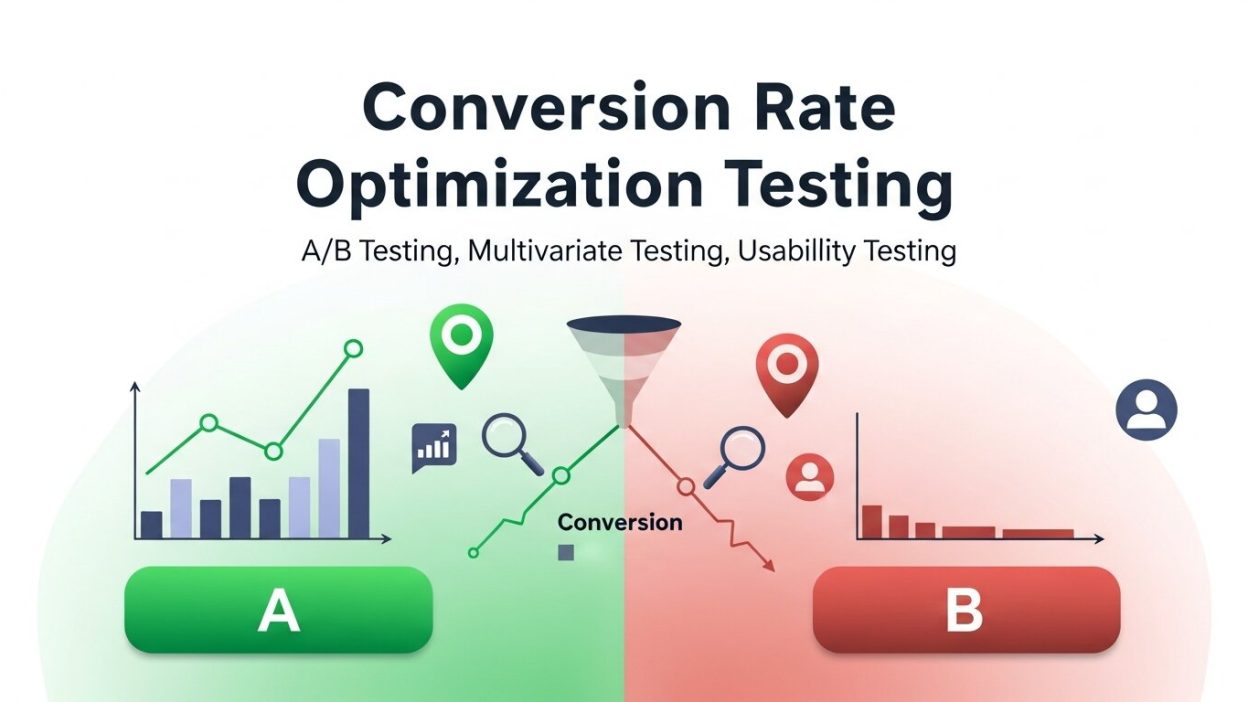
A/B testing is one of the most widely used CRO methodologies. This approach compares two versions of a webpage element to determine which performs better.
Version A serves as the control, while Version B introduces a specific change. Traffic is divided between both versions, and performance metrics are monitored throughout the testing period.
Because A/B testing isolates individual variables, it provides clear evidence regarding which changes influence user behavior.
Businesses can use A/B testing to evaluate headlines, images, forms, pricing strategies, navigation elements, and many other components.
Multivariate Testing and Advanced Experimentation
 While A/B testing evaluates one variable at a time, multivariate testing examines multiple elements simultaneously.
This approach can uncover interactions between different page components and identify optimal combinations. However, multivariate testing generally requires higher traffic volumes to generate statistically reliable results.
Organizations with substantial website traffic often use advanced testing strategies to accelerate optimization efforts and gain deeper insights into customer behavior.
Optimizing Landing Pages
Landing pages frequently serve as the first interaction between visitors and a business. Their performance has a direct impact on conversion outcomes.
Effective landing pages communicate value clearly, minimize distractions, and guide users toward a specific action.
Testing different headlines, visual elements, page structures, and messaging can reveal which combinations resonate most strongly with visitors.
Even seemingly minor improvements can generate meaningful increases in conversion rates over time.
Improving Form Performance
Forms often represent critical conversion points. Whether collecting leads, processing registrations, or facilitating purchases, forms can either encourage or discourage user action.
Long or complicated forms frequently create friction. Testing shorter forms, simplified layouts, and improved instructions can help increase completion rates.
Businesses should continually evaluate form performance to ensure that conversion opportunities are not being lost due to unnecessary complexity.
Enhancing Product Pages
For eCommerce businesses, product pages play a central role in revenue generation.
Customers rely on product information, images, reviews, and pricing details to make purchasing decisions. Testing various elements can improve confidence and increase conversions.
Many online retailers use conversion rate optimization shopify strategies to refine product pages, streamline checkout experiences, and improve customer journeys. These efforts often focus on reducing friction and creating a smoother purchasing process.
As competition continues to grow, optimizing product experiences becomes increasingly important for long-term success.
Using Data to Drive Decisions
One of the greatest strengths of CRO testing is its reliance on objective data.
Rather than implementing changes based solely on intuition, businesses can use performance metrics to guide decision-making. Conversion rates, click-through rates, engagement levels, and revenue figures provide measurable indicators of success.
Data-driven optimization helps organizations allocate resources more effectively and avoid costly mistakes.
The most successful CRO programs treat testing as an ongoing process rather than a one-time project.
The Role of Technology in CRO
 Modern testing platforms have made conversion optimization more accessible than ever before.
Many organizations utilize conversion rate optimization software to create experiments, analyze user behavior, monitor results, and automate portions of the optimization process. These tools simplify testing workflows and provide valuable insights that support continuous improvement.
As technology evolves, CRO platforms continue to offer increasingly sophisticated capabilities that help businesses identify opportunities and improve website performance.
Selecting the right tools depends on factors such as traffic volume, business goals, technical resources, and budget considerations.
Measuring Test Results
Accurate measurement is essential for effective CRO testing.
Businesses should establish clear success metrics before launching experiments. These metrics may include conversion rates, revenue per visitor, average order value, lead quality, or customer acquisition costs.
It is also important to ensure statistical significance before drawing conclusions. Ending tests prematurely can lead to inaccurate decisions and missed opportunities.
Careful analysis helps ensure that optimization efforts produce meaningful and sustainable improvements.
Avoiding Common CRO Mistakes
Many businesses make mistakes that limit the effectiveness of their testing programs.
One common issue is testing too many variables simultaneously without sufficient traffic. This can make it difficult to identify which changes influenced results.
Another mistake involves focusing solely on design preferences rather than user behavior data. CRO should always prioritize customer needs and measurable outcomes.
Businesses should also avoid abandoning optimization efforts after a few successful tests. Consumer behavior, market conditions, and competitive landscapes constantly evolve, making continuous testing essential.
Building a Long-Term Optimization Strategy
Conversion optimization delivers the greatest value when approached as an ongoing process.
Successful organizations establish testing frameworks that encourage continuous learning and improvement. They collect data regularly, generate new hypotheses, conduct experiments, and implement successful findings.
Many teams also develop an internal conversion rate optimization checklist to ensure that testing initiatives remain organized, consistent, and aligned with business objectives. Structured processes help maintain momentum and improve overall effectiveness.
By embedding optimization into company culture, businesses can create sustainable competitive advantages and drive long-term growth.
Optimizing eCommerce Stores for Better Conversion Performance
For online retailers, improving the customer journey is essential for increasing sales and maximizing revenue. Every stage of the buying process, from product discovery to checkout completion, presents opportunities for optimization. Businesses can improve performance by simplifying navigation, enhancing product descriptions, displaying clear pricing information, and reducing friction during checkout. High-quality product images, customer reviews, and trust signals also play an important role in building confidence and encouraging purchases. Many store owners implement conversion rate optimization Shopify strategies to analyze customer behavior, identify drop-off points, and test improvements that increase sales. By continuously refining the shopping experience, eCommerce businesses can create smoother customer journeys that lead to higher conversion rates and long-term growth.
The Future of Conversion Rate Optimization
 The future of CRO is increasingly influenced by artificial intelligence, machine learning, and predictive analytics.
Advanced technologies enable businesses to personalize experiences in real time based on user behavior, preferences, and intent. These capabilities allow organizations to deliver highly relevant experiences that improve engagement and conversion rates.
As customer expectations continue to evolve, businesses that embrace data-driven experimentation will be better positioned to adapt and succeed.
The principles of testing, measurement, and continuous improvement will remain central to conversion optimization regardless of technological advancements.
Frequently Asked Questions
What is conversion rate optimization testing?
Conversion rate optimization testing is the process of experimenting with website elements to determine which changes increase conversions. It uses data and user behavior insights to improve actions such as purchases, form submissions, newsletter sign-ups, and other business goals.
Why is conversion rate optimization testing important?
CRO testing helps businesses generate more revenue from existing website traffic. Instead of spending more on acquiring visitors, companies can improve user experiences and increase the percentage of visitors who complete desired actions.
What is the difference between A/B testing and multivariate testing?
A/B testing compares two versions of a single element or page to identify the better performer. Multivariate testing evaluates multiple elements simultaneously, helping businesses understand how different combinations of changes influence conversion rates.
How long should a conversion rate optimization test run?
The duration depends on website traffic and conversion volume. Most tests should continue until they reach statistical significance, ensuring results are reliable and not influenced by random fluctuations in visitor behavior.
What metrics should be tracked during CRO testing?
Important metrics include conversion rate, click-through rate, bounce rate, average order value, revenue per visitor, customer acquisition cost, and engagement levels. Tracking these indicators helps businesses evaluate the impact of optimization efforts accurately.
Can small businesses benefit from conversion rate optimization testing?
Yes, small businesses can benefit significantly from CRO testing. Even modest improvements in conversion rates can increase leads and sales without requiring additional advertising budgets, making optimization a cost-effective growth strategy.
What are the most common elements tested in CRO?
Businesses commonly test headlines, call-to-action buttons, landing page layouts, forms, product descriptions, pricing displays, images, trust signals, and navigation structures. These elements often have a direct impact on user engagement and conversion rates.
How often should conversion rate optimization testing be performed?
Conversion optimization should be an ongoing process. Consumer preferences, market trends, and user behavior change over time, making continuous testing essential for maintaining strong performance and identifying new growth opportunities.
Conclusion
Conversion rate optimization testing is one of the most effective ways to increase revenue without dramatically increasing marketing expenses. By focusing on improving user experiences, eliminating friction, and making data-driven decisions, businesses can generate more value from existing website traffic.
Successful CRO programs require patience, discipline, and a commitment to ongoing experimentation. From optimizing landing pages and forms to refining product experiences and analyzing user behavior, every improvement contributes to stronger business performance.