
You’ve poured time and money into driving traffic to your website. Visitors are showing up, browsing your pages, maybe even adding products to their carts. And then? They leave. No sign-up. No sale. No conversion.
Sound familiar? You’re not alone. Most websites convert somewhere between 2% and 4% of their visitors, which means the vast majority of people walk away without taking action. The good news is that small, smart changes can dramatically shift those numbers in your favor.
That’s where conversion rate optimization (CRO) comes in. But here’s the catch: plenty of well-meaning marketers sabotage their own efforts by making avoidable mistakes. They test the wrong things, ignore key data, or rush changes that hurt more than they help.
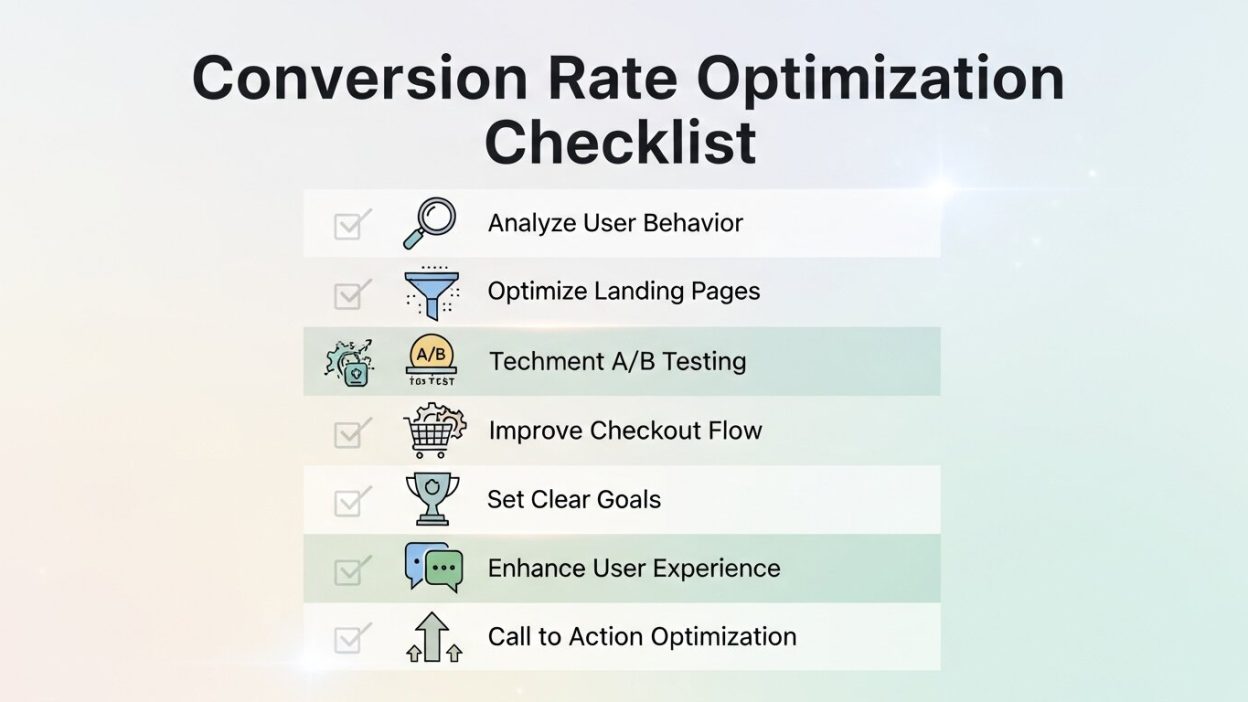
This conversion rate optimization checklist walks you through the most common pitfalls and shows you how to sidestep them. Whether you’re running your first conversion rate optimization audit or fine-tuning an existing strategy, these insights will help you turn more visitors into customers.
What Is Conversion Rate Optimization?
Conversion rate optimization is the process of improving your website so a higher percentage of visitors complete a desired action. That action might be making a purchase, signing up for a newsletter, downloading an ebook, or filling out a contact form.
The formula is simple. Divide your number of conversions by your total visitors, then multiply by 100. If 50 people buy from your store out of 2,000 visitors, your conversion rate is 2.5%.
CRO isn’t about guessing. It relies on data, testing, and a clear understanding of how people actually use your site. When done right, it lowers your cost per acquisition, boosts revenue, and helps you get more value from the traffic you already have.
Now let’s dig into the mistakes that stand between you and better results.
Mistake #1: Skipping the Research Phase
 The biggest CRO blunder? Diving into changes without understanding the problem first.
Too many teams redesign buttons, rewrite headlines, or overhaul entire pages based on gut feeling. They assume they know what’s wrong. But assumptions aren’t data, and they often lead you down the wrong path.
A proper conversion rate optimization audit starts with research. Before you change a single pixel, gather both quantitative and qualitative information:
- Analytics data: Use tools like Google Analytics to find where visitors drop off. Which pages have high bounce rates? Where do users abandon the checkout process?
- Heatmaps and session recordings: Tools like Hotjar or Microsoft Clarity show you exactly where people click, scroll, and hesitate.
- User surveys and feedback: Ask visitors directly what’s stopping them from converting. Sometimes the answer is shockingly simple.
When you base decisions on real evidence, your tests become far more likely to succeed. Skip this step, and you’re just throwing darts in the dark.
Mistake #2: Testing Too Many Things at Once
Eager to improve fast, some marketers change a dozen elements simultaneously. New headline, different colors, fresh images, reworded call-to-action—all at the same time.
The problem? When conversions go up (or down), you have no idea which change caused it. Your data becomes meaningless.
Effective CRO depends on controlled testing. With A/B testing, you compare two versions of a page that differ by one variable. That way, you can pinpoint exactly what moved the needle.
If you want to test multiple variables, use multivariate testing instead—but only if you have enough traffic to reach statistical significance. Low-traffic sites should stick to simple A/B tests and focus on high-impact elements first.
Patience pays off here. One well-structured test teaches you more than ten messy ones.
Mistake #3: Ending Tests Too Early
 You launch a test, see a 20% lift after two days, and declare victory. Tempting, right? But this is one of the most damaging mistakes in the book.
Early results can be misleading. A small sample size produces wild swings that don’t reflect long-term behavior. What looks like a clear winner on Tuesday might flip by the weekend.
To get reliable results, your test needs to reach statistical significance—usually a 95% confidence level. This means running the test long enough to collect adequate data, typically at least one to two full weeks. Factor in weekly patterns too, since weekday and weekend visitors often behave differently.
Most conversion rate optimization software, like Optimizely, VWO, or Google Optimize alternatives, will tell you when a test reaches significance. Trust the numbers, not your impatience.
Mistake #4: Ignoring Mobile Users
More than half of all web traffic now comes from mobile devices. Yet countless businesses still design and test exclusively for desktop.
If your mobile experience is clunky—tiny buttons, slow load times, forms that are painful to fill out—you’re hemorrhaging conversions. A page that converts beautifully on desktop might fall flat on a phone.
Make mobile optimization a core part of your checklist:
- Ensure buttons and links are large enough to tap easily.
- Simplify forms and reduce the number of required fields.
- Compress images and streamline code to speed up load times.
- Test your checkout or sign-up flow on actual devices, not just an emulator.
A fast, frictionless mobile experience can lift conversions across your entire audience.
Mistake #5: Overlooking Page Load Speed
 Speed matters more than most people realize. Research from Google shows that as page load time goes from one second to three seconds, the probability of a bounce increases by 32%. Push it to five seconds, and that probability jumps by 90%.
Every extra second of loading costs you customers. People expect instant access, and they won’t wait around.
To diagnose speed issues, run your site through Google PageSpeed Insights or GTmetrix. Common culprits include oversized images, bloated scripts, and slow server response times. Fixing these can deliver an immediate conversion boost without changing a single word of copy.
Mistake #6: Writing Weak Calls-to-Action
Your call-to-action (CTA) is where the magic happens—or doesn’t. A vague, buried, or boring CTA quietly kills conversions.
“Submit” and “Click here” tell visitors nothing about what they’ll get. Compare those to “Get my free trial” or “Send me the guide.” The second versions are specific, benefit-driven, and far more compelling.
Strengthen your CTAs with these principles:
- Use action-oriented language that focuses on the benefit, not the task.
- Create visual contrast so the button stands out from the rest of the page.
- Reduce risk with phrases like “No credit card required” or “Cancel anytime.”
- Place CTAs strategically, both above the fold and at natural decision points.
Test different versions to see what resonates with your audience. Sometimes a single word change produces a measurable lift.
Mistake #7: Forgetting About Trust Signals
People don’t convert if they don’t trust you. This is especially true for first-time visitors who’ve never heard of your brand.
Many sites bury or completely omit the elements that build credibility. That’s a costly oversight.
Add trust signals throughout your site to reassure hesitant visitors:
- Customer reviews and ratings show real people have had positive experiences.
- Testimonials and case studies provide social proof and concrete results. Strong conversion rate optimization case studies can be especially persuasive when they showcase measurable outcomes.
- Security badges and guarantees ease concerns around payments and data.
- Trust seals from recognized organizations lend instant authority.
When visitors feel safe and confident, they’re far more likely to take that final step.
Mistake #8: Neglecting the Value Proposition
Visitors decide within seconds whether your site is worth their time. If your value proposition isn’t crystal clear, they’ll bounce before they understand what you offer.
Your value proposition should answer one question instantly: why should I choose you over the competition? Yet many homepages lead with clever taglines or vague slogans that explain nothing.
Make your value proposition prominent, specific, and easy to grasp. Lead with the concrete benefit you deliver. Support it with details that back up the claim. And place it front and center, where it’s the first thing visitors see.
Mistake #9: Treating CRO as a One-Time Project
 Perhaps the most fundamental mistake of all is viewing conversion rate optimization as something you do once and forget.
CRO is an ongoing process. Customer expectations shift. Competitors evolve. New devices and technologies emerge. What works today may underperform six months from now.
The best-performing companies treat optimization as a continuous cycle: research, hypothesize, test, analyze, and repeat. They build a culture of experimentation, always looking for the next improvement.
Set up a regular cadence for reviewing your metrics and running new tests. Even small, incremental gains compound over time into significant growth.
Frequently Asked Questions
1. What is a conversion rate optimization checklist?
A conversion rate optimization checklist is a structured guide that helps businesses identify and improve factors affecting website conversions. It covers areas such as user experience, page speed, calls-to-action, mobile responsiveness, trust signals, and testing strategies to increase the percentage of visitors who complete desired actions.
2. Why is conversion rate optimization important?
Conversion rate optimization helps businesses get more value from existing website traffic. Instead of spending more money on attracting visitors, CRO focuses on improving the user experience and increasing the likelihood that visitors become customers, subscribers, or leads, ultimately boosting revenue and marketing efficiency.
3. How often should I perform a CRO audit?
A CRO audit should be conducted regularly, ideally every quarter. Frequent audits help identify new issues, track changing user behavior, evaluate test results, and uncover fresh opportunities to improve conversions. Businesses with high traffic or frequent website updates may benefit from more frequent reviews.
4. What is considered a good conversion rate?
A good conversion rate varies by industry, audience, and business model. While many websites convert between 2% and 4%, some high-performing sites achieve significantly higher rates. The goal should be continuous improvement rather than comparing your results directly to industry averages.
5. How does page speed affect conversions?
Page speed directly impacts user experience and visitor retention. Slow-loading pages increase bounce rates and frustrate users, making them less likely to complete desired actions. Improving load times often leads to better engagement, longer sessions, and higher conversion rates across both desktop and mobile devices.
6. What are trust signals in CRO?
Trust signals are elements that help visitors feel confident about your business. These include customer reviews, testimonials, security badges, money-back guarantees, industry certifications, and case studies. Strong trust signals reduce hesitation and encourage users to take action, especially when making purchases online.
7. Why is mobile optimization essential for conversion rate optimization?
A large percentage of website traffic comes from mobile devices. If your website is difficult to navigate, slow to load, or hard to use on smartphones, visitors may leave before converting. Mobile optimization ensures a smooth experience and helps maximize conversions across all devices.
8. What should I test first when improving conversions?
Start by testing high-impact elements such as headlines, calls-to-action, forms, landing pages, value propositions, and checkout processes. These components often have the greatest influence on user decisions and can produce measurable improvements when optimized through structured A/B testing.
9. Which tools are commonly used for conversion rate optimization?
Popular CRO tools include analytics platforms, heatmap software, session recording tools, A/B testing platforms, and user feedback solutions. These tools help businesses understand visitor behavior, identify friction points, and make data-driven decisions that improve website performance and conversions.
10. Is conversion rate optimization a one-time process?
No. Conversion rate optimization is an ongoing process of research, testing, analysis, and refinement. Customer expectations, market trends, and user behaviors change over time, so continuous optimization is necessary to maintain and improve conversion performance in the long term.
Your Path to Higher Conversions
Conversion rate optimization isn’t about chasing quick wins or copying what worked for someone else. It’s about understanding your visitors, testing thoughtfully, and refining your site based on what the data tells you.
By avoiding these common mistakes—skipping research, testing too much at once, ending tests prematurely, and the rest—you set yourself up for sustainable, meaningful results. Use this checklist as a starting point for your next conversion rate optimization audit, and revisit it regularly as your strategy matures.