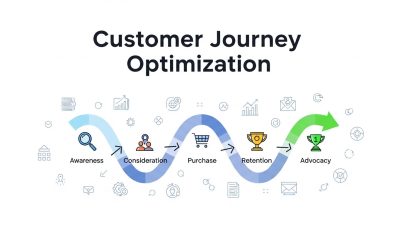


Search rankings and customer loyalty might seem like separate goals—one belongs to the marketing team, the other to product or customer success. But they’re more connected than most businesses realize. User experience optimization sits at the intersection of both, quietly driving results that neither SEO tactics nor retention strategies can achieve alone.
If your website ranks well but visitors leave without converting, something’s broken. If your customers love your product but your site is difficult to navigate, you’re leaving growth on the table. User experience optimization fixes both problems at once—and understanding how it works can fundamentally change how you approach digital strategy.
This post breaks down what user experience optimization actually involves, how it influences search engine rankings, and why it’s one of the most powerful levers for improving customer retention. You’ll also find practical guidance on what to prioritize, including a conversion rate optimization checklist to help you get started.
What Is User Experience Optimization?
User experience optimization (UXO) is the ongoing process of improving how people interact with your website or digital product. The goal is to make every touchpoint—from landing pages to checkout flows—faster, clearer, and more satisfying for the user.
Unlike a one-time redesign, UXO is iterative. It draws on behavioral data, usability testing, heatmaps, session recordings, and analytics to identify friction points and test solutions. The result is a site that gets progressively better at serving its users’ needs.
It’s closely related to conversion rate optimization (CRO), but broader in scope. CRO focuses specifically on increasing the percentage of visitors who take a desired action. UXO encompasses everything that shapes the experience leading up to—and after—that action.
How Does User Experience Optimization Affect SEO?
 Google’s ranking systems have evolved significantly over the past decade. Early algorithms rewarded keyword density and backlink volume. Today, they prioritize signals that reflect genuine user satisfaction. That shift makes user experience optimization directly relevant to search performance.
Core Web Vitals: Google’s UX Report Card
In 2021, Google officially incorporated Core Web Vitals into its ranking algorithm. These metrics measure three aspects of page experience:
- Largest Contentful Paint (LCP): How quickly the main content of a page loads. Google recommends under 2.5 seconds.
- Interaction to Next Paint (INP): How responsive a page is to user interactions like clicks and taps.
- Cumulative Layout Shift (CLS): How visually stable a page is as it loads—elements shifting around frustrate users and signal poor experience.
Failing these benchmarks doesn’t just hurt usability. It directly impacts your ability to rank competitively, especially in markets where multiple sites target the same keywords.
Bounce Rate, Dwell Time, and Behavioral Signals
When a user clicks your result in search and immediately returns to the results page, that’s a signal. When they stay, scroll, and explore multiple pages, that’s a different signal entirely. Google uses behavioral data to refine rankings over time, which means a poor user experience compounds—driving rankings down, reducing traffic, and creating a cycle that’s hard to reverse.
Dwell time (how long a visitor stays on your page before returning to search) and bounce rate both reflect whether your content and experience are meeting expectations. User experience optimization targets these metrics directly by improving page clarity, reducing load times, strengthening internal linking, and ensuring content matches search intent.
Mobile Experience as a Ranking Factor
Google has used mobile-first indexing since 2019, meaning it primarily uses the mobile version of your site for ranking and indexing purposes. A site that looks great on desktop but is clunky on mobile is penalized in search—and increasingly likely to frustrate the majority of your visitors. Mobile optimization is no longer optional; it’s foundational to both UXO and SEO.
The Link Between User Experience and Customer Retention
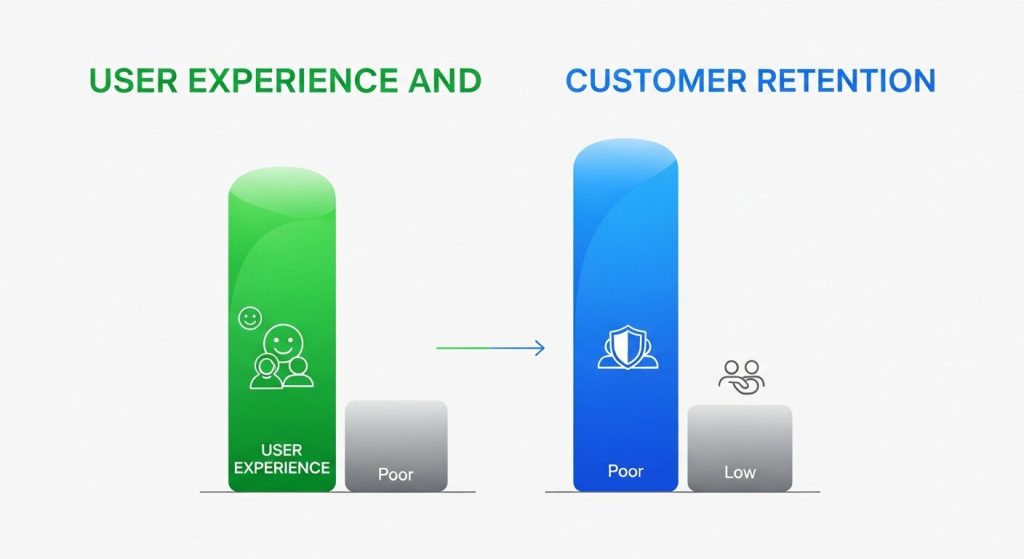 Retention is where the real value of user experience optimization becomes clear. Acquiring a new customer costs five to seven times more than retaining an existing one, according to research from Bain & Company. Yet many businesses invest heavily in acquisition while under-investing in the experience that determines whether customers come back.
First Impressions Set the Baseline
Research from Google found that users form an opinion about a webpage in as little as 50 milliseconds. That snap judgment—based on visual design, layout, and loading speed—sets the tone for everything that follows. A slow, cluttered, or confusing experience creates a negative bias that’s hard to overcome, even with excellent content or a strong offer.
User experience optimization ensures that first impression is a strong one. Clear navigation, fast load times, intuitive layouts, and consistent branding all contribute to the kind of first visit that earns a second.
Reducing Friction in the Customer Journey
Every unnecessary step, confusing label, or broken flow between a user and their goal creates friction. Friction increases cognitive load. Increased cognitive load leads to abandonment. For e-commerce businesses, this dynamic is especially costly—the average cart abandonment rate sits at 70.19%, according to data from the Baymard Institute.
A conversion rate optimization checklist for e-commerce typically addresses friction points like:
- Requiring account creation before checkout
- Insufficient payment options
- Unclear shipping costs revealed late in the process
- Slow-loading product pages
- Poor mobile checkout flows
Platforms like Shopify have built conversion rate optimization tools directly into their ecosystem, recognizing how critical these touchpoints are. Conversion rate optimization on Shopify often focuses on checkout optimization, product page clarity, and personalization—all of which are extensions of user experience optimization.
Trust Signals and Perceived Quality
Users equate design quality with brand quality. A polished, well-organized site communicates competence and reliability. Security badges, clear return policies, real customer reviews, and transparent pricing all reduce perceived risk and increase the likelihood of both conversion and repeat purchase.
Trust, once established through a great experience, becomes the foundation of retention. Customers who trust your brand are more likely to return, more likely to recommend you to others, and more resistant to switching to a competitor.
What to Prioritize in Your User Experience Optimization Strategy
 With so many potential improvements to make, it helps to work through a clear framework. A practical conversion rate optimization checklist provides a starting point, but your priorities should be shaped by your own data.
Start with Analytics and User Research
Before changing anything, understand what’s actually happening on your site. Use tools like Google Analytics 4, Hotjar, or Microsoft Clarity to identify:
- Which pages have the highest exit rates
- Where users are dropping off in conversion funnels
- Which devices and browsers are generating the most friction
- What users are searching for using your on-site search
Pairing quantitative data with qualitative research—user interviews, usability tests, survey responses—gives you a fuller picture of why problems exist, not just where they occur.
Optimize for Speed First
Page speed is the highest-leverage improvement for most sites. Faster pages rank better, reduce bounce rates, and improve conversion rates. According to Google, a one-second delay in mobile page load time can reduce conversions by up to 20%.
Priority actions include:
- Compressing and properly formatting images (WebP is preferred)
- Enabling lazy loading for below-the-fold content
- Minimizing JavaScript and CSS files
- Using a content delivery network (CDN)
- Upgrading your hosting if server response time is slow
Clarify Navigation and Page Hierarchy
Users should never have to think hard about where to go next. Navigation should be intuitive, labels should match how your audience describes your products or services, and the most important actions should be visually prominent.
Test your navigation with real users. Ask them to complete common tasks—finding a product, locating your returns policy, getting in touch—and observe where they hesitate or get lost. Those friction points are your highest-priority fixes.
Use Conversion Rate Optimization Software to Test and Iterate
Tools like VWO, Optimizely, and AB Tasty are purpose-built conversion rate optimization software platforms that let you run A/B tests on page elements, layouts, and copy. Rather than guessing what will improve performance, you can test hypotheses systematically and let data guide decisions.
This iterative approach is what separates user experience optimization from a one-time design refresh. The most effective UXO programs are continuous—always testing, always learning, always improving.
Personalization as a Retention Tool
Personalization is one of the most powerful levers for customer retention, and it’s increasingly accessible for businesses of all sizes. Showing returning customers relevant product recommendations, remembering their preferences, or tailoring email content to their behavior creates an experience that feels designed for them.
According to McKinsey, companies that excel at personalization generate 40% more revenue from those activities than average players. Personalization doesn’t require a massive technology investment to get started—even basic segmentation in your email platform can meaningfully improve retention.
FAQ: User Experience Optimization (UXO)
1. What is user experience optimization (UXO)?
UXO is the ongoing process of improving how users interact with a website or app. It focuses on making navigation easier, faster, more intuitive, and overall more satisfying to increase engagement and usability.
2. How is UXO different from CRO?
UXO improves the overall user journey and experience, while CRO focuses specifically on increasing conversions like sign-ups or sales. CRO is a subset of UXO, targeting measurable actions rather than the full experience.
3. Why does UXO matter for SEO?
UXO improves SEO by enhancing Core Web Vitals, reducing bounce rates, and increasing engagement signals. Search engines prioritize sites that load fast, respond smoothly, and keep users satisfied with relevant content.
4. What are Core Web Vitals?
Core Web Vitals are Google performance metrics measuring loading speed (LCP), interactivity (INP), and visual stability (CLS). They help determine user experience quality and directly influence search rankings and overall site performance.
5. How does UXO improve customer retention?
UXO improves retention by creating smooth, frustration-free experiences. When users can easily find what they need, trust the brand, and enjoy the journey, they are more likely to return and stay loyal.
6. What tools are used for UXO?
Common UXO tools include Google Analytics, Hotjar, Microsoft Clarity, VWO, and Optimizely. These tools help track user behavior, identify friction points, analyze performance, and test improvements through experiments and data insights.
7. What is the most important UXO factor?
Page speed is often the most important UXO factor because slow loading increases bounce rates and reduces conversions. Faster websites improve user satisfaction, engagement, search rankings, and overall business performance significantly.
8. How does UX affect bounce rate?
Poor UX increases bounce rate because users leave quickly when pages are slow, confusing, or unhelpful. Good UX keeps users engaged with clear design, relevant content, and smooth navigation throughout the site.
9. What is personalization in UXO?
Personalization in UXO means tailoring content, recommendations, and experiences based on user behavior, preferences, or history. It increases relevance, engagement, satisfaction, and often leads to higher conversions and customer loyalty.
10. Where should I start with UXO?
Start UXO by analyzing user data, identifying drop-off points, and fixing high-impact issues like page speed and navigation. Then test improvements on key pages to gradually enhance overall user experience effectively.
Turning UXO into a Competitive Advantage
User experience optimization rewards patience and consistency. The businesses that treat it as a core discipline—rather than a periodic project—build compounding advantages over time. Better experiences earn higher rankings, which bring more traffic. More traffic provides more data for optimization. Better optimization improves retention, which increases lifetime value and reduces dependence on paid acquisition.
The starting point doesn’t need to be complicated. Run a Core Web Vitals audit. Work through a conversion rate optimization checklist for your most important pages. Identify one friction point in your checkout or onboarding flow and test a fix. The organizations that win long-term aren’t those with the biggest budgets—they’re the ones most committed to understanding and serving their users better than anyone else.