
This blog explores Conversion Rate Optimization (CRO), offering actionable strategies, advanced AI tools, and automation techniques to boost conversions. It emphasizes data-driven methods, user experience improvements, and continuous testing for sustainable business growth.
In the vast and competitive digital landscape, attracting visitors to your website is only half the battle. You might have the most beautiful website design or the most compelling social media campaign, but if those visitors leave without taking action, your efforts are wasted. This is where Conversion Rate Optimization (CRO) becomes the most critical tool in your marketing arsenal.
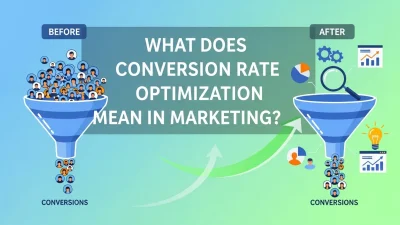
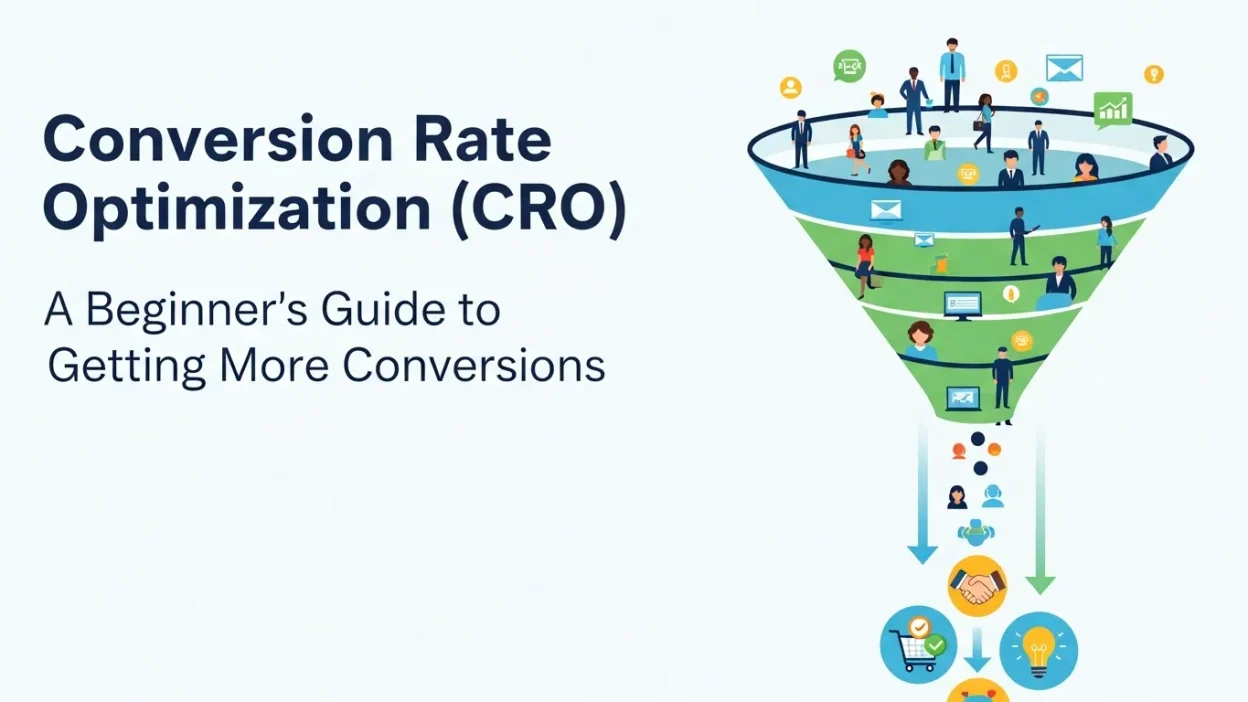
Conversion Rate Optimization is a systematic process of increasing the percentage of website visitors who take a desired action—be it making a purchase, signing up for a newsletter, filling out a form, or any other goal that aligns with your business objectives. Unlike traffic generation, which focuses on bringing people in the door, CRO focuses on what happens once they are inside. It is about understanding user behavior, improving user experience (UX), and optimizing website elements to encourage conversions.
In this comprehensive guide, we will explore the depths of CRO, from its fundamental principles to advanced strategies involving AI and automation. By the end, you will have a clear roadmap to transforming your website into a high-performance conversion engine.
What is Conversion Rate Optimization?
At its core, Conversion Rate Optimization (CRO) focuses on methods of improving your website or landing page so you can motivate more visitors to undertake specific actions. These actions, or “conversions,” are the lifeblood of your online business. They might include:
- Placing an order: The ultimate goal for e-commerce sites.
- Adding your name to a newsletter list: Building a long-term audience.
- Filling out a contact form: Generating leads for service-based businesses.
- Downloading a resource: establishing authority through whitepapers or ebooks.
- Clicking on a call-to-action button: Moving users deeper into the sales funnel.
CRO involves observing user behavior, identifying points of pain, and improving the user experience to attract more customers or subscribers. It is not about guessing; it is about using data to make informed decisions that drive growth.
Why CRO Matters More Than Traffic
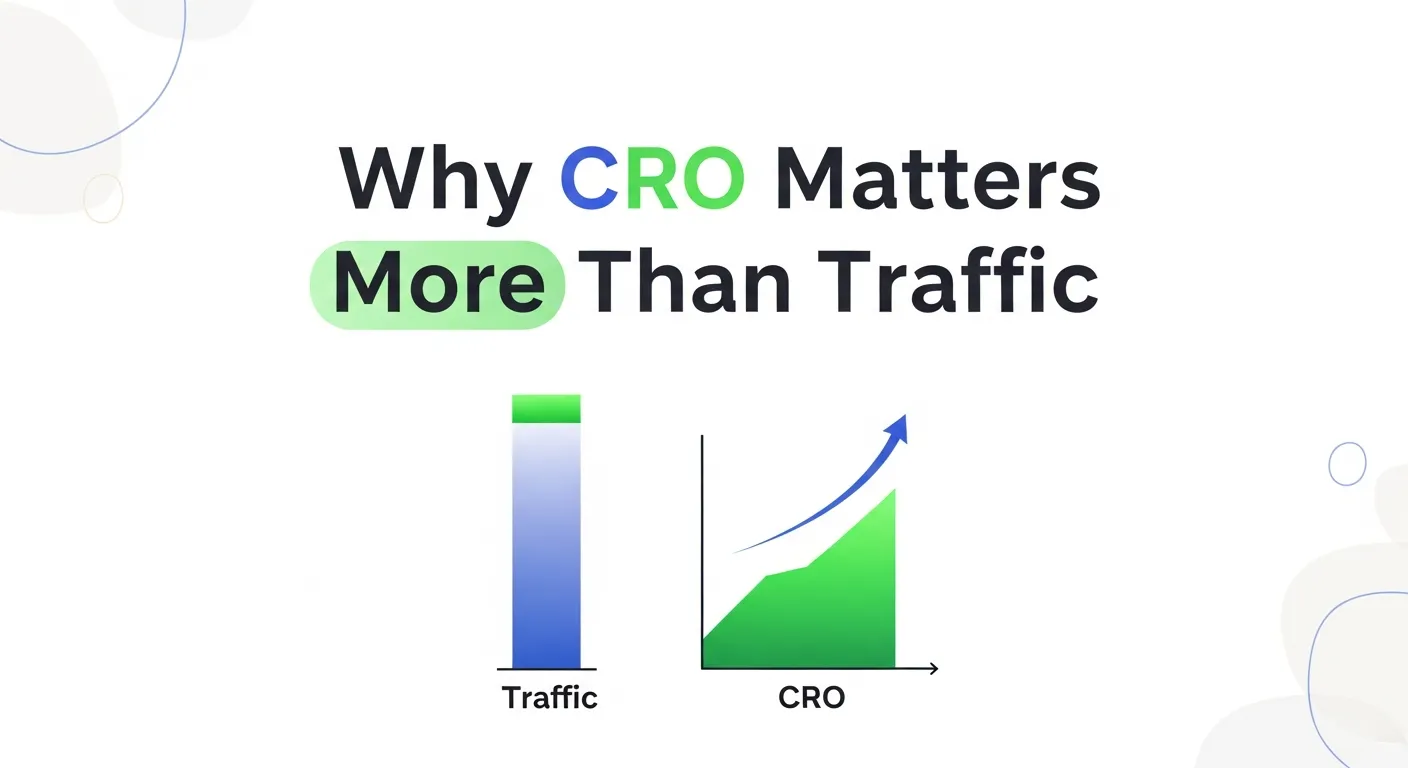
Imagine your website is a leaky bucket. You are pouring water (traffic) into it, hoping to fill it up. If the bucket has holes (usability issues, poor design, unclear messaging), the water leaks out faster than you can pour it in. Spending money on more water won’t fix the problem; you need to patch the holes.
For example, if your website gets 1,000 visitors and 30 of them take a certain action you want, then your conversion rate is 3% (30 divided by 1,000). Conversion Rate Optimization is about identifying strategies to raise that 3% figure to 4%, 5%, or even higher, without having to drive a single extra visitor to your site.
Unique Advantages of CRO
Investing in Conversion Rate Optimization offers distinct benefits that other marketing strategies cannot match:
- Better ROI: Increases in profits that are not called for by increased spending in advertising. You are getting more value from the traffic you already have.
- Enhanced User Experience: An optimized website is clearer, faster, and easier to use. This isn’t just good for sales; it builds brand loyalty and trust.
- Competitive Edge: A higher conversion rate means you can afford to pay more for traffic than your competitors. If you convert twice as many visitors, your cost-per-acquisition is halved, allowing you to bid more aggressively.
- Over Time Benefits: Even small improvements in your website will compound into large gains years down the line. A 1% increase today could mean thousands of dollars in extra revenue by next year.
How Does CRO Work? The Core Process
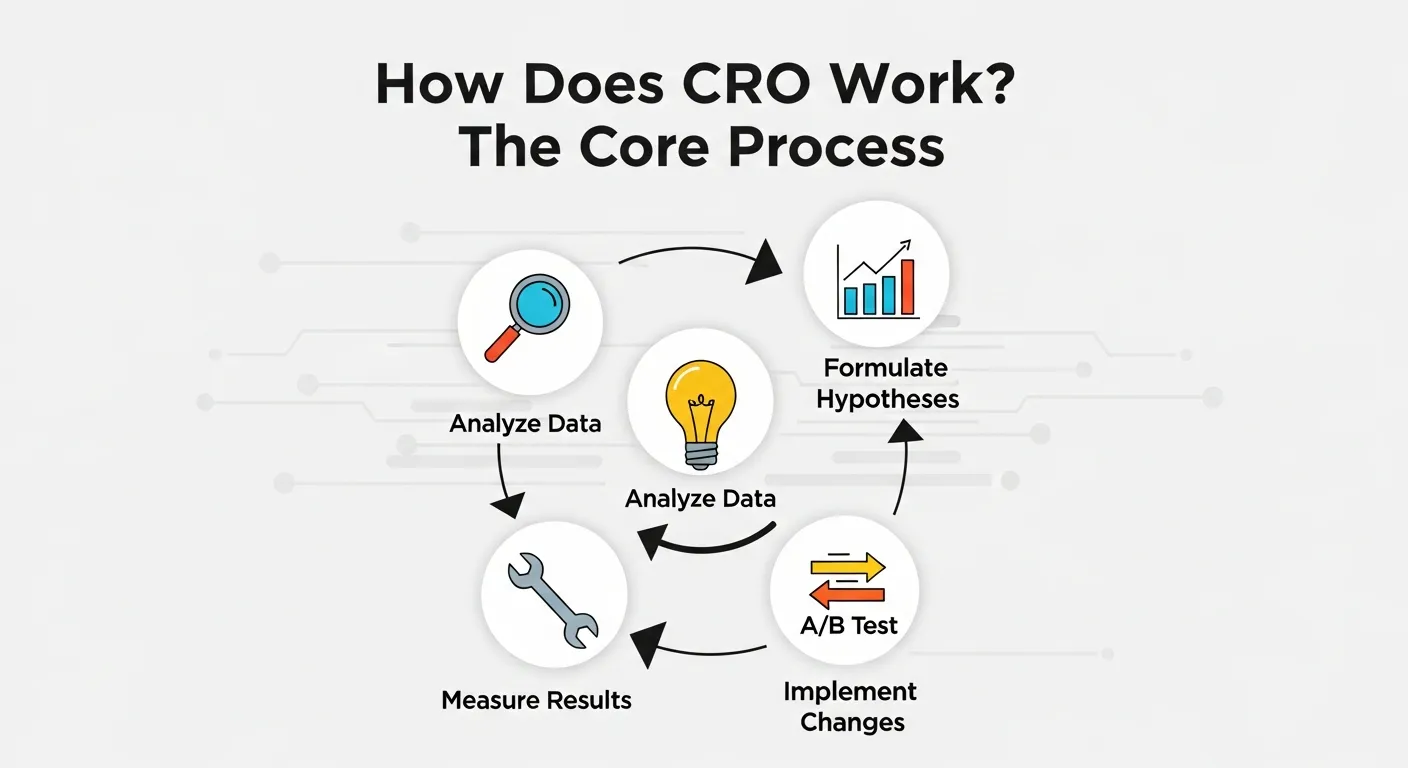
Conversion Rate Optimization uses data-driven methods to better understand how users behave and to make changes that would increase conversions. It removes the guesswork and relies on scientific testing. The general process follows a cyclical path:
1. Research and Analysis
Understanding why visitors are not converting is the backbone of Conversion Rate Optimization. You cannot fix what you do not understand. Start by analyzing your website’s performance with quantitative tools like Google Analytics, Adobe Analytics, or specialized CRO platforms.
Key Metrics to Analyze:
- Bounce rates: Are people leaving immediately? This suggests your landing page doesn’t match their expectations.
- Time on site: Are they engaging with your content?
- Exit pages: Where are they dropping off? Is it the pricing page? The checkout?
- Heatmaps: Tools like Hotjar or Crazy Egg show you exactly where users click, scroll, and move their mouse.
- Session recordings: Watch real users navigate your site to spot confusion or bugs.
Don’t ignore qualitative data. Collect feedback through surveys, interviews, or on-site feedback widgets. This will tell you why real users feel frustrated or bewildered, adding context to what is provided by analytics.
2. Identify Conversion Barriers
Now that you have the necessary data, you need to synthesize it to identify the stumbling blocks on your site. These are the “holes in the bucket.” Common barriers include:
- A confusing checkout process: Asking for too much information or having too many steps.
- Pages that load too slowly: In the age of mobile, speed is a feature.
- Lack of trust signals: If users don’t see reviews, testimonials, or security badges, they won’t buy.
- Clunky mobile user experience: If your site is hard to use on a phone, you are losing half your audience.
For example, if your data shows that users drop off during the payment process, this could indicate that your checkout form is too complex, has technical bugs, or lacks preferred payment options.
3. Experiment and Hypothesize
With hypotheses in hand, use A/B testing or multivariate testing to experiment. This involves creating different versions of a page and testing them against each other to see which one performs better. A hypothesis might look like this: “By changing the ‘Buy Now’ button from green to red, we will increase click-through rates because red creates a sense of urgency.”
Testing Examples:
- Headlines: Does a question work better than a statement?
- Images: Do photos of people convert better than product shots?
- Layout: Does a single-column layout work better than a multi-column one?
- Social Proof: Does putting a testimonial on the landing page increase user trust?
Tools such as Optimizely, VWO, or Google Optimize let you carry out these experiments with ease, ensuring your results are statistically significant.
4. Measure and Iterate
After experiments run their course, measure the impact of your changes against key metrics like:
- Conversion rates
- Average order value (AOV)
- Click-through rates (CTR)
- Revenue per visitor
Retain what works, adjust what doesn’t, and continually iterate as you collect more data. Conversion Rate Optimization is never “finished.” Consumer behaviors change, technology evolves, and there is always room for improvement.
Advanced Strategies: Leveraging Technology in CRO
As the digital world evolves, so do the tools we use for Conversion Rate Optimization. While basic A/B testing remains fundamental, integrating AI and automation can take your results to the next level.
Leveraging AI for CRO Success
In the rapidly evolving landscape of digital marketing, Artificial Intelligence (AI) has emerged as a game-changer for Conversion Rate Optimization. While traditional methods rely heavily on manual analysis and A/B testing cycles, AI accelerates this process by processing vast amounts of data in real-time to predict user behavior. Tools like intelligent chatbots and automated personalization engines can engage visitors at the exact moment they show intent or hesitation. By leveraging machine learning algorithms, businesses can now deliver hyper-personalized experiences that not only retain attention but also significantly smooth the path to purchase. For a deeper dive into how these tools work, you can read more about AI chatbots for customer engagement and conversions.
The integration of AI into your CRO strategy offers several distinct advantages that go beyond basic analytical capabilities:
- Real-Time Personalization: AI adjusts content, product recommendations, and offers dynamically based on individual user behavior during their current session.
- 24/7 Customer Engagement: AI-powered chatbots provide instant support and answers to pre-sales questions, preventing potential customers from bouncing due to a lack of information.
- Predictive Analytics: Instead of just analyzing past data, AI predicts future actions, identifying which visitors are most likely to convert and focusing resources on them.
- Automated Testing: AI can run complex multivariate tests continuously, automatically routing traffic to the best-performing variations without human intervention.
- Churn Reduction: By identifying behavioral patterns associated with exit intent, AI can trigger timely interventions to keep users on the site.
To understand the shift in methodology, it is helpful to look at how AI-driven approaches compare to standard practices.
|
Feature |
Traditional CRO |
AI-Driven CRO |
|---|---|---|
|
Data Analysis |
Manual review of historical data |
Real-time processing and predictive modeling |
|
Personalization |
Segment-based (broad groups) |
Individual-based (hyper-specific) |
|
Testing Speed |
Slow, sequential A/B testing |
Rapid, simultaneous multivariate testing |
|
User Engagement |
Static forms and passive content |
Interactive chatbots and dynamic content |
|
Scalability |
Limited by human resource capacity |
Infinite scalability with automated tools |
Cross-Platform Automation in CRO
Effective Conversion Rate Optimization often requires data from multiple sources—your CRM, email marketing platforms, analytics tools, and sales software. Manually transferring this data isn’t just tedious; it’s a breeding ground for human error that can skew your conversion insights. Cross-platform automation solves this by creating seamless bridges between your disparate software ecosystems. Instead of wasting hours on copy-pasting customer details or manually updating lead scores, automation ensures that data flows instantly and accurately across all your systems. This allows your team to focus on strategy rather than administration. By implementing robust cross-platform data entry automation, you ensure your CRO decisions are based on the most up-to-date and accurate information available.
Integrating automation into your CRO workflow brings several transformative benefits:
- Elimination of Data Silos: Ensure that your sales team sees the same customer data as your marketing team, creating a unified view of the customer journey.
- Reduced Human Error: automated data transfer removes the risk of typos, duplicate entries, or lost leads that frequently occur with manual input.
- Faster Response Times: triggers can instantly notify sales teams or send welcome emails the moment a conversion happens, striking while the iron is hot.
- Enhanced Lead Scoring: automatically update lead scores in your CRM based on user behavior tracked in your analytics tools, prioritizing high-value prospects.
- Resource Optimization: free up valuable employee time to focus on creative testing and strategy rather than repetitive data entry tasks.
To visualize the impact, here are common CRO tasks that can be shifted from manual effort to automated workflows:
|
Task Category |
Manual Process |
Automated Workflow |
|---|---|---|
|
Lead Capture |
Copying form submissions from the website to the CRM |
Instant sync of form data to CRM and email lists |
|
User Segmentation |
Manually tagging users based on purchase history |
Auto-tagging based on behavior and transaction data |
|
Follow-up |
Sales reps manually check for new leads daily |
Instant Slack/Email notification to sales upon signup |
|
Reporting |
Compiling data from 3 tools into a spreadsheet |
Real-time dashboards pulling data via API connectors |
|
Personalization |
Updating email templates manually for segments |
Dynamic content insertion based on live user attributes |
Conversational Marketing and CRO
In the world of high-speed digital interactions, waiting for an email response is often a deal-breaker for potential customers. Conversational marketing bridges this gap by using AI-driven chatbots and targeted messaging to engage visitors the moment they land on your site. Instead of forcing users to navigate complex menus or wait for business hours, this approach starts a dialogue immediately, guiding them toward the products or solutions they need. By implementing conversational marketing AI chatbots for engagement, businesses can transform passive browsing into active buying conversations, significantly reducing friction in the buyer’s journey.
Adopting a conversational approach within your CRO strategy unlocks several powerful benefits:
- Instant Qualification: Bots can ask pre-set qualifying questions to determine if a lead is ready to buy or needs more nurturing, saving your sales team valuable time.
- 24/7 Availability: Unlike human staff, conversational tools are always awake, capturing leads and answering queries at 2 AM just as effectively as at 2 PM.
- Shortened Sales Cycles: By answering questions instantly and recommending products in real-time, you remove the waiting periods that often cause buyers to lose interest.
- Personalized Experience: Modern tools can recognize returning visitors and tailor the conversation based on their past behavior or location.
- Human Handoff: When a query becomes too complex, the system seamlessly transfers the chat to a live agent, ensuring the customer never feels stuck.
To see why this shift is essential for modern optimization, consider the differences between traditional support methods and conversational marketing.
|
Feature |
Traditional Customer Support |
Conversational Marketing |
|---|---|---|
|
Response Time |
Hours or days (Email/Ticket) |
Instant (Real-time chat) |
|
Availability |
Limited to business hours |
24/7/365 availability |
|
Interaction Style |
Reactive (Waiting for customer to ask) |
Proactive (Initiating chat upon arrival) |
|
Scalability |
Limited by staff size |
Infinite (Handles thousands of chats at once) |
|
Context |
Often starts from scratch |
Uses data to provide context-aware answers |
Top Tips to Boost Your Conversion Rates
While high-tech tools are incredibly powerful, foundational Conversion Rate Optimization tactics remain effective. Here are actionable tips you can implement immediately.
1. Simplify Your Call-to-Actions (CTAs)
A clear call to action is the signpost that tells users where to go. If your signpost is blurry, hidden, or confusing, no one will follow it.
- Be Specific: Instead of saying “Submit,” write “Get Your Free Guide!” or “Send Me the Report.”
- Use Action Verbs: Start with strong verbs like “Start,” “Join,” “Discover,” or “Claim.”
- Color Contrast: Ensure your button color stands out from the rest of the page. If your site is blue, an orange button will pop.
- Placement: Keep your primary CTA above the fold (visible without scrolling) but also repeat it at the bottom of the page.
2. Optimize Page Loading Time
Speed kills—or rather, the lack of it does. Research has shown that pages taking 3 seconds or more to load lose 40% of their visitors. In the world of Conversion Rate Optimization, every millisecond counts.
- Compress Images: Large images are the #1 culprit for slow sites. Use tools like TinyPNG or WebP formats.
- Minimize Code: Remove unnecessary characters, spaces, and comments from your CSS and JavaScript files.
- Enable Caching: This allows returning visitors to load your site instantly by storing elements in their browser.
- Use a CDN: Content Delivery Networks serve your site from servers closest to the user’s physical location.
3. Use Social Proof
Humans are social creatures. We look to others to determine correct behavior, especially in uncertain situations (like buying from a new website). This psychological phenomenon is crucial for Conversion Rate Optimization.
- Testimonials: Feature quotes from happy customers, ideally with photos and full names to add authenticity.
- Case Studies: Show detailed stories of how your product solved a specific problem.
- Trust Badges: Display security seals (like Norton or McAfee) and payment icons (Visa, PayPal) to reassure users their data is safe.
- User Reviews: Allow customers to review products directly on the page. Even a few negative reviews can actually increase trust by showing transparency.
4. Create Mobile-First Sites
With mobile traffic consistently surpassing desktop traffic, designing for desktop first is a relic of the past. Conversion Rate Optimization must prioritize the small screen.
- Thumb-Friendly Design: Place buttons and links where they are easy to tap with a thumb.
- Readable Fonts: Ensure text is large enough to read without zooming.
- Simplified Forms: Typing on a phone is annoying. Minimize the number of fields and use auto-fill features where possible.
- Hamburger Menus: Use collapsible menus to save screen real estate.
5. Add Live Chat Support
We discussed conversational marketing earlier, but even a simple live chat widget can work wonders. Instant support helps to build trust and can overcome any buying hesitation a customer may be having in real-time. Features like Intercom or Zendesk Chat come with live chat integration facilities, which means you’ll be up and running quickly.
6. Test Everything
A/B testing is the golden rule of Conversion Rate Optimization. Never assume you know what your audience wants.
- Headlines: Test emotional vs. logical appeals.
- Forms: Test long forms (for higher quality leads) vs. short forms (for higher quantity).
- Colors: Test button colors, background colors, and font colors.
- Offers: Test “Free Shipping” vs. “10% Off.”
Common CRO Myths Debunked
There are many misconceptions about Conversion Rate Optimization that can lead businesses astray. Let’s clear them up.
Myth 1: CRO is used to increase traffic
Truth: That’s a misunderstanding. CRO revolves around improving the efficiency of current traffic. It creates a better container for the traffic you already have. While better UX might improve SEO and indirectly boost traffic, the primary goal is conversion, not acquisition.
Myth 2: Conversion problems are all technical
Truth: Though technical speed and bugs influence rates, they are rarely the whole story. Problems with messaging, weak value propositions, poor product-market fit, and lack of trust play an equally significant role. Conversion Rate Optimization is as much about psychology and marketing as it is about code.
Myth 3: CRO delivers immediate results
Truth: CRO is essentially a long-term plan—continuous improvement. Think marathon, not sprint. While you might get a quick win from fixing a broken button, true optimization comes from months of testing, learning, and iterating.
Myth 4: You should just copy Amazon
Truth: Best practices are a good starting point, but blindly copying giants like Amazon is dangerous. They have different audiences, different goals, and different brand authority. What works for them might tank your conversion rate. You must test what works for your specific users.
Use Case Example: The E-Commerce Turnaround
Let’s look at a practical example of Conversion Rate Optimization in action.
An e-commerce store selling artisanal coffee has a decent amount of traffic but a low 2% conversion rate. The owner is frustrated because ad spend is high, but sales are stagnant.
Step 1: Analysis.
Using Google Analytics, they see a high drop-off rate on the “Cart” page. Heatmaps show users clicking on the “Shipping Costs” link repeatedly, then leaving.
Step 2: Hypothesis.
The owner hypothesizes that users are surprised by high shipping costs at the very end of the process.
Step 3: Experiment.
They run an A/B test.
- Control: Standard checkout process where shipping is calculated at the end.
- Variation: A banner is added to the top of the site saying “Free Shipping on Orders Over $50.” They also simplify the checkout form, removing the “Company Name” field.
Step 4: Results.
The variation shows a significant improvement. Users are incentivized to add more to their cart to get free shipping, raising the Average Order Value (AOV). The simplified form reduces friction.
Outcome:
The store’s conversion rate rises to 3%. That 1% increase means a 50% increase in income without spending a penny more on ads. This is the power of Conversion Rate Optimization.
Why Choose CRO?
You should choose Conversion Rate Optimization if you’re serious about seeing every penny in your budget work as hard as possible. It informs every single decision, moving you away from “gut feelings” and toward data-backed certainty. By zeroing in on the barriers that hinder user experiences, you turn casual browsers into loyal customers. This ensures sustainable, long-term growth for your business that isn’t dependent on the whims of algorithm changes or ad price spikes.
Frequently Asked Questions (FAQ) about Conversion Rate Optimization
1. What exactly is Conversion Rate Optimization (CRO), and why do I need it?
CRO is the systematic process of increasing the percentage of website visitors who take a desired action, like filling out a form or making a purchase. It focuses on understanding user behavior to remove barriers and improve the overall user experience. To get a comprehensive breakdown of the basics, you can read more about website conversion rate optimization to see how it fits into your digital strategy.
2. How is CRO different from SEO, or are they related?
While SEO focuses on driving traffic to your site, CRO focuses on converting that traffic into customers once they arrive. They are complementary strategies; SEO gets users to the door, and CRO invites them in to stay. Many marketers wonder if CRO is CRO part of SEO, and the answer lies in how they work together to maximize the value of every visitor.
3. What is a “good” conversion rate for my industry?
Conversion rates vary wildly by industry, but a general benchmark is often cited between 2% and 5% for e-commerce. However, comparing yourself to averages can be misleading; it is better to benchmark against your own past performance. The goal should always be continuous improvement rather than hitting an arbitrary industry standard number.
4. How long does it typically take to see results from CRO?
CRO is a long-term strategy, not a quick fix, so you shouldn’t expect overnight miracles. Depending on your traffic volume, running a statistically significant test might take anywhere from two weeks to a month. Sustainable growth comes from iterative testing and learning over several months or even years.
5. Do I need a lot of website traffic to start doing CRO?
While high traffic helps you reach statistical significance faster, you can still perform CRO with lower traffic volumes. You may need to focus more on qualitative data like user feedback, surveys, and heatmaps rather than just A/B testing. Optimizing for micro-conversions, like newsletter signups, can also help you gather data with fewer visitors.
6. Why is CRO considered essential for business growth?
Investing in CRO lowers your customer acquisition costs by getting more value out of the visitors you already have. It allows you to grow your revenue without necessarily spending more on advertising or traffic generation. Understanding why conversion rate optimization is needed for growth is key to building a sustainable and profitable online business model.
7. What tools do I need to get started with CRO?
You don’t need an expensive suite of tools to begin; free tools like Google Analytics are perfect for identifying problem areas. For qualitative data, tools like Hotjar or Microsoft Clarity offer heatmaps and session recordings to see how users behave. Eventually, you will want an A/B testing platform like VWO or Optimizely to run experiments on your site.
8. Can CRO hurt my website’s SEO rankings?
Generally, CRO improves SEO because search engines favor sites that provide a good user experience and keep visitors engaged. However, you must avoid deceptive practices like cloaking or significantly slowing down your site with testing scripts. As long as you follow search engine guidelines for testing, your rankings should remain safe or even improve.
9. What is the difference between A/B testing and multivariate testing?
A/B testing involves comparing two versions of a single page element, like a headline or button color, to see which performs better. Multivariate testing compares multiple variables and their combinations simultaneously to find the best overall mix. A/B testing is simpler and requires less traffic, while multivariate testing is complex and needs high traffic volume.
10. How often should I be testing my website?
Testing should be an ongoing, continuous habit rather than a one-time project. Consumer behavior, technology, and market trends change, so what worked last year might not work today. Aim to always have a test running or be in the analysis phase of a completed test to keep improving.
Take the First Step
As we mentioned above, perhaps you are currently focused on more than just driving traffic. If you want to transform your digital presence, start by analyzing the data on your website. Identify the biggest roadblocks, formulate a hypothesis, and get testing. Continual iteration is the secret to Conversion Rate Optimization success.
Need help refining your strategy? Check out our resources or get in touch with us today. Your future customers are already on your site—help them find what they need.