
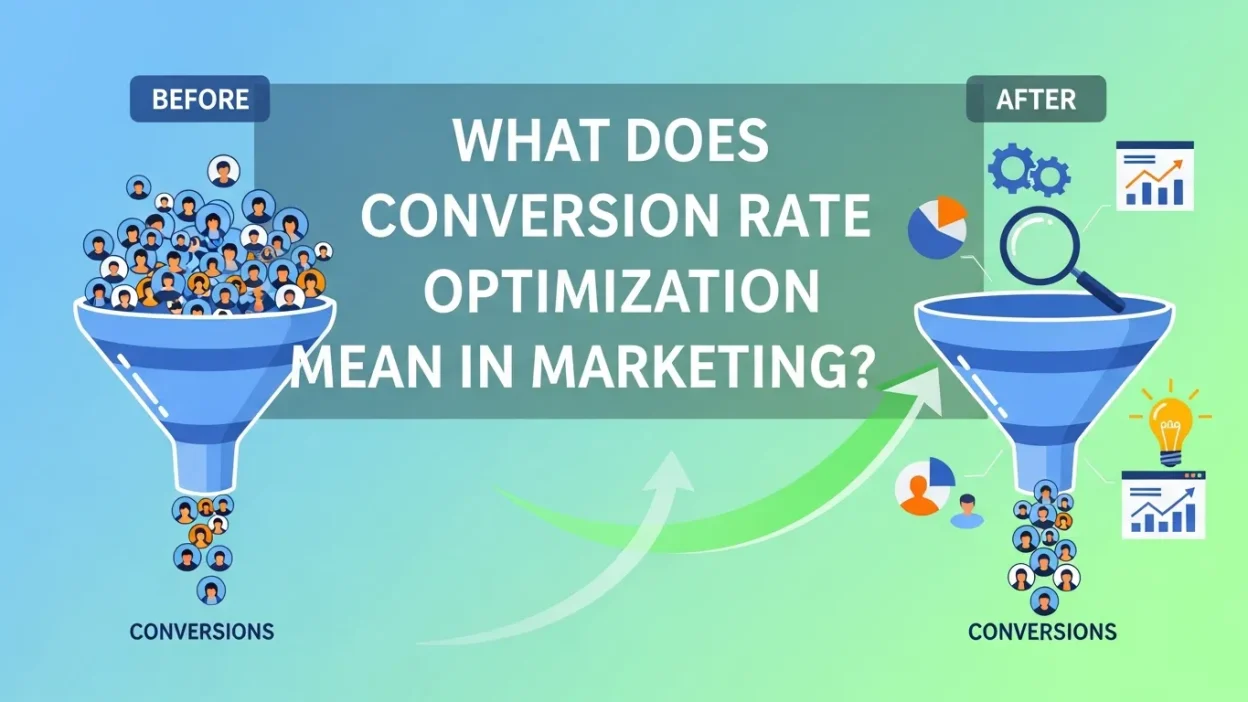
This blog explores Conversion Rate Optimization (CRO), its importance, and actionable strategies like A/B testing, automation, and AI chatbots. It provides a step-by-step guide, tools, and FAQs to help businesses maximize ROI and enhance user experiences.
If you have spent any time in the digital marketing space, you have likely heard the term Conversion Rate Optimization (CRO) discussed. It’s a frequent topic in conversations about improving marketing performance and driving business growth. But what is Conversion Rate Optimization, and why is it a critical component of a successful marketing strategy? Understanding this concept is the first step toward unlocking significant potential within your existing digital assets.
Conversion Rate Optimization is the systematic process of enhancing your website, software product, or other digital platforms to increase the percentage of visitors who take a desired action. This “conversion” can be anything from subscribing to a newsletter or downloading a whitepaper to making a purchase or filling out a contact form. CRO is about making every interaction a customer has with your brand online as effective as possible, ultimately boosting sales and return on investment (ROI) without necessarily increasing your advertising spend. It’s a discipline that turns your existing traffic into a more powerful engine for growth.
Why Is Conversion Rate Optimization Important?
Many businesses become fixated on driving more traffic to their websites. While website traffic is essential, it’s only one part of the equation. What happens after 1,000 visitors land on your homepage in a single day? This is where Conversion Rate Optimization becomes indispensable. It bridges the gap between attracting visitors and turning them into valuable customers by perfecting their experience and guiding them seamlessly through your conversion funnel.
The core value of a strong Conversion Rate Optimization strategy lies in its ability to create a more efficient marketing and sales process. By focusing on the users you already have, you can uncover insights that lead to substantial improvements in performance. This proactive approach not only impacts your bottom line but also enhances brand perception and customer loyalty. Let’s delve deeper into the specific benefits that make CRO a non-negotiable for modern businesses.
Maximize Your Return on Investment (ROI)

One of the most compelling reasons to invest in Conversion Rate Optimization is its direct impact on your ROI. CRO allows you to make the most of the traffic you already possess. Instead of continuously pouring more money into advertising campaigns to attract new visitors, you focus on converting the ones you have at a higher rate. This efficiency translates into a much better return on your overall marketing investment.
Consider a practical example: your e-commerce site receives 20,000 visitors per month. If your current conversion rate is 1.5%, you generate 300 customers. By implementing Conversion Rate Optimization techniques, you manage to increase that rate to just 2.5%. This seemingly small adjustment results in 500 customers per month—an additional 200 customers without spending a single extra dollar on paid ads. This demonstrates the powerful leverage that Conversion Rate Optimization provides. It maximizes the value of every visitor and every marketing dollar spent.
A Better Experience Creates Better Engagement
Users who have a positive and frictionless experience on your website are far more likely to stay, engage with your content, and ultimately convert. A site that is optimized for conversions isn’t just a good sales tool; it’s a sign of excellent customer-centric design. Conversion Rate Optimization is fundamentally about understanding the user’s journey and removing any obstacles that stand in their way.
When you adopt a CRO mindset, you become obsessed with eliminating friction. This could mean reducing the number of clicks required to complete a purchase from ten to three, or cutting down the time it takes to fill out a form from one minute to twenty seconds. These improvements, while sometimes small, collectively create an experience that is intuitive, pleasant, and effective. Happy users are more likely to return for future purchases and become loyal advocates for your brand. This focus on user experience is a cornerstone of effective Conversion Rate Optimization.
Key CRO Metrics and Overlapping Disciplines
To effectively practice Conversion Rate Optimization, you must first understand what to measure. Success in CRO is data-driven, and tracking the right metrics is essential for identifying problems and opportunities. In the competitive digital landscape, where user attention is fleeting, these data points provide a clear roadmap for improvement. By analyzing user behavior, you can turn potential site weaknesses into strengths, boosting your income prospects while reducing the effort required from your users.
Critical Metrics to Monitor
Analyzing your website data is the starting point for any CRO initiative. Certain metrics are particularly revealing when it comes to user friction and drop-off points.
- Bounce Rate: This metric shows the percentage of visitors who land on a page and leave without taking any further action, like clicking a link or navigating to another page. A high bounce rate on a critical page (like a product page) is a major red flag that warrants a deeper investigation through Conversion Rate Optimization.
- Exit Rate: Unlike bounce rate, exit rate measures the percentage of visitors who leave your site from a specific page, even if they visited other pages beforehand. High exit rates on pages within your conversion funnel (e.g., the checkout process) can indicate a specific point of friction that is costing you sales.
- Average Time on Page: This shows how long users are spending on a particular page. Low time on page for content that should be engaging could suggest the content is not meeting user expectations or is poorly presented.
- Traffic Sources: Understanding where your visitors are coming from (e.g., organic search, social media, paid ads) helps you tailor their experience. A solid Conversion Rate Optimization plan considers the user’s origin and intent.
- Conversion Funnel Drop-off: Analyzing where users abandon your conversion funnel is crucial. If you see a massive drop-off between the “add to cart” step and the “enter payment” step, you know exactly where to focus your Conversion Rate Optimization efforts.
By regularly tracking these metrics, you can identify where users are getting lost and develop hypotheses on how to better guide them toward your conversion goals. This analytical approach is fundamental to a successful Conversion Rate Optimization strategy.
The Role of User Behavior Tools
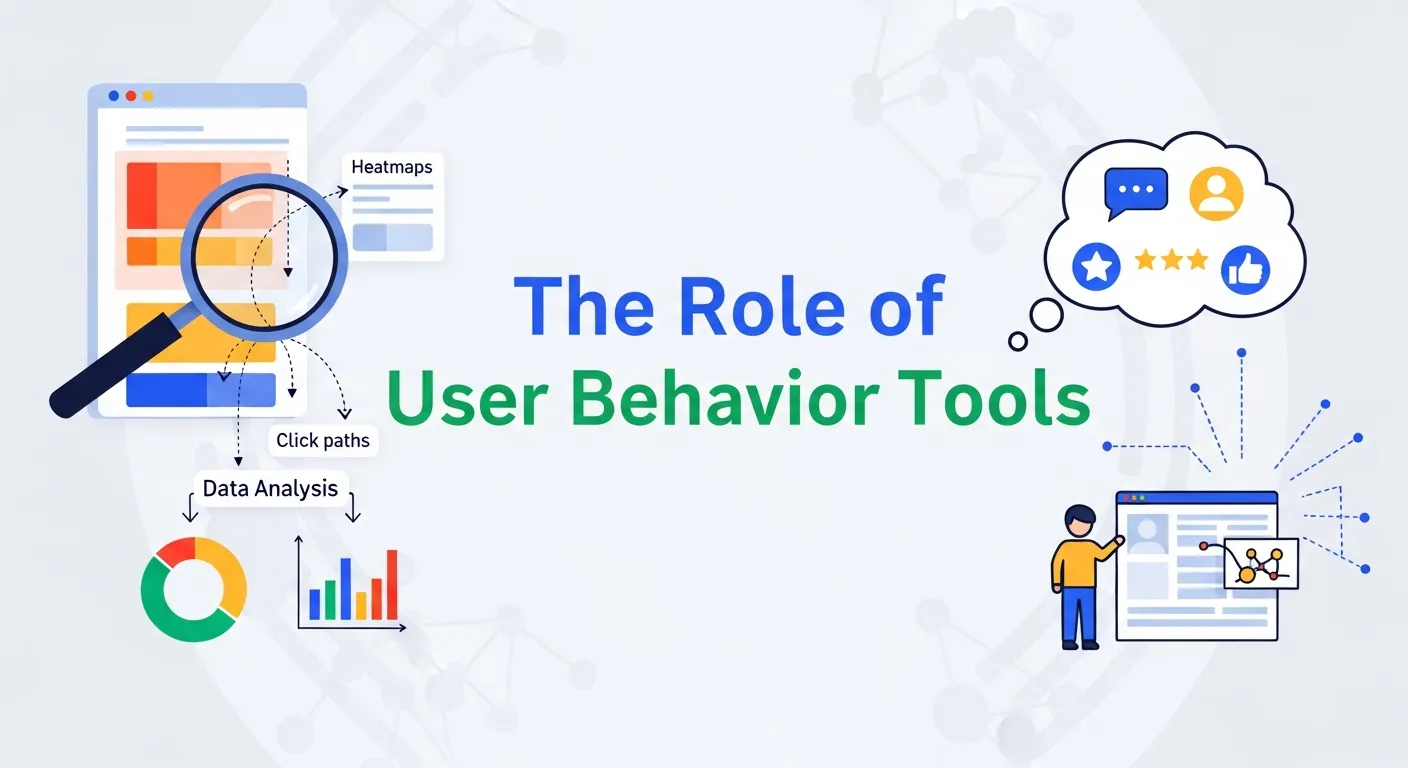
While analytics data tells you what is happening on your site, user behavior tools help you understand why it’s happening. These qualitative tools provide deep insights into the user experience, allowing you to see your website through your visitors’ eyes.
- Heatmaps: These tools create visual representations of where users click, move their mouse, and scroll on a page. Heatmaps reveal which elements are capturing attention and which are being ignored, providing invaluable feedback for your Conversion Rate Optimization efforts.
- Session Recordings: Session recordings are videos of anonymous user journeys on your site. Watching these recordings allows you to witness firsthand the struggles and “aha!” moments users experience. You might discover a broken button or a confusing navigation element that your analytics data alone would never reveal.
- User Surveys and Polls: Sometimes, the best way to understand your users is to simply ask them. On-page surveys and feedback polls can provide direct access to audience feedback, uncovering motivations, objections, and pain points. This qualitative data is a goldmine for generating strong hypotheses for your Conversion Rate Optimization tests.
Using these tools in tandem gives you a comprehensive view of user issues and opportunities. They transform abstract numbers into actionable insights, providing a new perspective that is essential for impactful Conversion Rate Optimization.
A/B Testing: The Heart of CRO
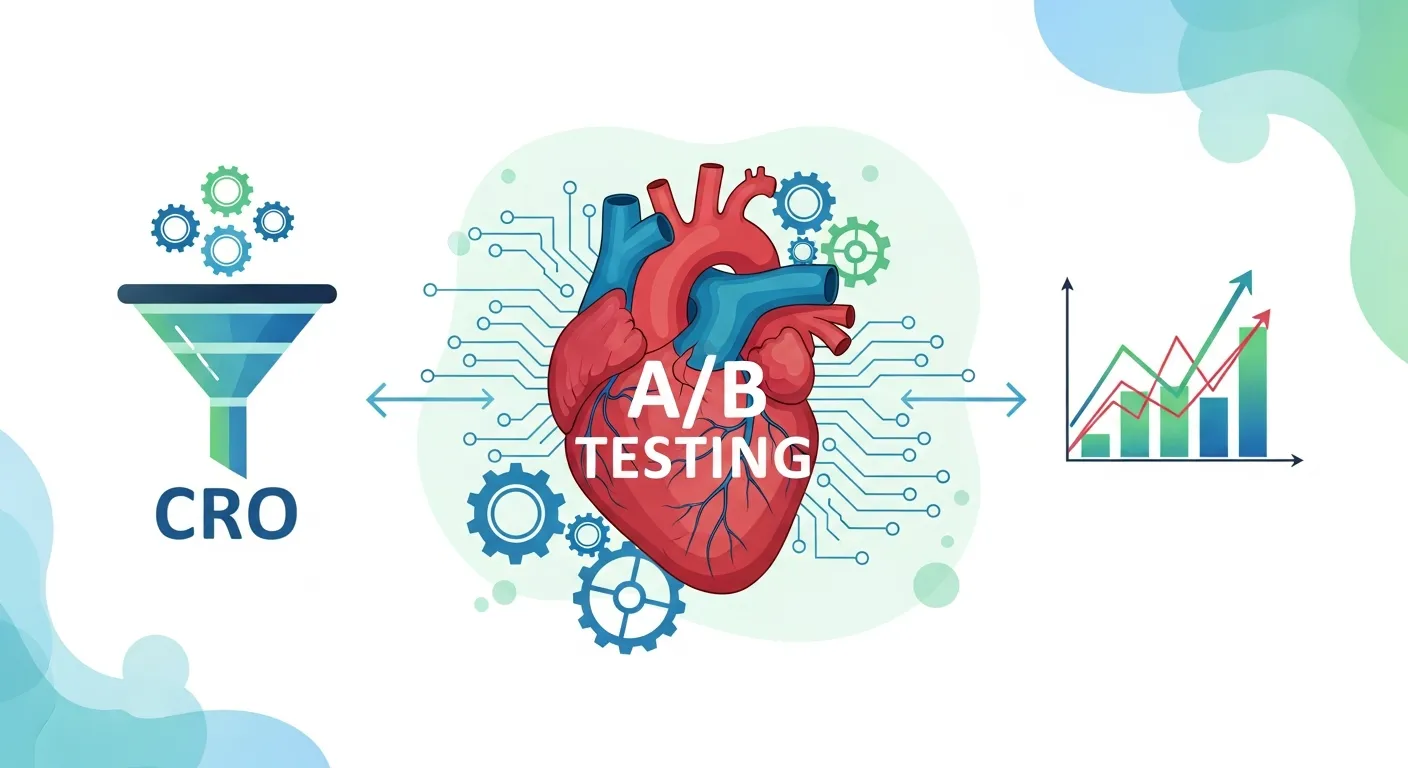
A/B testing, also known as split testing, is a core practice of Conversion Rate Optimization. It is the scientific method of comparing two or more variations of a webpage or element to determine which one performs better in achieving a specific goal. For example, you can A/B test different headlines, calls-to-action (CTAs), images, or even the color of a button to find out which version generates more clicks, sign-ups, or sales.
The process is straightforward: you split your traffic between the original version (the “control”) and the new version (the “variation”). By measuring which version leads to a statistically significant increase in conversions, you can implement the winner and continuously improve your website’s performance. This iterative process of testing and refining is what drives long-term success in Conversion Rate Optimization.
Integrating Automation and AI in Your CRO Strategy
Modern Conversion Rate Optimization extends beyond manual tweaks and basic A/B tests. The integration of automation and artificial intelligence (AI) has opened up new frontiers for creating highly personalized and efficient user experiences. These technologies can process vast amounts of data to uncover patterns and opportunities that would be impossible for a human to identify, taking your CRO efforts to the next level.
By automating repetitive tasks and leveraging AI for predictive analysis, you can scale your optimization efforts and deliver dynamic experiences that adapt to individual user behaviors in real-time. This is a crucial evolution in the field of Conversion Rate Optimization.
Leveraging Automation for Seamless Data Management
A significant challenge in Conversion Rate Optimization is managing and interpreting data from multiple sources. User data can come from your website analytics, CRM, email platform, and third-party tools. Manually collating and analyzing this information is time-consuming and prone to error. Automation is the key to solving this problem.
Automated data integration can streamline your entire workflow. For instance, using tools for cross-platform data entry automation can ensure that user information captured on your website is instantly and accurately synced with your backend systems. This has several benefits for CRO:
- Unified Customer View: It creates a single, consistent profile for each user, allowing for more holistic analysis.
- Reduced Friction: Automating form fills or personalizing content based on previously captured data reduces user effort.
- Faster Insights: Automated reporting can quickly flag underperforming segments or pages, enabling a more agile Conversion Rate Optimization cycle.
The below illustrates how automation can impact different stages of the user journey:
|
User Journey Stage |
Manual Process |
Automated Process |
CRO Impact |
|---|---|---|---|
|
Lead Capture |
Manually entering lead info into CRM |
Form data auto-syncs to CRM |
Faster lead follow-up, fewer data errors |
|
Personalization |
Showing the same content to all users |
Displaying dynamic content based on user history |
Higher relevance and engagement |
|
Post-Conversion |
Manually sending a confirmation email |
Triggering an automated welcome email sequence |
Improved onboarding and customer retention |
By automating data management, you free up valuable time and resources to focus on the strategic aspects of Conversion Rate Optimization.
The Rise of Conversational Marketing with AI Chatbots
Another powerful application of AI in Conversion Rate Optimization is conversational marketing. AI-powered chatbots have transformed from simple FAQ bots into sophisticated tools that can engage visitors, qualify leads, and even guide users through the conversion process. They offer a scalable way to provide instant, personalized assistance 24/7.
Integrating AI chatbots can significantly boost your conversion rates. For more on this, see conversational marketing AI chatbots for engagement. As visitors increasingly expect instant gratification, the ability to provide real-time, personalized support is a powerful competitive advantage that directly contributes to a higher conversion rate.
Personalization at Scale: The Future of CRO
While traditional Conversion Rate Optimization focuses on improving the experience for the “average” user, the future lies in personalization at scale. This involves tailoring the website experience to the unique needs, preferences, and behaviors of each visitor. AI and machine learning are the driving forces behind this evolution, enabling businesses to move beyond simple A/B tests to create truly dynamic and individualized user journeys.
This advanced form of CRO recognizes that a one-size-fits-all approach is no longer effective. By delivering the right message to the right person at the right time, you can dramatically increase relevance and, consequently, conversion rates. This is the ultimate goal of a mature Conversion Rate Optimization program.
Dynamic Content and AI-Driven Recommendations
One of the most impactful ways to implement personalization is through dynamic content. This technique involves showing different versions of content, such as headlines, images, or CTAs, to different user segments based on their data. For example:
- A returning visitor might see a welcome message and products related to their previous purchases.
- A new visitor from a specific geographic location could be shown shipping information relevant to their region.
- A user who arrived from a social media ad about a particular product might land on a page where that product is prominently featured.
AI takes this a step further by powering sophisticated recommendation engines, similar to those used by Amazon and Netflix. These engines analyze a user’s browsing history, past purchases, and real-time behavior to suggest products or content they are most likely to be interested in. This not only improves the user experience but also increases average order value and customer lifetime value—key metrics influenced by Conversion Rate Optimization.
Using AI Chatbots for Advanced Customer Engagement
As we touched upon earlier, AI chatbots are becoming central to modern digital strategies. Their role in personalization and Conversion Rate Optimization is expanding rapidly. Advanced chatbots do more than just answer questions; they proactively engage users to drive conversions. The impact of AI chatbots on customer engagement and conversions is well-documented.
Here’s how they contribute to a personalized CRO strategy:
- Lead Qualification: Chatbots can ask targeted questions to qualify leads in real-time, segmenting them based on their needs and routing high-value leads directly to a sales team.
- Personalized Guidance: A chatbot can act as a personal shopper, asking a visitor about their needs and guiding them to the perfect product, bypassing the need for extensive site navigation.
- Cart Abandonment Recovery: If a user is about to leave the site with items in their cart, a chatbot can pop up with a special offer or ask if they need help, recovering a potentially lost sale.
This compares the capabilities of basic chatbots versus advanced, AI-powered ones in the context of Conversion Rate Optimization:
|
Feature |
Basic Chatbot (Rule-Based) |
Advanced Chatbot (AI-Powered) |
|---|---|---|
|
Conversation Flow |
Follows a rigid, pre-programmed script. |
Uses Natural Language Processing (NLP) to understand and adapt to user intent. |
|
Personalization |
Limited to no personalization. |
Offers personalized recommendations and content based on user data. |
|
Lead Generation |
Can capture basic contact information. |
Can qualify leads, score them, and integrate with CRM systems. |
|
Proactive Engagement |
Typically passive, waiting for user input. |
Can proactively initiate conversations based on user behavior (e.g., exit-intent). |
By embracing these AI-driven personalization techniques, you can create a website that feels uniquely tailored to each visitor, making the path to conversion feel less like a funnel and more like a conversation. This is the pinnacle of modern Conversion Rate Optimization.
The CRO Step-by-Step Guide
Now that you understand the what, why, and how of Conversion Rate Optimization, it’s time to put it into practice. A structured approach is key to achieving meaningful and sustainable results. CRO is not a one-time project but an ongoing cycle of analysis, testing, and refinement. Follow this step-by-step guide to build and execute your own CRO program.
Step 1: Set Clear and Measurable KPIs
Before you change a single element on your website, you must define what success looks like. Start by establishing your Key Performance Indicators (KPIs). These are the quantifiable metrics that align directly with your business objectives. Your KPIs will serve as the North Star for your Conversion Rate Optimization efforts. Depending on your business model, your primary KPI could be:
- Sales or revenue
- Lead generation (form submissions)
- Newsletter subscriptions
- Free trial sign-ups
- Content downloads
In addition to your primary KPI, identify secondary or micro-conversions that contribute to the main goal, such as adding an item to a cart, watching a product video, or creating an account. Having clear KPIs is the first and most critical step in any Conversion Rate Optimization journey.
Step 2: Analyze Your Quantitative Data
With your KPIs defined, dive deep into your website analytics (e.g., Google Analytics). Your goal is to identify high-traffic pages that are underperforming in relation to your KPIs. Look for pages with high bounce rates, significant exit rates within the conversion funnel, or low time on page. These are your prime candidates for optimization.
This quantitative analysis helps you pinpoint the “where” of your problems. For example, you might discover that your main product category page gets a lot of traffic but has a very low click-through rate to individual product pages. This insight tells you exactly where to focus your initial Conversion Rate Optimization efforts.
Step 3: Understand Your Audience Through Qualitative Research
Once you know where the problems are, you need to understand why they are happening. This is where qualitative research comes in. You need to get inside the minds of your users. Create detailed customer personas to understand who your target audience is, what they are looking for, and what their pain points and motivations are.
Use the user behavior tools we discussed earlier:
- Heatmaps and Scroll Maps: See what users are looking at and ignoring.
- Session Recordings: Watch how real users interact with your site to spot usability issues.
- User Surveys and Feedback Polls: Ask users directly about their experience and what might be preventing them from converting.
This qualitative insight is crucial for forming strong, evidence-based hypotheses for your tests. It guides your entire Conversion Rate Optimization strategy, ensuring your changes are based on user needs, not just guesswork.
Step 4: Formulate a Hypothesis and Prioritize
Based on your quantitative and qualitative research, you can now formulate a hypothesis. A good hypothesis follows a clear structure: “If I change [Independent Variable] for [User Segment], I expect it to cause [Impact on KPI] because [Rationale from Research].”
For example: “If we change the call-to-action button color on our product pages from grey to orange, we expect to see a 15% increase in ‘Add to Cart’ clicks because our heatmap analysis shows the current button is being ignored.”
You will likely generate many hypotheses. Use a prioritization framework (like PIE: Potential, Importance, Ease) to decide which tests to run first, focusing on those with the highest potential impact and feasibility.
Step 5: Design and Run A/B Tests
Now it’s time to experiment! Using an A/B testing tool, create the variation of your page based on your hypothesis. It is critical to change only one variable at a time to ensure your test results are “pure” and you can confidently attribute any change in performance to that specific element.
Launch your test and let it run until it reaches statistical significance (typically 95% or higher). This ensures that your results are not due to random chance. Be patient; ending a test too early can lead to false conclusions and misguided decisions in your Conversion Rate Optimization program.
Step 6: Analyze Results, Iterate, and Refine
Once your test is complete, analyze the results. Did the variation win, lose, or have no effect? Regardless of the outcome, you have learned something valuable about your audience.
- If your variation wins: Implement the winning version for all users and move on to your next prioritized hypothesis.
- If your variation loses or is inconclusive: Analyze the results to understand why it didn’t work. Use these learnings to refine your approach and formulate a new hypothesis.
Conversion Rate Optimization is not a single event; it is a continuous loop of learning and improvement. Regularly analyze your campaigns, refine your strategy based on performance data, and never stop testing. This iterative process is what will compound your gains over time and lead to significant growth.
FAQ: Answering Your Top CRO Questions
1. What is a good conversion rate?
A “good” conversion rate is highly relative and depends on your industry, traffic source, and the specific conversion goal. While average e-commerce conversion rates hover around 1-3%, what matters most is establishing your own baseline and focusing on continuous improvement through Conversion Rate Optimization.
2. How long does it take to see results from CRO?
The time to see results varies. You might see a lift from a single successful A/B test within a couple of weeks. However, building a mature and impactful Conversion Rate Optimization program that delivers sustained growth is a long-term commitment that often takes several months to establish.
3. Is Conversion Rate Optimization part of SEO?
While they are distinct disciplines, they are closely related and mutually beneficial. SEO focuses on driving traffic to your site, while CRO focuses on converting that traffic. For more details, to understand how they work together for holistic growth. CRO as a part of SEO to understand how they work together for holistic growth.
4. Can I do CRO on a small budget?
Absolutely. While enterprise-level tools can be expensive, there are many free or low-cost tools available for analytics (Google Analytics), heatmaps, and even A/B testing. The most important investment is time for analysis and a commitment to a structured testing process.
5. What is the difference between UX Design and CRO?
User Experience (UX) design is a broad field focused on the entire experience a user has with a product. CRO is a more specific, data-driven subset that focuses on optimizing that experience to achieve a specific business goal (a conversion). Good UX is often a prerequisite for successful CRO.
6. What is website conversion rate optimization?
In essence, it is the practice of systematically improving your website’s performance by using analytics and user feedback to enhance the user experience and increase the percentage of visitors who complete a desired action. A deeper dive into what website conversion rate optimization is can provide a more comprehensive overview of its core principles.
7. Should I test big changes or small changes?
Both have their place. Small, iterative changes (like button color or headline copy) are great for continuous, incremental gains. Radical redesigns, or “big bang” tests, can lead to larger wins but are also riskier. A balanced Conversion Rate Optimization strategy often includes both.
8. Why is Conversion Rate Optimization needed for growth?
CRO is essential for sustainable growth because it makes your marketing efforts more efficient. Instead of solely relying on acquiring more traffic, it allows you to generate more value from the traffic you already have. This leads to higher ROI, lower customer acquisition costs, and scalable growth, highlighting why conversion rate optimization is needed for growth.
9. What’s more important: acquiring new customers or converting existing ones?
A healthy business needs both. However, it is generally much more cost-effective to convert an existing visitor or retain a current customer than to acquire a new one. A strong Conversion Rate Optimization focus ensures you are not letting potential revenue slip through the cracks.
10. What is statistical significance in A/B testing?
Statistical significance is a measure of confidence that the result of your test is not due to random chance. A confidence level of 95% means there is only a 5% probability that the observed difference between your control and variation occurred randomly. Reaching this threshold is critical for making reliable decisions in your Conversion Rate Optimization program.