
Explore the evolution of Conversion Rate Optimization (CRO) from basic web usability to AI-driven personalization. Learn how CRO enhances user experience, boosts conversions, and drives growth through data-driven strategies, mobile optimization, conversational marketing, and predictive AI tools.
At the very core of contemporary digital marketing strategies stands Conversion Rate Optimization (CRO). This delicate and precise discipline allows businesses to fine-tune their online presence to breed loyal customers and maximize revenue. But when precisely did Conversion Rate Optimization first come into being? How did we move from simple hit counters to complex predictive AI models?
To understand where we are going, we must look back. This comprehensive guide explores the timeline of Conversion Rate Optimization, analyzing how technological shifts, user behavior changes, and analytical breakthroughs have shaped the industry into the powerhouse it is today.
The Early Days of Web Optimization (1990s)
The Advent of Websites and Basic Functionality
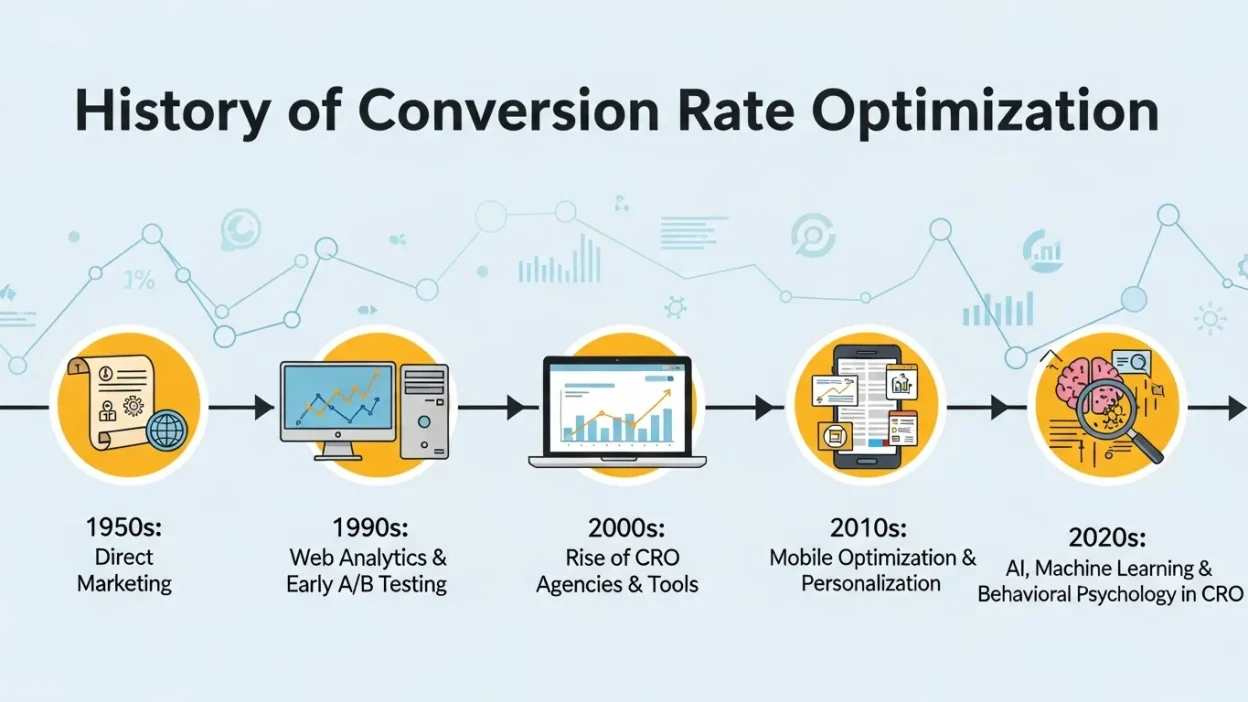
The history of Conversion Rate Optimization is closely linked to the dawn of the Internet itself. When the World Wide Web first went online to the public in 1991, the concept of “optimization” in a marketing sense was non-existent. At this stage, websites were primarily a collection of static, text-heavy pages with only minimal interactivity. These were the days of “brochureware”—digital versions of printed company pamphlets.
During this era, Conversion Rate Optimization was not yet on the agenda because the primary goal was simply connectivity. The principal effort for developers was to make sites work and ensure they were usable via slow, unstable dial-up connections. If a page loaded without crashing the browser, it was considered a success.
However, even in this primitive stage, the seeds of Conversion Rate Optimization were being sown. Webmasters began to realize that layout mattered. They noticed that breaking up long blocks of text improved readability. While they didn’t have the metrics to prove it, they were practicing the very earliest forms of usability optimization, which is a foundational pillar of modern Conversion Rate Optimization.
The Arrival of E-Commerce
It was not until the late 1990s, when e-commerce truly arrived with the launch of platforms like Amazon and eBay, that businesses seriously looked at website performance and usability. Suddenly, a website was no longer just a digital business card; it was a storefront.
During this period, the basic idea of making a website more efficient started to take shape. Business owners realized that confusion led to lost sales. Simple experiments, such as testing different headlines or adjusting button placements on e-commerce sites, formed the basis of what became Conversion Rate Optimization later.
The limitations were severe. There were no sophisticated tracking pixels or heatmaps. Decisions were often made based on the “HiPPO” method—the Highest Paid Person’s Opinion. Yet, the financial stakes of e-commerce forced the industry to start thinking about the user journey.
The Rise of Web Analytics (2000–2005)

Moving Beyond Server Logs
Before the 2000s, tracking visitor behavior was a nightmare involving complex server log files that were difficult to interpret. You could see how many “hits” a site got, but you couldn’t easily see what those people did.
By the beginning of the 2000s, the landscape changed. New software solutions began to emerge that made data accessible. This era culminated in the launch of Google Analytics in 2005 (born from the acquisition of Urchin). This tool presented businesses with a free, accessible opportunity to use data to measure website performance.
Data-Driven Insights
Metrics such as bounce rate, page views, and session duration became available to the masses. This enabled marketers for the first time to study visitor behavior in granular detail. This introduction of data-driven insights offered a tangible means to improve the efficacy of websites and set the stage for formal Conversion Rate Optimization strategies.
Companies could now track exactly how many visitors converted to leads, customers, or subscribers. This capability laid the groundwork for formal Conversion Rate Optimization measurement. Marketers could finally ask, “Why did 98% of people leave this page without buying?” and have the data to begin answering the question.
The Origin of “Conversion Rate Optimization” (2007)
The Term Is Coined and Formalized
According to a widely held belief, the specific term “Conversion Rate Optimization” first entered popular usage around 2007. Industry pioneers like Tim Ash, who would become an important figure in Conversion Rate Optimization circles, began publishing influential works such as Landing Page Optimization.
During this period, a community began to form. Blogs, conferences, and forums dedicated to internet marketing began discussing “conversion” as a specific metric to be managed. This marked a landmark moment for digital marketing. Conversion Rate Optimization now explicitly refers to increasing the percentage of website visitors who completed a desired action (for example: a purchase, filling out a form, or a download).
From Usability to Methodology
The practice moved from a vague notion of usability enhancement to a structured methodology based on analytics and experiments. It was no longer just about “making it look good”; it was about “making it sell.” The Eisenberg brothers (Bryan and Jeffrey) were also instrumental during this time, introducing the concept of “persuasion architecture” and bringing buyer psychology into the mix.
CRO in Action: The Era of A/B Testing (Late 2000s)
The Split Testing Revolution
By the late 2000s, Conversion Rate Optimization techniques were beginning to be delivered to the users of e-commerce and SaaS companies aiming for online scale. A/B testing (or split testing) became standard practice.
Companies began testing different versions of web pages to find which design, content, or layout produced higher conversions. Tools like Google Website Optimizer (the precursor to Google Optimize) made this technology accessible to non-developers.
The “Green vs. Red” Button Phase
For a time, the industry was obsessed with granular tactics. For instance, marketers found that just changing the call-to-action (CTA) button from green to red could double or even triple conversions because people were drawn to the more prominent design.
While this era was critical for proving the value of Conversion Rate Optimization, it also led to a simplistic view of the discipline. Many believed there was a “magic bullet”—a single color or word that would skyrocket sales. Companies like Amazon and Netflix were pioneers in showing that true Conversion Rate Optimization wasn’t about magic tricks; it was about small, iterative changes that drove drastic improvement in revenue over time.
The Evolution of CRO in the 2010s
Moving Beyond Simple Testing
The 2010s saw a major change in how businesses were approaching Conversion Rate Optimization. The industry matured, realizing that changing button colors had diminishing returns. It moved past simple A/B testing and towards a holistic view of User Experience (UX).
Companies realized that Conversion Rate Optimization was more than just fiddling with layout; it was about addressing customers’ broader needs, anxieties, and behaviors. The focus shifted from “What can we trick the user into clicking?” to “How can we make this process easier for the user?”
Visualizing User Behavior
Heatmaps, tools such as Crazy Egg and Hotjar, and scroll maps complement standard A/B testing. These tools offered businesses insight into their visitors’ actual interactions on their sites. You could see where users clicked, where they stopped scrolling, and where they experienced “rage clicks” (repeatedly clicking a non-functional element).
Surveys and feedback widgets began to feature more prominently, ensuring that Conversion Rate Optimization strategies aligned with what customers wanted to experience. The qualitative data (the “why”) finally caught up with the quantitative data (the “what”).
Personalization Takes Center Stage
Brands came to start customizing website experiences according to user data, such as where the person is located, what their past behavior was, and what kind of device they are using. For example, a retailer of clothes might show heavy coats to users visiting from snowy regions and swimwear for those in warmer climates. This level of segmentation became a powerful lever in Conversion Rate Optimization.
The Role of Mobile Optimization in CRO
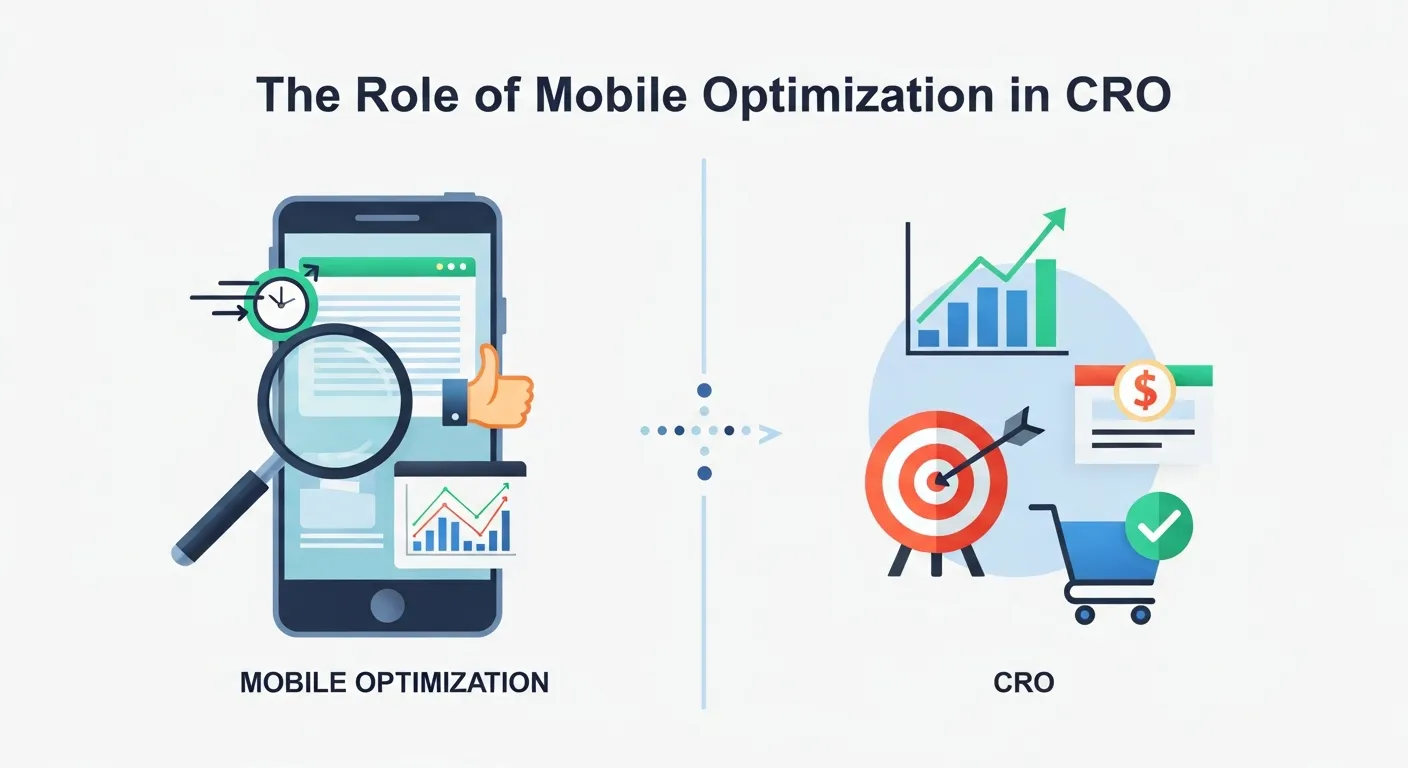
As smartphone usage exploded in the mid-2010s, the scope of Conversion Rate Optimization expanded significantly. It became clear that desktop strategies did not translate perfectly to mobile interfaces. The screen real estate was smaller, the connection speeds were variable, and user intent was often more urgent.
Mobile optimization ensures that users have a seamless experience, regardless of the device they use. Websites that are not mobile-friendly risk losing a significant portion of their audience, as Google now prioritizes mobile-first indexing.
Key Aspects of Mobile CRO
|
Aspect |
Impact on Conversion Rate Optimization |
Implementation Goal |
|---|---|---|
|
Mobile-First Design |
Prioritizes the mobile experience during the design phase rather than treating it as an afterthought. |
Ensure touch targets (buttons) are large enough and navigation is intuitive on small screens. |
|
Responsive Layouts |
Adapts content fluidly to all screen sizes, from tablets to large monitors. |
Eliminate horizontal scrolling and ensure text is readable without zooming. |
|
Speed Optimization |
Reduces bounce rates significantly. Mobile users are notoriously impatient; a 1-second delay can kill conversions. |
Compress images and minify code to load content instantly on 4G/5G networks. |
One of the biggest challenges in mobile Conversion Rate Optimization is data entry. Filling out long forms on a smartphone is tedious and leads to high abandonment rates. To mitigate this, successful optimizers streamline backend processes. For businesses managing high volumes of information, using tools for cross-platform data entry automation can ensure that data flows smoothly between mobile interfaces and backend databases, reducing errors and improving the overall user journey.
The Impact of Conversational Marketing on CRO
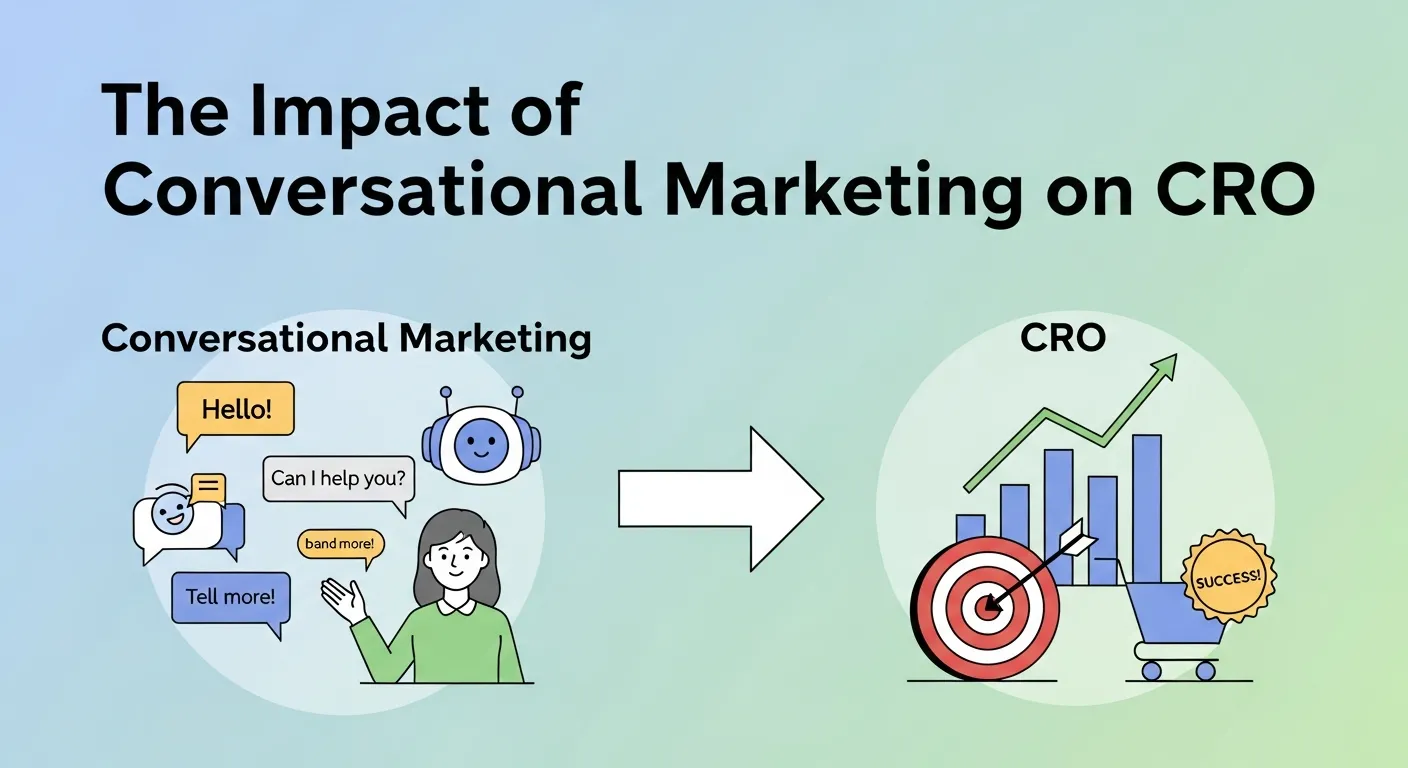
In the quest to improve conversion rates, businesses realized that static forms were passive. They required the user to do all the work. Enter conversational marketing: the practice of engaging users in real-time dialogue.
Powered by advancements in Natural Language Processing (NLP), conversational marketing has revolutionized Conversion Rate Optimization. By engaging users the moment they land on a site, chatbots can guide them through the buyer’s journey, answer queries instantly, and even upsell products without human intervention.
Benefits of Conversational Tools in CRO
|
Feature |
Benefit to Conversion Rates |
CRO Application |
|---|---|---|
|
Instant Responses |
Drastically reduces bounce rates by providing immediate value and answers. |
Deploy on pricing pages to answer common objections immediately. |
|
24/7 Availability |
Captures leads outside of standard business hours, increasing total volume. |
Ensure international traffic can convert even when your sales team is asleep. |
|
Lead Qualification |
Filters out unqualified traffic, ensuring sales teams focus only on high-value prospects. |
Use bots to ask budget and timeline questions before routing to a human. |
To bridge the gap between anonymous traffic and qualified leads, many brands now deploy conversational marketing AI chatbots to guide users. These tools act as virtual shop assistants, actively increasing the likelihood of conversion by removing friction and uncertainty from the buying process.
The Role of AI in Predictive CRO

We are currently witnessing the most significant shift in the history of Conversion Rate Optimization: the move from reactive to predictive optimization.
In the past, Conversion Rate Optimization was reactive. You ran a test, looked at the results, and made a change. Artificial intelligence has taken this to the next level by enabling predictive analysis. AI tools can analyze vast oceans of user behavior patterns and predict future actions, allowing businesses to optimize their websites proactively for individual users in real-time.
AI Capabilities Transforming CRO
|
AI Capability |
Impact on Conversion Rate Optimization |
Predictive Function |
|---|---|---|
|
Pattern Recognition |
Identifies subtle behaviors that humans miss (e.g., mouse movement velocity). |
Detects when a user is frustrated or confused before they leave. |
|
Dynamic Content |
Changes headlines, images, and offers on the fly based on predicted intent. |
Shows a discount code only to users predicted to abandon their cart. |
|
Automated Testing |
Runs thousands of multivariate tests simultaneously, speeding up optimization. |
“Bandit algorithms” automatically route traffic to the winning variation without manual input. |
Modern tools utilize AI chatbots for customer engagement and conversions to predict user intent. For example, if an AI detects a user is comparing specs, it might trigger a comparison guide. If it predicts price sensitivity, it might trigger a free shipping offer. This level of automated, intelligent response is the frontier of Conversion Rate Optimization.
CRO in Recent Times (2020s and Beyond)
CRO as a Growth Lever
In recent years, Conversion Rate Optimization began to strengthen its position as an essential tool for holistic business growth. High-growth businesses regarded it as a solid way of increasing revenue without having to plough significant resources into attracting more traffic.
The logic is sound: Why would you spend more on ads when you can get a revenue boost from your current users? This philosophy shifted Conversion Rate Optimization from a marketing tactic to a C-suite priority.
Tools for Everyone
Tools such as Optimize (founded in 2010 but maturing later) and VWO gave businesses easy-to-use platforms to perform in-depth experiments on users. They provided an entry point for companies big and small, even if they had no technical expertise in-house. This democratization meant that a local bakery could run the same types of tests as a multinational retailer.
CRO as Part of a Digital Strategy
Conversion Rate Optimization now covers the whole digital customer journey, not just the website. Marketers now carry out conversion optimization across multiple channels, including mobile apps as well as emails and even tweets. Platforms such as HubSpot and Salesforce help businesses join up these insights into a single picture that is seamless and customer-centered.
CRO and User Privacy
In the modern-day Conversion Rate Optimization landscape, one strong trend is that of balancing optimization whilst still attempting to honor user privacy. Laws like GDPR (General Data Protection Regulation) and CCPA (California Consumer Privacy Act) have caused most marketing organizations to rethink their data collection methods.
The death of the third-party cookie has forced optimizers to rely more on first-party data and contextual targeting. Today, businesses are employing anonymized data and cookie-less options to comply but still keep on increasing customer lifetime value.
Key Takeaways from the History of CRO
The history of Conversion Rate Optimization shows that marketing has moved from intuition-based techniques to data-driven efforts for delivering value to customers. To sum up briefly:
- It all started in the late 1990s with pretty basic web usability improvements.
- Around 2007, the term “Conversion Rate Optimization” gained traction thanks to industry leaders and tools such as Google Analytics.
- The 2010s saw a move to user-focused strategies that include advanced testing methods, personalization, and better UX.
- AI and an approach across many platforms define Conversion Rate Optimization today, helping companies be competitive in driving online conversions.
How You Can Apply CRO Today
Now that you have seen how Conversion Rate Optimization has been established and developed, why don’t you explore what it can do for your company? Not all people need to be tech titans to introduce powerful Conversion Rate Optimization methods.
All big transformations start with tiny tweaks. Minor changes to the website, blog, or social platforms commonly return disproportionate results just as they always have. Whether it is clarifying your value proposition, speeding up your mobile site, or adding a chatbot, the principles remain the same: listen to the data and solve the user’s problem.
Leading-edge tools like Google Optimize, Hotjar, and Crazy Egg can help you get ahead of the curve. If you are still undecided as to which direction to begin with, then consider hiring those with expertise in the space.
Frequently Asked Questions (FAQ)
1. What exactly is Conversion Rate Optimization (CRO)?
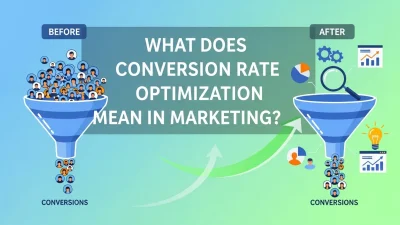
Conversion Rate Optimization is the systematic process of increasing the percentage of website visitors who take a desired action—be that filling out a form, becoming a customer, or otherwise. The CRO process involves understanding how users move through your site, what actions they take, and what’s stopping them from completing your goals.
2. Is CRO a part of SEO, or are they different?
They are distinct but complementary. SEO (Search Engine Optimization) focuses on driving traffic to your site, while Conversion Rate Optimization focuses on converting that traffic once it arrives. However, a good CRO can improve SEO rankings by lowering bounce rates. For a deeper dive, read more at is cro part of seo.
3. Why do I need CRO if my traffic is already high?
High traffic does not equal high revenue. If you have 100,000 visitors but only a 0.5% conversion rate, you are leaving money on the table. Conversion Rate Optimization helps you capitalize on the traffic you already have, lowering your customer acquisition costs (CAC) and improving ROI without spending more on ads.
4. What is a “good” conversion rate?
This varies wildly by industry. E-commerce might average 2-3%, while B2B lead generation might see 5-10%. The best benchmark is your own historical data. The goal of Conversion Rate Optimization is to beat your own past performance, not necessarily to match an arbitrary industry standard.
5. How long does a CRO test need to run?
A test needs to run until it achieves statistical significance, usually at least 95%. This ensures the results aren’t due to random chance. Depending on your traffic volume, a Conversion Rate Optimization test might take anywhere from one week to a month. Stopping a test too early is a common mistake.
6. What elements of a website should be optimized?
You can optimize almost anything: the headline, copy, images, form length, call-to-action (CTA) buttons, page speed, and site structure. However, Conversion Rate Optimization should prioritize high-impact areas like the checkout page, pricing page, and main landing pages.
7. What is the difference between A/B testing and Multivariate testing?
A/B testing compares two versions of a page (Version A vs. Version B) to see which performs better. Multivariate testing compares multiple variables (like headline + image + button color) simultaneously to see which combination performs best. Multivariate testing requires significantly more traffic.
8. How does personalization fit into CRO?
Personalization is a tactic within Conversion Rate Optimization where you tailor content to specific user segments. It increases relevance, which usually increases conversions. Learn more about the specifics at what is website conversion rate optimization.
9. Can CRO help with customer retention?
Absolutely. Conversion Rate Optimization isn’t just for new customer acquisition. It can be applied to onboarding flows, user dashboards, and email renewal sequences to ensure existing customers stay engaged and upgrade their plans.
10. Why is CRO considered essential for business growth?
It is the most cost-effective way to scale. By improving efficiency, you generate more revenue from every single visitor. It provides a competitive advantage and stabilizes cash flow. Discover why growth depends on it at why conversion rate optimization need for growth.