
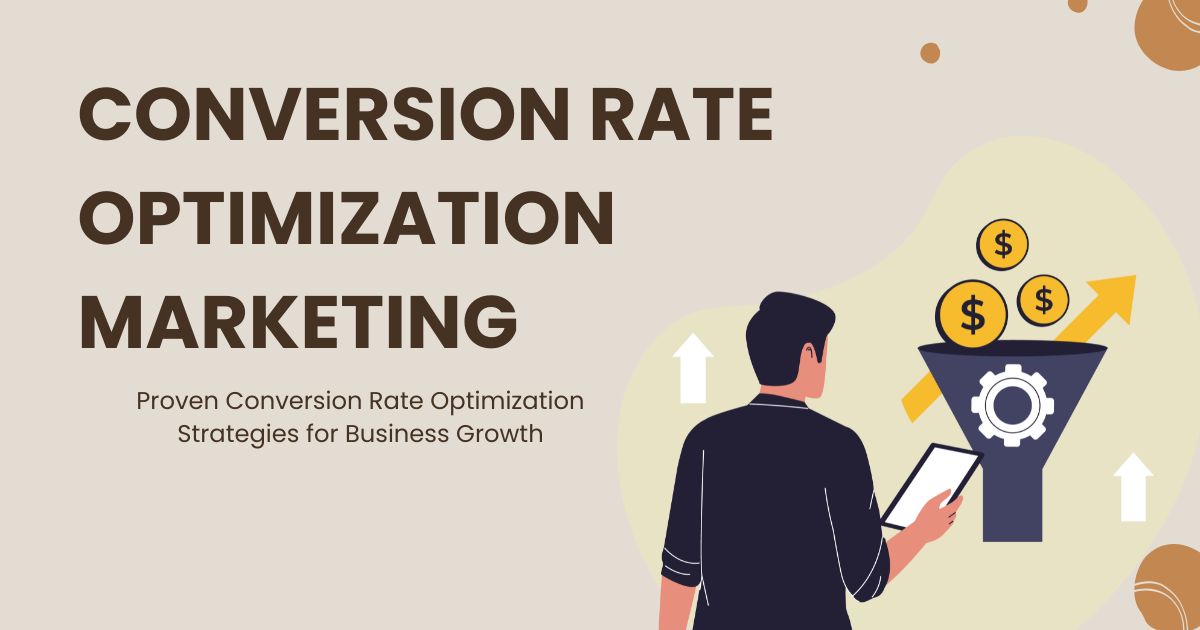
This guide shows how to Master Conversion Rate Optimization Marketing by turning more visitors into customers through data-driven strategies, testing, and UX improvements. It covers essential CRO techniques, tools, and real-world examples to boost conversions effectively. By implementing these strategies, businesses can maximize ROI and achieve sustainable growth.
Understanding Conversion Rates: The Foundation of Success

Before diving into optimization strategies, it’s crucial to understand what conversion rates mean for your business. A conversion rate represents the percentage of visitors who complete a desired action on your website or landing page.
What Counts as a Conversion?
Conversions vary depending on your business goals and industry. Common conversion actions include:
- Making a purchase
- Signing up for a newsletter
- Downloading a resource
- Requesting a demo
- Creating an account
- Filling out a contact form
Industry Benchmarks and Expectations
Average conversion rates differ significantly across industries. E-commerce sites typically see conversion rates between 2-3%, while B2B companies might consider 2-5% excellent. Software-as-a-Service (SaaS) companies often aim for 3-5% conversion rates on their landing pages.
Understanding your industry’s benchmarks helps set realistic goals and measure your performance against competitors. However, focus on improving your metrics rather than obsessing over industry averages.
Key Elements of an Effective CRO Strategy

Successful conversion rate optimization marketing requires a systematic approach built on several core elements. These components work together to create a comprehensive strategy that drives results. For a full roadmap, see The Complete Guide to Conversion Optimization Strategy.
Data-Driven Decision Making
Effective CRO strategies rely on data, not assumptions. This means collecting and analyzing user behavior data, conversion metrics, and customer feedback before making changes to your website or marketing campaigns.
Key metrics to track include:
- Bounce rate
- Time on page
- Click-through rates
- Form abandonment rates
- Cart abandonment rates
- Customer lifetime value
User Experience Optimization
Your website’s user experience directly impacts conversion rates. Visitors should navigate your site easily, find information quickly, and complete desired actions without friction. Focus on page load speed, mobile responsiveness, navigation clarity, content readability, and visual hierarchy. For mobile-specific guidance, check How to Improve Your Mobile Conversion Rate.
Focus on improving:
- Page load speed
- Mobile responsiveness
- Navigation clarity
- Content readability
- Visual hierarchy
Compelling Value Propositions
Your value proposition communicates why visitors should choose your product or service over alternatives. A strong value proposition is clear, specific, and addresses your target audience’s pain points.
Test different value propositions to see which resonates most with your audience. Consider testing variations in headlines, subheadings, and calls-to-action.
Step-by-Step Guide to CRO Implementation

Implementing conversion rate optimization marketing requires a structured approach. Follow these steps to build an effective CRO program for your business.
Establish Baseline Metrics
Before making any changes, measure your current performance. Document your existing conversion rates, traffic sources, and user behavior patterns. This baseline data will help you measure the impact of your optimization efforts.
Identify Optimization Opportunities
Analyze your website and marketing funnel to identify areas for improvement. Look for:
- Pages with high traffic but low conversion rates
- Steps in your funnel where users frequently drop off
- Forms with high abandonment rates
- Pages with below-average time on site
Develop Hypotheses
Create specific, testable hypotheses about why certain pages or elements aren’t converting well. For example: “The checkout process is too complicated, causing cart abandonment. Simplifying it to three steps will increase completion rates.”
Design and Execute Tests
Create variations of your pages or elements based on your hypotheses. Use A/B testing or multivariate testing to compare performance between different versions.
Analyze Results and Implement Winners
Once your tests reach statistical significance, analyze the results. Implement winning variations and document lessons learned for future optimization efforts.
Essential Tools and Technologies for CRO

The right tools can significantly improve your conversion rate optimization marketing efforts. Here are the essential categories of CRO tools and popular options in each.
Analytics and Tracking Tools
Google Analytics remains the foundation for most CRO efforts, providing insights into user behavior, traffic sources, and conversion paths. Enhanced e-commerce tracking helps you understand which products and campaigns drive the most valuable conversions.
Specialized analytics tools like Hotjar or Crazy Egg offer heatmaps and session recordings that reveal how users interact with your pages.
A/B Testing Platforms
Testing platforms allow you to experiment with different page variations without requiring extensive technical knowledge. Popular options include Optimize, VWO, and Google Optimize.
Choose a platform that integrates well with your existing technology stack and provides the statistical rigor needed for reliable results.
Customer Feedback Tools
Understanding why visitors don’t convert is just as important as knowing what makes them buy. Survey tools like Qualaroo or exit-intent surveys can provide valuable qualitative insights.
Customer interviews and user testing sessions offer a deeper understanding of user motivations and frustrations.
Real-World Success Stories
Learning from successful conversion rate optimization marketing campaigns can inspire your efforts and provide practical insights.
E-commerce Success Story
An online retailer increased their conversion rate by 35% by simplifying their product pages. They removed unnecessary elements, improved product images, and streamlined the add-to-cart process. The key was focusing on what customers needed to make purchase decisions.
SaaS Landing Page Optimization
A software company doubled its trial signup rate by changing its landing page headline from a feature-focused message to a benefit-focused one. They also added social proof elements and simplified their signup form from eight fields to three required fields.
B2B Lead Generation Improvement
A B2B company increased its lead generation by 150% by optimizing its contact forms. They reduced form fields, added progress indicators, and used smart form technology to minimize friction while maintaining lead quality.
Common CRO Mistakes to Avoid
Even experienced marketers make mistakes when implementing conversion rate optimization marketing strategies. Avoid these common pitfalls to maximize your success.
Testing Too Many Variables at Once
Multivariate testing can be powerful, but testing too many elements simultaneously makes it difficult to identify which changes drive results. Start with simple A/B tests before moving to more complex experiments.
Ending Tests Too Early
Statistical significance takes time to achieve. Ending tests prematurely can lead to false conclusions and poor decision-making. Use proper sample size calculators and wait for tests to reach significance.
Ignoring Mobile Users
Mobile traffic continues to grow across all industries. Ensure your optimization efforts include mobile-specific testing and improvements.
Focusing Only on Conversion Rate
While conversion rate is important, don’t ignore other metrics like average order value, customer lifetime value, or profit margins. Sometimes, a slightly lower conversion rate with higher-value customers delivers better business results.
Measuring and Analyzing CRO Results
Proper measurement and analysis are crucial for successful conversion rate optimization in marketing. Establish clear measurement frameworks and regularly review your results.
Key Performance Indicators (KPIs)
Track both primary and secondary KPIs to get a complete picture of your optimization efforts. Primary KPIs typically include conversion rate, revenue per visitor, and cost per acquisition.
Secondary KPIs might include engagement metrics, customer satisfaction scores, or retention rates.
Statistical Significance and Confidence
Understand the statistical concepts behind your testing results. Aim for 95% confidence levels and ensure your tests have adequate sample sizes to detect meaningful differences.
Long-term Impact Assessment
Some optimization changes may have delayed effects or seasonal variations. Monitor results over extended periods to understand the true impact of your changes.
Future Trends in CRO Marketing
Conversion rate optimization marketing continues to evolve with new technologies and changing user expectations. Stay ahead of these trends to maintain a competitive advantage.
Artificial Intelligence and Machine Learning
Artificial intelligence is transforming how businesses Master Conversion Rate Optimization Marketing, moving beyond basic testing to predictive, automated optimization. AI-powered CRO marketing tools analyze behavioral data in real time to deliver personalized experiences, adjusting headlines, offers, layouts, and recommendations based on user intent.
Many CRO teams now use AI to run experiments, predict cart abandonment, and trigger actions that boost conversions. By leveraging machine learning, brands can anticipate user needs and deliver the right experience at the right time, helping them truly Master Conversion Rate Optimization Marketing efficiently.
AI is transforming CRO, enabling predictive and automated optimization. Explore AI & Machine Learning in CRO for modern strategies to personalize experiences and increase conversions.
Voice Search Optimization
Voice technology is changing how users search, discover, and convert online, making it key for brands looking to Master Conversion Rate Optimization Marketing. With the rise of voice assistants and smart devices, users now favor conversational, question-based queries over traditional keywords.
CRO marketing teams must optimize pages for natural language, structured data, and fast-loading mobile experiences. Considering voice-first journeys—like voice-enabled searches, conversational CTAs, and frictionless voice checkout—helps brands stay ahead and effectively Master Conversion Rate Optimization Marketing in a voice-driven world.
Privacy-First Optimization
Privacy regulations and growing user awareness are reshaping how businesses Master Conversion Rate Optimization Marketing, especially when it comes to data collection and personalization. As third-party cookies decline, brands that want to successfully master conversion rate optimization marketing are shifting toward first-party and zero-party data gathered through consent-based interactions such as subscriptions, loyalty programs, surveys, and gated content. This approach not only ensures compliance but also builds stronger, more trusted customer relationships.
Privacy-first strategies are now a core requirement for organizations aiming to Master Conversion Rate Optimization Marketing at scale. Modern CRO marketing focuses on transparency, ethical data usage, and value exchange—where users willingly share data in return for personalized experiences, exclusive offers, or enhanced service quality. This shift is pushing CRO teams to design trust-driven user experiences that balance personalization performance with evolving global privacy standards.
At the same time, advanced technologies are helping brands Master Conversion Rate Optimization Marketing without compromising user privacy. Tools using aggregated data models, contextual targeting, and AI-driven behavioral insights allow marketers to deliver relevant experiences while respecting data protection expectations. As privacy laws continue to evolve, companies that master conversion rate optimization marketing through ethical data practices will gain a long-term competitive advantage and stronger customer loyalty.
Maximizing Your Conversion Potential
Conversion rate optimization marketing offers tremendous opportunities for businesses willing to invest in systematic, data-driven approaches. Success requires patience, persistence, and a commitment to continuous testing and improvement.
Start with small, manageable tests and gradually build your optimization program. Focus on understanding your customers’ needs and removing barriers to conversion. Remember that even small improvements in conversion rates can have significant impacts on your bottom line.
The companies that master conversion rate optimization marketing will have sustainable competitive advantages in their markets. By implementing the strategies outlined in this guide, you’ll be well-positioned to maximize your conversion potential and drive meaningful business growth.
Interested in achieving a sun-kissed glow without harmful UV exposure? This ultimate guide to the best self-tanning products breaks down top-rated formulas, application tips, and what to consider for different skin types and tones.
Frequently Asked Questions (FAQ)
What is Master Conversion Rate Optimization Marketing?
Master Conversion Rate Optimization Marketing is a strategic approach focused on systematically improving website and campaign performance by turning more visitors into customers through data analysis, testing, and user experience improvements.
What is a good conversion rate in 2026?
Average conversion rates vary, but most industries fall between 1.5% and 2.5%, while top-performing businesses often reach 3.5% to 5% or higher.
Why is CRO more profitable than increasing traffic?
Improving conversion rates allows businesses to generate more revenue from existing traffic without increasing ad spend. CRO tools alone can deliver ROI exceeding 200% in many cases.
How important is AI in modern conversion optimization?
AI is becoming essential. Companies using AI-driven CRO often see conversion improvements of 20% or more through predictive personalization and automation.
Does site speed really affect conversions?
Yes. Even a one-second delay can reduce conversions significantly, and faster websites consistently outperform slower competitors.
What is the fastest way to improve conversion rates?
Some of the fastest wins include simplifying forms, improving page speed, strengthening value propositions, and adding trust signals like reviews and testimonials.
How often should you run CRO tests?
Top-performing companies test continuously. CRO is not a one-time project — it is an ongoing optimization process.