

This guide explains Conversion Rate and How to Improve It, showing how tools like Optimizely help businesses turn visitors into engaged users or paying customers. It covers A/B testing, personalization, analytics, and optimization strategies to boost performance. By applying data-driven insights, you can continuously enhance user experience and maximize conversions.
Understanding the Psychology Behind Conversion Rate

Conversion rate isn’t just a metric—it’s a reflection of how effectively your website communicates value and guides users toward desired actions. Every element on your page, from headline wording to button color, plays a role in shaping visitor behavior. By understanding user psychology, you can influence decisions without being pushy.
For instance, social proof is a powerful driver of conversions. Displaying product reviews, testimonials, or the number of users who have already signed up for your service signals credibility and reduces hesitation. Similarly, the principle of scarcity—highlighting limited-time offers or low stock alerts—can create urgency, nudging visitors toward immediate action.
By studying behavior through Optimizely’s advanced analytics, you can determine which psychological triggers resonate most with your audience. This insight allows you to refine your strategies, ensuring that improvements to Conversion Rate are not just data-driven but also human-centered.
What is Conversion Rate?
Simply put, conversion rate is a percentage of website visitors who complete a specific action, whether it be buying a product; filling in forms or signing up for newsletters. The Abbvie Conversion helps you to measure the success of your A/B testing, multivariate testing, and personalized campaigns. Learn more about Conversion Rate Optimization in Demand.
Optimizely’s conversion measures how well your website, landing pages and digital campaigns are stimulating the actions they hope to encourage. By monitoring this metric, businesses can note where in their systems improvements are needed, test possible solutions to them, and implement data-driven changes for consistent improvements in results.
The Importance of Conversion Rate

The conversion rate is the lifeblood of any online business. It shows how well you are engaging your audience as well as prompting them to take action. This is why your conversion rate ought to be a priority for improvement.
- Higher ROI: An increase in your conversion rate means that you have greatly boosted revenue without needing to attract more traffic.
- Enhanced User Experience: A finely-tuned website ensures visitors can take a clear, enjoyable path to their objectives.
- Competitive Edge: Companies with high conversion rates are always ahead of their competition, which may well be hampered by inefficiencies here or there.
- Data-Driven Decisions: Knowing the conversion rate allows you to make informed adjustments to whatever you are producing, whatever pages you are publishing or even strategies that need to be pursued.
We found that the conversion rate was very different among different industries. In some fields this figure could be as high as 20% from 3% in others–that’s like an increase of 566%.
It is important for you to identify where your business falls in this spectrum under the guidance of Optimizely. You can then start making plans to raise those percentages higher still.
Using Optimizely Effectively—To Monitor and Raise Conversion Rate
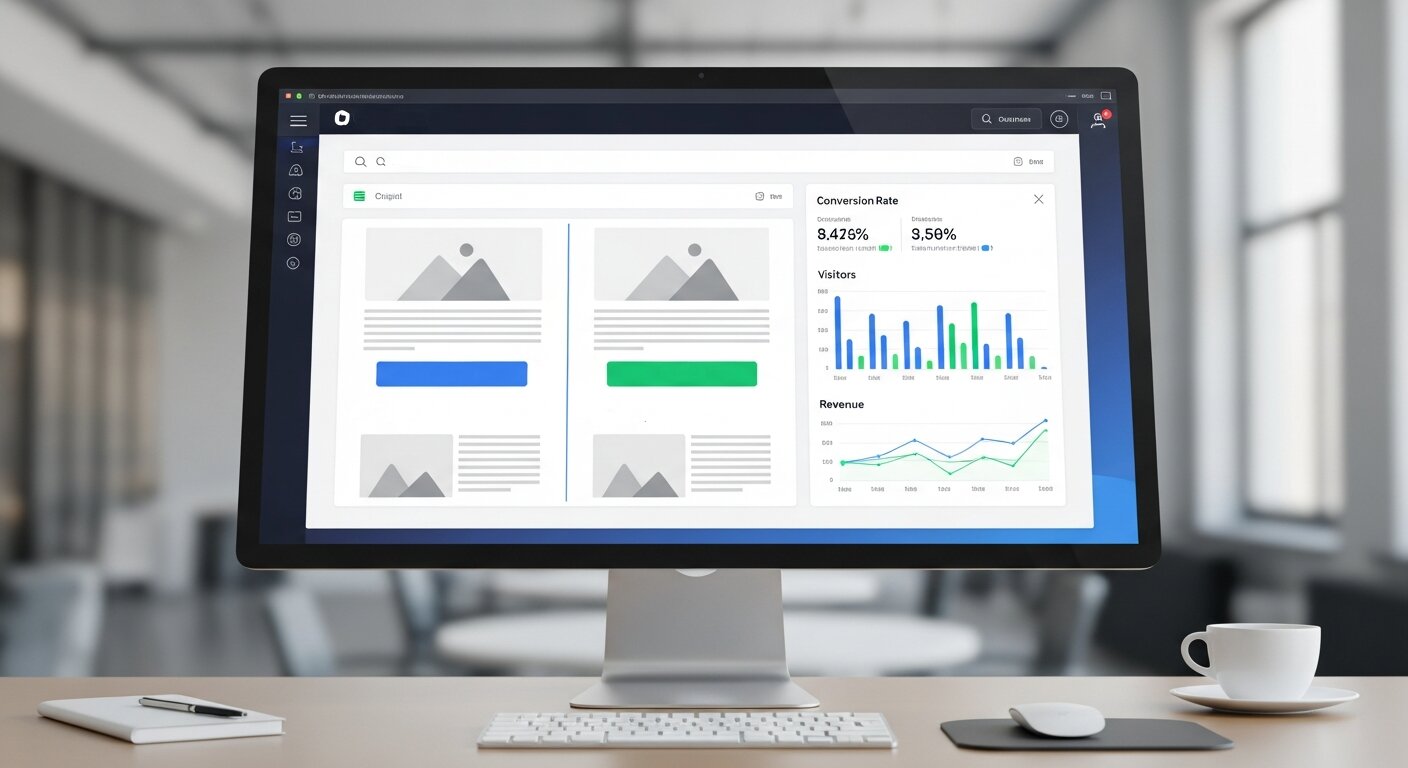
Set Real Results and Goals
It’s vitally important that we first define just what constitutes a conversion for your business before testing begins. Are you trying to increase the number of people who buy products, sign up for newsletters, download apps? Once these goals have been set up in Optimizely, we can then begin tracking performance directly related to them and so forth.
Before testing begins, define what counts as a conversion for your business. Are you focusing on product purchases, newsletter sign-ups, or app downloads? Once goals are established, you can track performance directly with Optimizely. For strategies, check out our conversion rate optimization tips.
- E-commerce businesses might focus on checkout completions as the goal.
- SaaS products businesses could concentrate on free trial sign-ups.
- Media websites may measure visitor engagement levels by such items as how many people view or download an article, etcetera.
By lining up KPIs (Key Performance Indicators) with your goals, you will see to it that your tests are really in tune with the things that can most help you grow.
Set Up A/B and Multivariate Tests
It is Optimizely’s testing power that lies at the core of everything. With features for A/B testing and multivariate testing, you will be able to distill the elements on your website which influence user behavior.
- A/B Testing lets you compare two versions of a web page or app experience. CTA buttons, for example–will a blue button do better than a red one? You’ll know soon.
- Multivariate Testing goes a step further by examining all manner of variables together so as to reveal which combinations are most effective—headlines and images, layouts and captions.
Optimize Personalization Strategies
Solutions that can be made to fit all sizes generally do not work. Whether by behavior, gender, or previous interactions; Omniture garments tailored to individual user segments mean personalized marketing is within your grasp.
For example: If you have an e-commerce site, a recommendation personalized based on browsing history like “Products You Might Also Like…” can vastly increase the probability of purchase by your customers.
Personalized experiences do more than just drive conversion rates upward. They create trust, loyalty, and a stronger link with the audience.
Leverage Advanced Behavioral Analytics
Optimizely’s analytics tools, including heatmaps and session recordings, reveal where users struggle or succeed. Monitor scroll depth, form completions, and CTA click-through rates to refine your website. For more insights on leveraging analytics in business, check out social media analytics for business success.
- For example: Monitor “scroll depth” to check if users are really engaging with your content.
- Assess completions of forms in order to see at what stage users bail out.
- Look at click-through rates to assess just how effectively your CTAs are performing.
With this knowledge at hand, you can make more intelligent, evidence-based modifications to help users achieve their goals more easily.
Iterative Development and Long-Term Strategy
One of the most important things that the practice of optimization teaches is this: it is not a one-time fix, but something constant. The data from your first experiments can show you promising directions for change, but real power lies in iterating upon those results.
Over time you will be able to:
- Spot trends that are relevant to buyer behavior
- Develop long-term strategies to raise conversions over the board
- Anticipate so as to meet with changing customer expectations.
Optimizely allows you to do all this flexibly and accurately.
Practical Guide for Improving Your Conversion Rate Using Optimizely
Here are several more pointers that can help you leverage the platform to its full potential:
- It is critical to minimize the number of fields in forms.
- Include Strong, Compelling CTAs: Whatever you want readers to do, make your call to action (CTA) crystal clear. Consider how you can best guide users toward the end result with strong verbs and compelling messaging. Make it easy for them by telling them exactly what they need to do next!
- Be Sure to Be Mobile Ready: Mobile users made up 54.4% of global web traffic in 2023, meaning you shouldn’t skimp on making your site mobile-friendly.
- Experiment With Different Headlines: The headline is often the first thing that visitors see on your site. Try different versions to see which performs best.
- Page Load Time: Google has found that even a one-second delay in page load time can decrease conversions by up to seven percent.
Tracking Success Over Time

Optimizely not only allows you to track conversions but also provides detailed reports on statistical significance, confidence intervals, and raw data, giving you a complete picture of how your website or campaigns are performing. By monitoring these metrics over time, you can identify trends, understand seasonal behavior, and pinpoint exactly where users are dropping off or completing actions successfully.
This ongoing tracking ensures that your optimization strategies remain aligned with your business objectives. You can see not just immediate results but also long-term improvements in Conversion Rate and How to Improve It, helping you make data-driven decisions rather than relying on guesswork.
Additionally, Optimizely integrates seamlessly with other tools such as Google Analytics, CRM systems, email marketing platforms, and e-commerce solutions. This integration consolidates all your data in one place, allowing for a holistic view of ROI, campaign performance, and user engagement. By connecting your analytics, testing, and reporting tools, you ensure every change you make is measurable and contributes to meaningful growth.
Optimizely provides detailed reports on statistical significance, confidence intervals, and raw data, allowing you to track trends and identify areas for improvement. Integrating with tools like Google Analytics and CRM platforms ensures a holistic view of ROI and campaign performance. For a broader overview, see our conversion rate optimization in digital marketing guide.
The Next Level With Optimizely
Optimizing your conversion rate is more than just tweaking a few buttons—it’s about creating a systematic approach to improvement that continuously enhances user experience and drives measurable business results. Optimizely’s suite of tools empowers you to identify bottlenecks, test multiple solutions, and implement strategies backed by reliable data, so your efforts to improve Conversion Rate and How to Improve It are both effective and sustainable.
For example, you can use heatmaps and session recordings to uncover where visitors hesitate, drop off, or abandon carts. Then, through A/B or multivariate testing, you can experiment with different layouts, CTAs, or personalized content to see what works best. Over time, these small, iterative improvements accumulate into significant gains in conversions, revenue, and customer satisfaction.
By consistently applying this data-driven methodology, businesses gain a competitive edge—enhancing user experiences, increasing trust and loyalty, and ultimately unlocking the full potential of their online presence.
Are you ready to take your online business to the next level? Start by signing up for an Optimizely free trial today and witness firsthand how data-driven optimization can transform your Conversion Rate and How to Improve It. Don’t leave growth to chance—let insights guide every decision and watch your website turn visitors into engaged, paying customers.
Optimizing conversion rate is a systematic process that enhances user experience and drives measurable business results. Using heatmaps, session recordings, and testing strategies, small iterative improvements can lead to significant gains in conversions, revenue, and customer satisfaction. For more advanced insights, check out AI and machine learning in CRO.
Frequently Asked Questions (FAQs)
What is conversion rate and why does it matter for my business?
Conversion rate is the percentage of visitors who complete a desired action on your website. Understanding your conversion rate helps you see how effectively your website converts visitors into paying customers, leads, or engaged users—essential for knowing where to focus improvements.
What is the best way to improve conversion rate and how to improve it effectively?
The best way is through a combination of A/B testing, multivariate testing, personalization, and analyzing user behavior. Using platforms like Optimizely can help you implement changes backed by data, making your efforts to improve conversion rate more accurate and effective.
How often should I analyze conversion rate and how to improve it?
Conversion rate optimization is an ongoing process. Regular testing, reviewing analytics, and iterating on your website content and design ensures that your conversion rate improves consistently over time.
Can personalization really impact conversion rate and how to improve it?
Yes. Personalizing user experiences, such as showing recommendations or custom content based on behavior, increases engagement and trust. This approach is one of the most effective ways to improve conversion rate and drive long-term results.
What common mistakes lower conversion rate and how to improve it?
Overly long forms, confusing navigation, weak CTAs, and generic content can hurt conversion rates. Identifying these pain points and testing solutions with Optimizely helps improve conversion rate and ensures your website works better for visitors.
How does website speed affect conversion rate and how to improve it?
Slow-loading pages frustrate users and reduce conversions. Optimizing images, improving server response time, and enabling caching are practical ways to improve conversion rate by giving users a faster, smoother experience.
How do A/B tests help with conversion rate and how to improve it?
A/B tests compare two versions of a page, form, or CTA to see which performs better. Using the insights gained, you can make data-driven changes that gradually improve conversion rate over time.
Is there an average conversion rate, and how to improve it if I’m below it?
Conversion rates vary by industry—from as low as 2% in some sectors to 20% in others. Knowing your baseline helps identify opportunities for growth. Implementing targeted optimizations is the most reliable way to improve conversion rate.
How can content and messaging affect conversion rate and how to improve it?
Clear, compelling headlines and messaging guide visitors toward desired actions. Optimizing your content with persuasive copy, visuals, and CTAs is a key strategy to improve conversion rate and drive higher engagement.
Can analytics help track conversion rate and how to improve it?
Absolutely. Advanced analytics provide insights into where users drop off, which pages convert best, and how visitors behave. Using this data to make iterative improvements is central to improving conversion rate successfully.