
Conversion Rate Optimization (CRO) improves your website’s ability to turn visitors into customers, leads, or subscribers. By analyzing behavior, testing strategies, and optimizing key touchpoints, CRO drives higher conversions, better ROI, and measurable business growth.
Many businesses attract visitors to their websites, yet struggle to convert them into customers, leads, or subscribers. This is where Conversion Rate Optimization (CRO) becomes essential.
CRO is a systematic approach that leverages data-driven insights, user behavior analysis, and strategic adjustments to increase the percentage of visitors who complete desired actions—whether that’s making a purchase, signing up for a newsletter, or downloading resources. By optimizing these touchpoints, even small improvements can generate significant growth and higher returns on your marketing efforts.
This guide outlines the fundamental steps to implement Conversion Rate Optimization effectively. By following these strategies, you will gain actionable knowledge to enhance your website’s performance, improve user engagement, and achieve measurable results.
What is CRO (Conversion Rate Optimization)?
Before diving into the steps of improving your website, it’s essential to understand what Conversion Rate Optimization (CRO) really is.
Conversion Rate Optimization is the systematic process of enhancing your website, landing pages, or digital funnels to increase the percentage of visitors who complete a desired action—known as a “conversion.”
A conversion can be any action that moves your business forward, such as:
- Making a purchase or completing a transaction
- Filling out a contact or lead generation form
- Subscribing to a newsletter or membership
- Downloading resources like ebooks or guides
- Spending more time engaging with key content
Why small changes matter:
Even tiny improvements in your conversion rate can translate into substantial business growth. For example:
- If 100 people visit your site and 5 sign up for your newsletter, your conversion rate is 5%.
- By applying CRO strategies, you might increase that rate by just 0.1%—resulting in more subscribers without additional traffic.
Over time, incremental changes—optimizing CTAs, improving page layout, enhancing messaging, or reducing friction—can lead to significant increases in revenue and ROI, making every visitor more valuable.
In short: CRO isn’t about attracting more traffic—it’s about making the traffic you already have work harder by nudging visitors toward the actions that matter most for your business. Even small improvements compound into measurable results over time.
Why is Conversion Rate Optimization (CRO) Important?
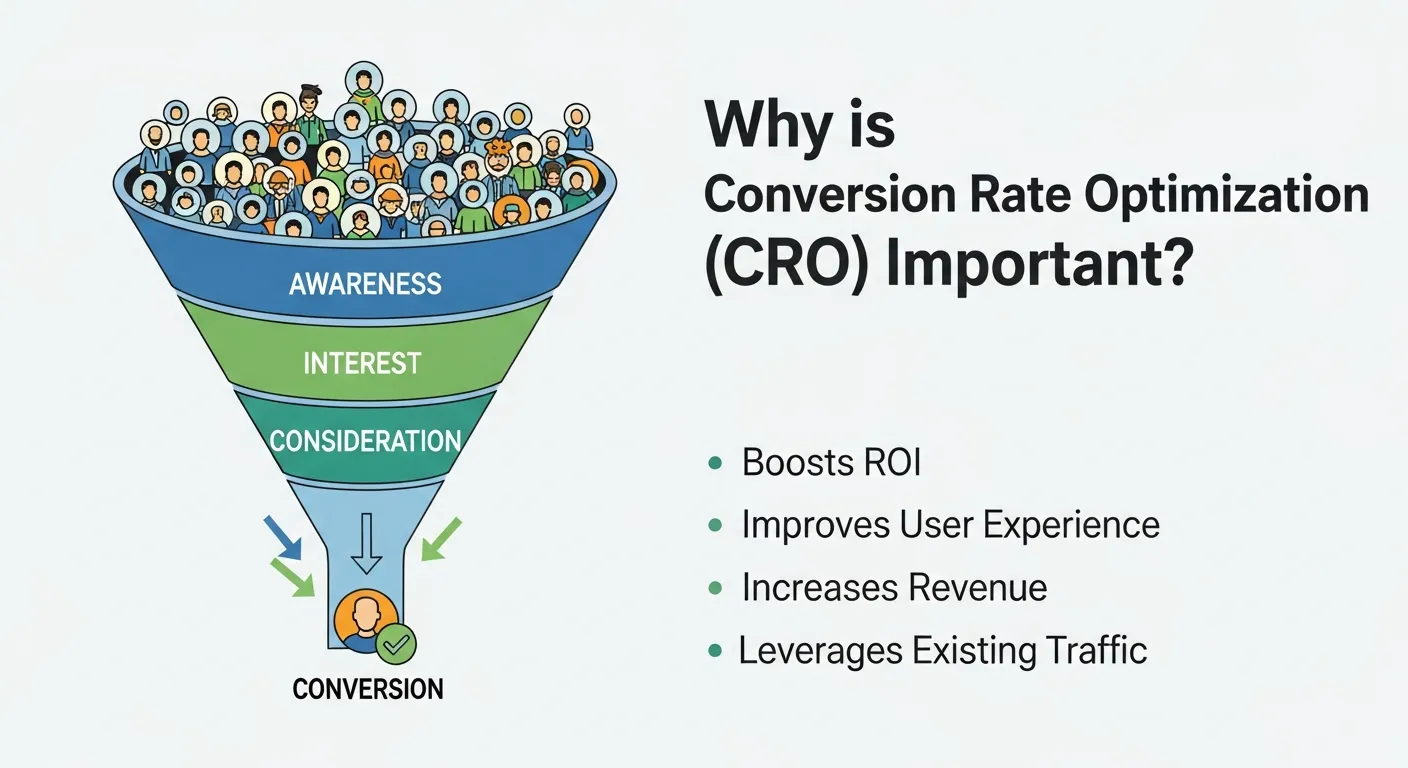
Conversion Rate Optimization (CRO) isn’t just a buzzword—it’s a fundamental strategy that turns your existing website traffic into measurable business results. Even a small improvement in your conversion rate can have a massive impact on revenue, marketing efficiency, and overall growth. Here’s why CRO matters:
1. Increases Marketing Return on Investment (ROI)
CRO allows you to get more value from your existing traffic. Instead of spending more money on ads to attract visitors, optimizing your site ensures a higher percentage of those visitors complete desired actions, such as:
- Making a purchase
- Subscribing to a newsletter
- Downloading a resource
- Filling out a lead form
For example, if your website gets 10,000 visitors per month and 500 convert, your conversion rate is 5%. By applying CRO strategies—even increasing conversions by just 1%—you now gain 600 conversions without spending more on marketing. Each dollar spent becomes more effective, boosting your ROI significantly.
2. Improves User Experience (UX)
CRO isn’t just about numbers; it’s about making your website more intuitive and engaging. A website that’s easy to navigate, loads quickly, and clearly communicates value encourages users to act. Benefits of CRO-driven UX improvements include:
- Higher customer satisfaction and repeat visits
- Reduced bounce rates
- Increased trust and credibility
For instance, a simple change like adding a clear, visible call-to-action or reducing form fields can make users feel confident and motivated to complete an action.
3. Supports Sustainable Growth
CRO turns small wins into long-term advantages. As your conversion rate improves:
- Revenue grows without proportional increases in traffic
- Marketing campaigns become more cost-effective
- You can reinvest savings into scaling your business further
Even tiny improvements, such as a 0.5% increase in conversion rate, compound over time into significant business growth.
4. Provides Data-Driven Insights
Through CRO, you gain actionable insights into your visitors’ behavior. Understanding what motivates or deters them allows you to:
- Make informed design and content decisions
- Predict how changes will impact conversions
- Continuously refine your website for better results
Conversion Rate Optimization ensures your website evolves based on real user data, not guesswork.
CRO turns small gaps in conversion into large opportunities. By increasing conversions, improving UX, and leveraging data-driven decisions, you maximize revenue, strengthen your brand, and get more out of every visitor.
Six Steps to Starting Conversion Rate Optimization
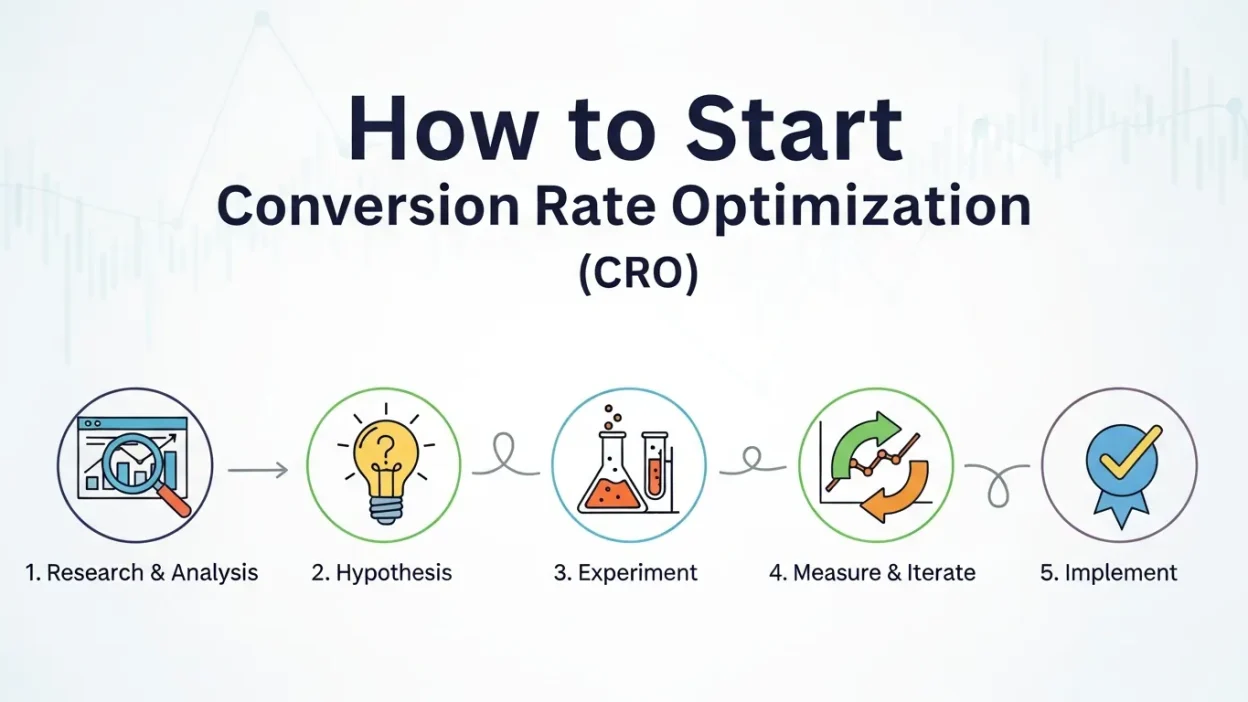
1. Define Your Goals and Metrics
Get started with your CRO plan by defining a clear objective. That means setting both your main conversion targets (macro-conversions) and secondary ones (micro-conversions).
Macro-conversions:
This is what you’re ultimately aiming for—things like sales or subscriptions. The main goal of all your work on CRO should be to move a customer toward a pay moment.
Micro-conversions:
These elements are the steps leading up to that main goal, such as adding products into a shopping cart or signing up for a trial.
Key metrics to monitor:
- Conversion rate
- Bounce rate
- Exit rate
Having clearly defined outcomes focuses your efforts and helps you make sure they are on the right track to achieve their goals.
2. Know Your Audience
To start your journey down CRO’s road, you need to know your visitors intimately. So ask yourself:
- Who are these people who come to the website?
- What do they want from it?
- What’s preventing them from doing what we hope they would?
How to uncover specific customer behavior:
- Use Google Analytics — search through all the data and try different ways of slicing it. Look not just at whole pages, but individual sections within a given page for patterns.
- Heatmap Analysis — Crazy Egg and Hotjar are tools that let you see where visitors are clicking or scrolling.
- Survey Your Visitors — Pop up surveys or an email asking people why they left what they were trying to do can reveal some points of friction always.
3. Do a Website Audit
Think of an audit as a health check for your website’s performance. Aspects to be reviewed include:
- Page Load Times
It’s very annoying to wait half a minute for your page to come up. Aim for a load time of 2 seconds or less. - Design and Navigation
Is your site easy to use? Visitors who can’t cope will soon disappear. - Mobile Optimization
About 60% of all internet traffic is mobile. Your site should also work on any size screen.
Use tools like Google’s PageSpeed Insights or SEMrush’s Site Audit Tool to identify inefficiencies.
4. Form a Hypothesis
CRO isn’t about making random changes and crossing your fingers. It’s about identifying specific problems and testing solutions based on data.
Make a hypothesis.
Take advantage of this opportunity to use the data you just went through.
Example:
Problem: Visitors aren’t completing the signup form.
Hypothesis: Adding a progress bar to the form will make the process feel quicker, increasing submissions.
Focus on one change at a time to measure its real impact effectively.
5. Run A/B Testing
One of the most effective CRO tools is A/B testing (also called split testing). It involves creating two versions of a webpage or element and seeing which performs better.
Example:
- Version A: Keep the original “Sign Up” CTA button on a white background.
- Version B: Test a red “Sign Up Now” button with bold text.
To conduct a successful test:
- Use tools like Google Optimize, Optimize, or VWO.
- Run the test for a set period.
- Ensure a statistically significant sample size.
- Track key metrics like clicks, conversions, and bounce rates.
6. Analyze Results and Iterate
Once testing is complete, analyze the results to find out if your hypothesis was correct.
Whether the results are desirable or otherwise, every test is useful in terms of education. If the change works, be sure to apply similar optimizations across other areas of your site. If the change doesn’t work, work out why and try again.
CRO is a process that’s always ongoing. Continuous testing and iteration will lead to long-term success.
Personalize the User Experience

Visitors today expect a website that understands them. Personalization goes beyond a simple greeting—it tailors content, offers, and recommendations to the unique needs of each visitor. By doing so, CRO helps move visitors closer to conversion naturally.
Why personalization works:
- Creates relevance: Visitors are more likely to engage with content that speaks directly to their interests.
- Reduces friction: Guides users toward what they want without confusion or extra clicks.
- Builds trust: Showing that you “get” your audience establishes credibility and rapport.
Key ways to personalize your site:
- Dynamic Content: Swap banners, product recommendations, or blog posts depending on visitor behavior. For example, first-time visitors might see “Start Free Trial,” while returning users see “Continue Where You Left Off.”
- Product Recommendations: Use browsing or purchase history to suggest complementary items, boosting average order value.
- Targeted CTAs: Customize buttons based on user segments. New visitors may see “Get Started Today,” while loyal customers see “Exclusive Upgrade Offer.”
- Behavior-triggered Popups: Popups that appear based on scrolling, inactivity, or exit intent can guide hesitant visitors toward a goal without being intrusive.
- Localized Experiences: Adjust language, currency, or promotions based on visitor location.
Tools for personalization:
| Tool | Purpose | Benefit |
|---|---|---|
| Chatbots | Engage visitors in real-time and guide them to purchase | Can boost sales with instant recommendations E-commerce Chatbots |
| Email Automation | Sends personalized follow-ups based on user behavior | Higher click-through and engagement rates |
| CMS Plugins | Adjust content dynamically based on user segments | Keeps visitors engaged and reduces bounce rates |
Track which personalized experiences lead to conversions using analytics. Even small tweaks—like recommending the right product or adjusting CTA copy—can increase conversions dramatically.
Leverage Reputation and Social Proof
Trust is the currency of the internet. Visitors often hesitate before purchasing or signing up, especially if your brand is new to them. CRO leverages social proof to reduce hesitation and guide users toward action.
Why social proof is critical:
- Provides validation: Seeing others take an action reduces perceived risk.
- Builds confidence: Testimonials and reviews reassure visitors that your product or service is reliable.
- Enhances credibility: Awards, badges, and certifications make your business appear professional and trustworthy.
Ways to incorporate social proof:
- Show Reviews & Testimonials: Place them strategically on product pages, landing pages, and checkout flows. Include star ratings, written feedback, or video testimonials.
- Case Studies & Success Stories: Demonstrate tangible results your product or service has achieved. Highlight specific metrics, improvements, or client satisfaction.
- Trust Badges & Certifications: Security, quality, or industry certifications signal reliability.
- User-Generated Content (UGC): Customer photos, videos, or posts create authenticity. Highlight real experiences to increase engagement.
- Influencer Endorsements: Partnering with credible figures in your industry can create instant trust.
Metrics to track social proof effectiveness:
| Metric | How to Measure | Expected Outcome |
|---|---|---|
| Review Engagement | Clicks on testimonials or expanded reviews | Increased confidence and higher conversion |
| Referral Traffic | From social mentions, forums, or review sites | More high-intent visitors |
| Bounce Rate | Compare pages with and without social proof | Lower bounce rates, longer sessions |
Investing in online reputation ensures that first impressions convert into meaningful actions. Every testimonial, badge, or case study is a step toward building trust.
Reputation Management Guide
Encourage satisfied customers to leave reviews, and display them prominently. A single positive review can sometimes outweigh multiple generic messages.
Integrate Paid Campaigns with CRO Insights
Paid campaigns bring traffic—but CRO ensures that traffic converts. By combining CRO insights with your advertising strategy, you can optimize ad spend, improve ROI, and create a cycle of continuous improvement.
Why this integration matters:
- High traffic alone doesn’t guarantee sales—conversion-focused strategies make your traffic more valuable.
- Landing pages optimized through CRO convert more visitors from the same ads.
- Ad messaging informed by data increases relevancy and decreases wasted spend.
Steps to integrate CRO with paid campaigns:
- Track Visitor Behavior: Identify which campaigns drive visitors who actually convert. Look beyond clicks—analyze on-site engagement and final conversions.
- Optimize Landing Pages: Replicate elements from pages with the highest conversion rates, including layout, CTA placement, and messaging.
- Adjust Ad Messaging: Test variations of headlines, offers, and visuals to see what motivates conversions—not just clicks.
- Retarget High-Intent Visitors: Bring back visitors who showed interest but didn’t convert, using CRO insights to tailor messaging.
- Segment Audiences by Behavior: Send different ads to visitors who abandoned carts, browsed specific categories, or spent more time on key pages.
Example CPC Campaign Performance :
| Campaign Type | Clicks | Conversions | Conversion Rate | Notes |
|---|---|---|---|---|
| Google CPC Ads | 10,000 | 450 | 4.5% | High-intent traffic |
| Facebook Ads | 15,000 | 300 | 2% | Needs optimized landing pages |
| Retargeting | 5,000 | 350 | 7% | High ROI from returning visitors CPC Ads Tips |
Use conversion data from CRO tests to refine ad targeting. Ads that bring traffic to high-converting pages will dramatically increase ROI compared to generic traffic.
By combining CRO and paid campaigns, your site will not only attract visitors but convert them efficiently, turning ad spend into measurable growth.
Pitfalls to Avoid When Doing Common Conversion Rate Optimization
Starting your journey with Conversion Rate Optimization (CRO) can feel overwhelming, but avoiding common pitfalls will help you see measurable results faster. Here are the critical mistakes new CRO practitioners often make—and how to steer clear of them:
1. Neglecting Mobile Optimization
With over 60% of website traffic coming from mobile devices, ignoring mobile users is one of the biggest conversion killers. A slow-loading or poorly designed mobile site frustrates users, increases bounce rates, and directly impacts your conversion rate.
Tips to avoid this pitfall:
- Ensure responsive design across all devices and screen sizes.
- Simplify navigation and reduce clutter for mobile visitors.
- Optimize images, scripts, and page load speed specifically for mobile.
- Test forms on mobile to ensure ease of completion.
2. Relying on Gut Feelings Instead of Data
Many businesses make changes based on assumptions or personal opinions rather than actual visitor behavior. Conversion Rate Optimization is data-driven, and ignoring analytics can lead to wasted time and poor results.
Tips to stay data-driven:
- Use tools like Google Analytics, Hotjar, or Crazy Egg to monitor visitor behavior.
- Focus on measurable metrics like conversion rate, bounce rate, and exit rate.
- Document hypotheses and test them instead of guessing.
3. Testing Too Many Variables at Once
While it’s tempting to make multiple changes at once, this approach makes it impossible to know which adjustment actually caused an increase or decrease in conversions.
Best practice:
- Test one variable at a time, such as a CTA button color or headline text.
- Run multivariate tests only after understanding individual element performance.
- Keep detailed records of every test for future reference.
4. Stopping Tests Too Soon
Patience is key in Conversion Rate Optimization. Ending tests before a statistically significant sample is collected can lead to misleading results and missed opportunities.
Tips for effective testing:
- Define sample sizes before running tests.
- Set clear test duration based on traffic and expected conversions.
- Avoid making changes mid-test unless critical errors occur.
5. Ignoring User Experience (UX)
Even the best CTA or discount won’t convert if visitors struggle to navigate your site. CRO is deeply tied to user experience, and poor UX can kill conversions.
Focus areas for UX:
- Clear, concise headlines and messaging.
- Intuitive navigation menus.
- Fast-loading pages and minimal popups.
- Easy-to-complete forms with minimal friction.
Turbocharge Your Site with Conversion Rate Optimization
Embarking on Conversion Rate Optimization may feel like a steep learning curve, but the payoff is worth it. By systematically analyzing visitor behavior, testing hypotheses, and iterating based on data, you can transform your website into a high-converting engine.
Step 1: Know Your Audience
Understanding your visitors’ needs, motivations, and pain points is foundational. CRO is most effective when you can predict and guide user behavior.
Actionable tips:
- Segment users by demographics, traffic source, or behavior.
- Use heatmaps to visualize clicks, scrolls, and attention hotspots.
- Conduct surveys or polls to gather qualitative insights.
Step 2: Make Data-Backed Hypotheses
Every change should have a reason behind it. Formulate hypotheses based on visitor data, not assumptions. For example:
- Problem: Users abandon the checkout page at the payment step.
- Hypothesis: Simplifying the payment form and adding trust badges will reduce drop-offs.
Step 3: Implement Continuous Improvement
Conversion Rate Optimization is an ongoing process. One successful test leads to the next opportunity. By fostering a culture of experimentation, your website can continually improve over time.
Tips for continuous optimization:
- Run A/B tests regularly on headlines, CTAs, layouts, and forms.
- Track results and apply successful strategies across similar pages.
- Monitor trends and seasonal behaviors to adjust strategies proactively.
Step 4: Focus on Long-Term Growth
CRO doesn’t just improve single metrics—it drives sustainable business growth. Higher conversion rates lead to increased revenue, better ROI, and enhanced user satisfaction. Over time, small incremental improvements can result in massive gains.
Don’t wait for perfect conditions. Start testing today. Even small optimizations can dramatically improve conversions, and the more you iterate, the more your site will become a conversion powerhouse. By combining smart analytics, thoughtful hypotheses, and continuous iteration, your website can move from the slow lane to the fast track of revenue growth.
FAQ – Conversion Rate Optimization (CRO)
1. What is Conversion Rate Optimization (CRO) and why is it important?
CRO is the process of improving your website or landing pages to get a higher percentage of visitors to complete desired actions, such as making a purchase, signing up for a newsletter, or downloading a resource. Its importance lies in maximizing the value of your existing traffic—rather than just attracting more visitors—and improving ROI without additional marketing spend. By continuously testing, analyzing, and optimizing, businesses can make even small changes that generate significant revenue growth.
2. How do I calculate my website’s conversion rate?
The basic formula for conversion rate is:
Conversion Rate (%)=Number of ConversionsTotal Visitors×100\text{Conversion Rate (\%)} = \frac{\text{Number of Conversions}}{\text{Total Visitors}} \times 100
For example, if 1000 visitors land on your site and 50 complete a purchase, your conversion rate is 5%. Monitoring this metric regularly helps track the effectiveness of your CRO strategies over time.
3. What are micro-conversions, and why are they important?
Micro-conversions are smaller, incremental actions visitors take that lead toward a major goal (macro-conversion), such as signing up for a newsletter, adding an item to a cart, or viewing a key product page. Tracking micro-conversions helps identify where users drop off and what motivates them to proceed, allowing you to boost engagement and guide visitors toward final conversions Boost Engagement with Micro-Conversions.
4. How do I create high-converting landing pages?
High-converting landing pages focus on clarity, simplicity, and relevance. Key strategies include:
- Clear headline and subheadline
- Compelling call-to-action (CTA)
- Minimal distractions (remove unnecessary navigation)
- Trust signals like testimonials or badges
- Mobile optimization
CRO best practices for landing pages can be applied systematically to improve conversions significantly. How to Create Landing Pages.
5. What role does A/B testing play in CRO?
A/B testing allows you to compare two versions of a page, form, or CTA to see which performs better. This method removes guesswork by relying on actual visitor behavior to guide optimizations. Common test areas include:
- Headlines and copy
- CTA text, size, and color
- Form layout or number of fields
- Product images or videos
A/B testing is most effective when testing one variable at a time and analyzing results for statistical significance.
6. How do I know which elements of my website to optimize first?
Start by identifying pages with the highest traffic or lowest conversion rates, as improvements there will have the greatest impact. Next, use analytics tools to track user behavior, heatmaps, and click patterns to uncover friction points. Focus on elements like CTAs, form fields, navigation, or checkout flow. Prioritize optimizations that are likely to produce measurable results quickly, then iterate.
7. Can CRO be applied to paid advertising campaigns?
Absolutely. CRO and paid campaigns complement each other. By analyzing conversion behavior from ads, you can refine targeting, adjust landing pages, and improve messaging to maximize ROI. Retargeting campaigns benefit particularly well, as CRO insights help focus on visitors who showed intent but didn’t convert. Integrating CRO into marketing ensures that every advertising dollar works harder Guide to CRO Marketing Strategies.
8. How does website speed affect conversions?
Website speed is critical. Even a 1-second delay can reduce conversions by 7–10%. Slow load times frustrate users, increase bounce rates, and hurt overall engagement. Use tools like Google PageSpeed Insights or GTmetrix to measure load times, and optimize images, scripts, and server response to ensure fast, smooth performance.
9. What is the difference between macro-conversions and micro-conversions?
- Macro-conversions: The primary goals of your site, such as completing a purchase, signing up for a paid subscription, or requesting a demo.
- Micro-conversions: Smaller steps that lead to macro-conversions, such as newsletter signups, video views, or clicks on CTA buttons.
Tracking both helps identify bottlenecks and incrementally increase your overall conversion rate.
10. How do I create a CRO strategy for my business?
A CRO strategy involves combining data analysis, testing, and continuous improvement. Key steps include:
- Define your business goals and target conversions
- Analyze visitor behavior using analytics and heatmaps
- Identify friction points and opportunities for improvement
- Form hypotheses and run A/B or multivariate tests
- Measure results, iterate, and expand successful optimizations
Following these steps consistently helps businesses grow conversions, revenue, and user engagement over time. More about Guide to CRO Marketing Strategies.