
Conversion Rate Optimization (CRO) is often hailed as the holy grail of digital marketing strategies. It is a data-driven process designed to increase the percentage of visitors who complete a desired action—whether that’s making purchases, signing up for newsletters, or filling out contact forms. For years, marketers have depended on Conversion Rate Optimization to squeeze every last drop of value from their existing traffic.
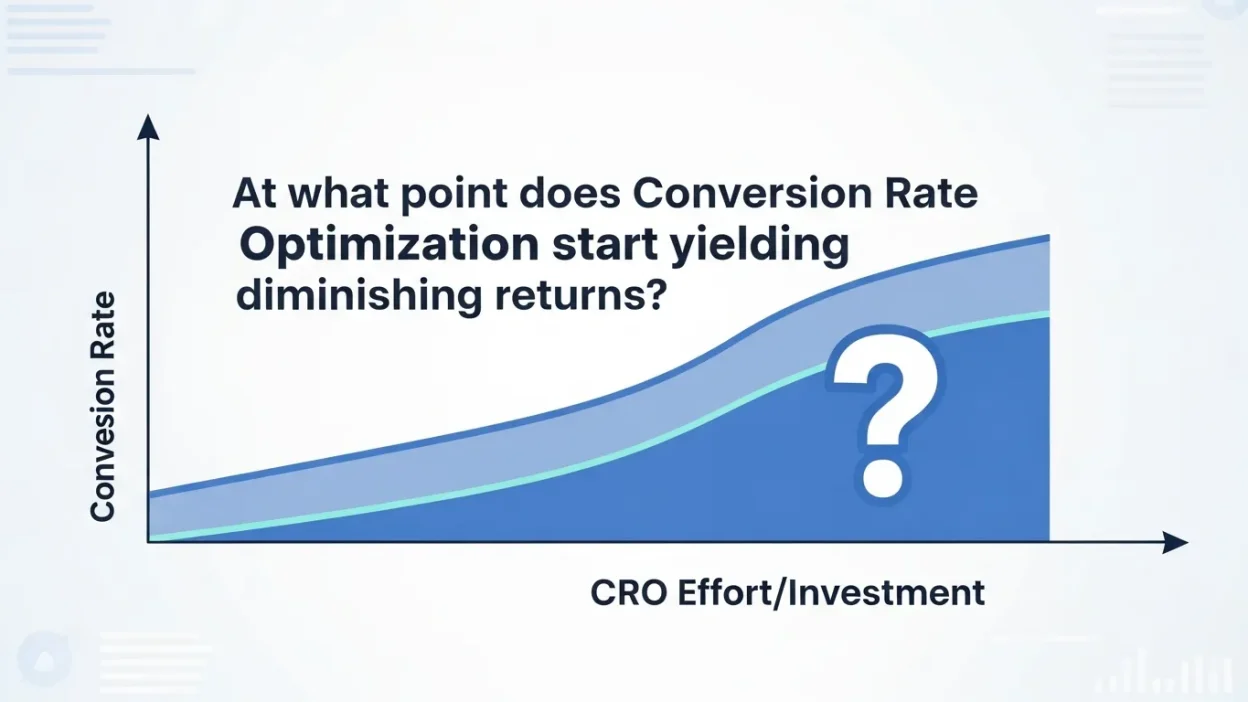
But despite the undeniable might of Conversion Rate Optimization, it is only effective to a certain extent. Like any resource-intensive activity, there comes a moment when the effort required to produce a marginal gain outweighs the benefit of that gain. After every reasonable effort has been exerted, there is a point where the returns start to diminish. This is the phenomenon of “diminishing returns” in CRO.
How do you determine when further Conversion Rate Optimization efforts may not be worth the resource expenditure? This post will look at the unmistakable signs of diminishing returns, explore why this happens, and offer concrete ways to adapt your strategy for sustainable, long-term growth.
What’s Conversion Rate Optimization, and When Should It Be Undertaken?
Before we launch a full-scale attack on the concept of diminishing returns, let’s stop a moment and define Conversion Rate Optimization. Fundamentally, CRO means systematically finding obstacles in your sales or sign-up funnel and removing them from your site to smooth the path for users.
The Core Components of Effective CRO
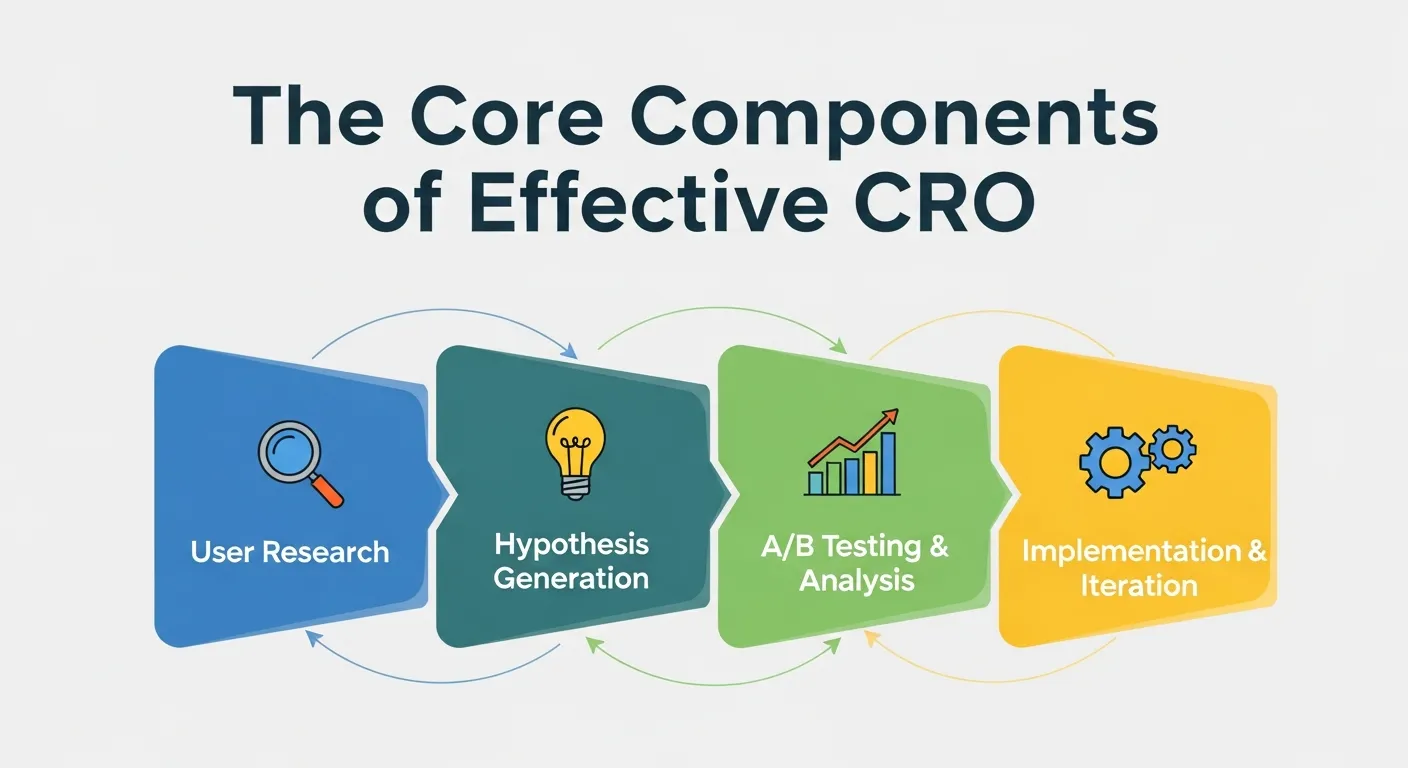
Those obstacles can be varied and often hide in plain sight. Addressing them usually involves:
- Speeding up pages: Enhancing load times to improve the overall user experience and reduce bounce rates.
- Clarifying Calls-to-Action (CTAs): Making buttons more persuasive, visible, and action-oriented.
- A/B Testing Elements: Headlines, images, and layouts are tested rigorously to see what resonates most successfully with the audience.
- Simplifying Checkouts: reducing friction with the minimum of hiccups possible so shopping carts aren’t abandoned at the last second.
When it’s done properly, Conversion Rate Optimization can turn even minor shifts in design into major results. For example, a single change to your headline could lead to a 10% or 20% increase in sign-ups. However, this potential doesn’t last forever. The “low-hanging fruit”—the easy fixes that yield massive results—are eventually all picked.
Understanding Diminishing Returns in CRO
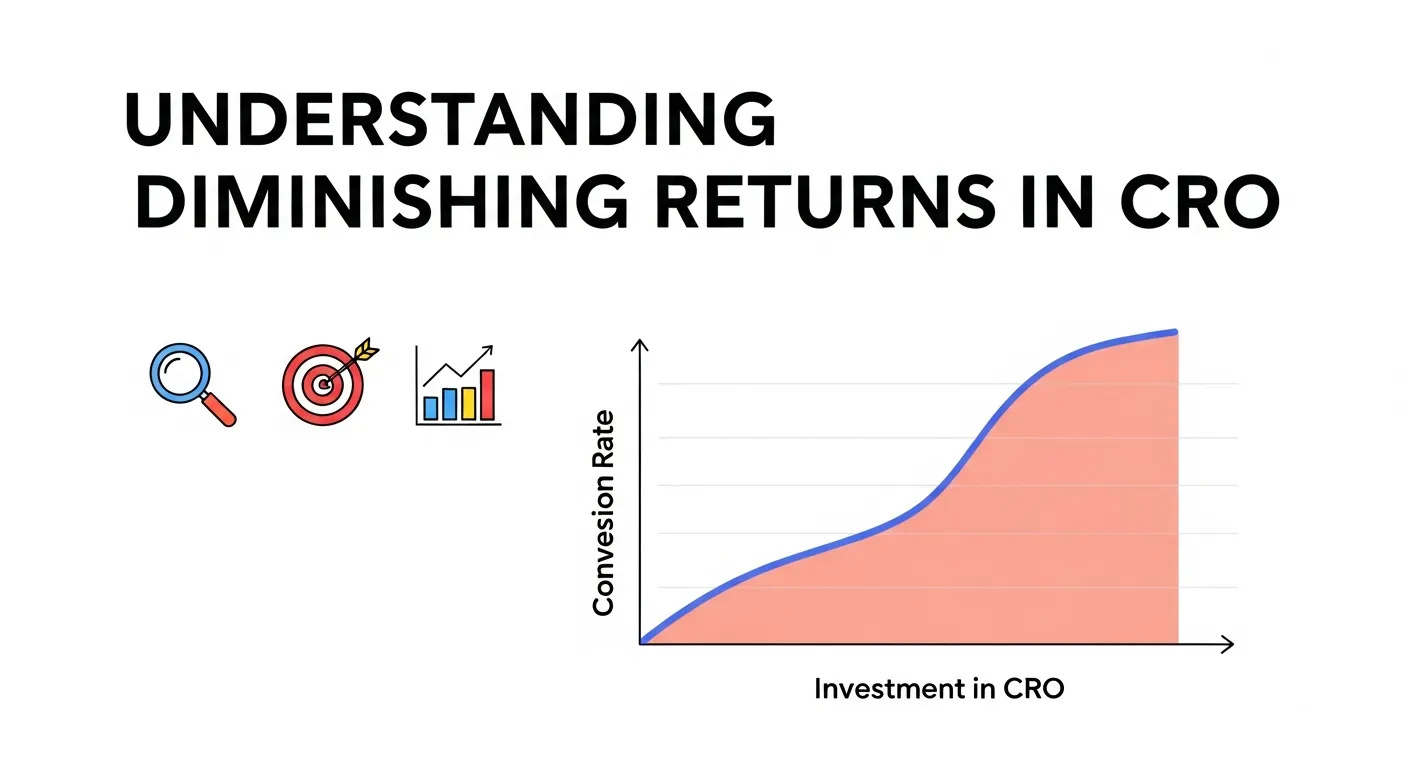
To illustrate the concept of diminishing returns in Conversion Rate Optimization, it is helpful to take an economic viewpoint as an example. Think of a farmer who is planting crops in a finite patch of land. The addition of fertilizer might dramatically increase yields at the outset. However, very soon after that initial boost, adding more fertilizer will not bring substantial growth. In fact, too much might even damage the soil.
The same principles apply to Conversion Rate Optimization.
In the early stages, you’ll find big wins by addressing the obvious inefficiencies on your website. Perhaps your mobile site was broken, or your checkout form had ten unnecessary fields. Fixing these results in huge jumps in conversion. However, as your site becomes more streamlined in areas such as URL structure, navigation, and copy, each small tweak will yield smaller, less obvious improvements.
Eventually, you might feel that you’re putting more effort into your Conversion Rate Optimization work than it’s worth—and only getting a minuscule return for all those hours spent on site optimization. This is the saturation point where the cost of optimization begins to equal or exceed the value it generates.
Signs You’re Getting Diminishing Returns With CRO
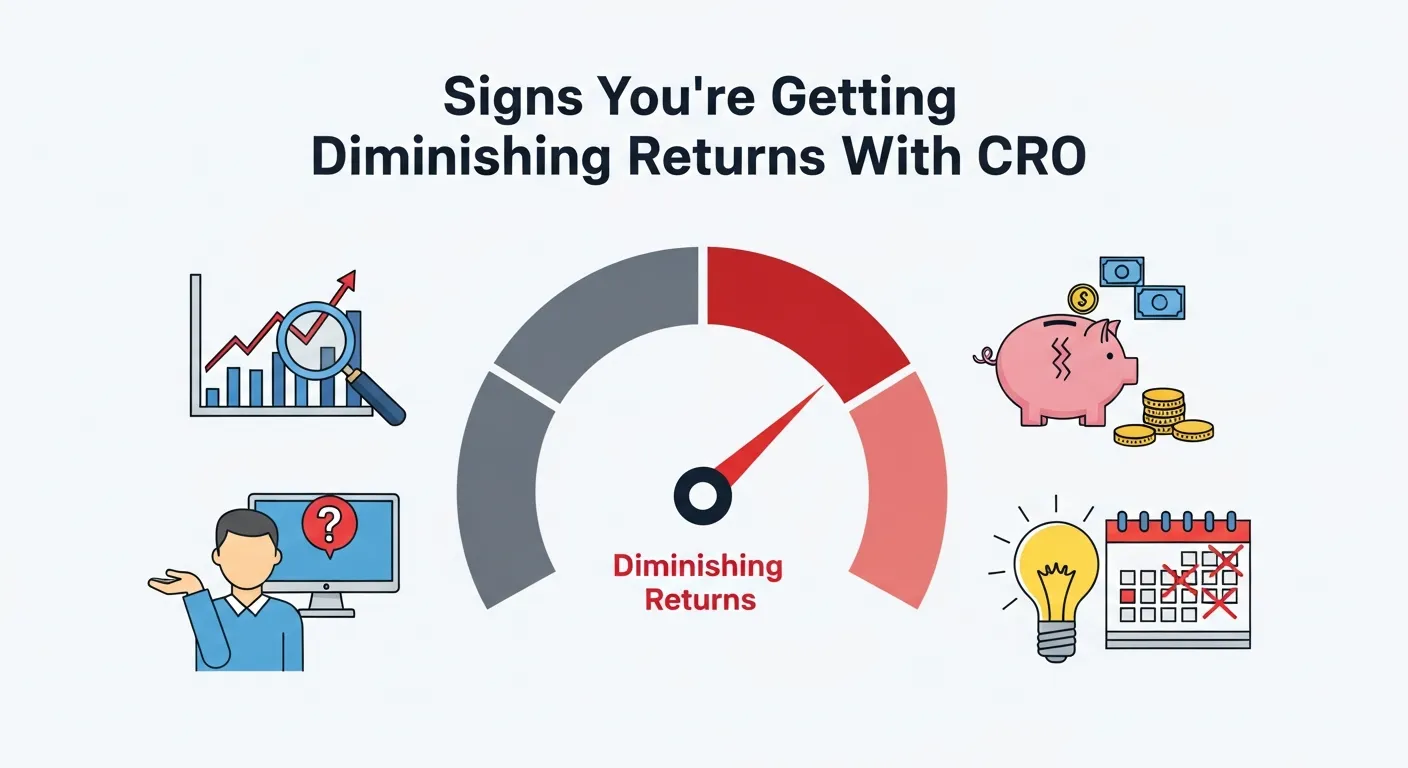
Recognizing when you have hit this wall is crucial for budget management. Here are the red flags indicating your Conversion Rate Optimization strategy needs a pivot.
Your Improvements Are No Longer Significant
In the early stages of Conversion Rate Optimization, you might see conversion rates jump from 3% to 5% or even 10% after making relatively simple changes. These are the “glory days” of optimization. But if your improvements are now less than 0.5% from a month-long A/B test, then it’s time to restrategize what you’re doing altogether.
While small wins are still valuable—compounding 1% gains over a year can lead to growth—if the overall impact is consistently low despite high effort, it may mean that there are no more big issues to resolve. We are heading into diminishing returns where the “juice isn’t worth the squeeze.”
Costs Are Rising Faster Than Returns
Conversion Rate Optimization requires resources. It demands budget for tools such as heatmaps, session recording, and A/B testing software, as well as the salaries for experts who guide you through the process.
If your team is dumping more money, time, or energy into producing change than that change is worth for them, then it ceases to be cost-effective. Consider, for instance, this scenario: if you spend $5,000 on a Conversion Rate Optimization initiative but your monthly added income from that change is only $300, that’s a clear case of diminishing returns. You would need over a year just to break even, by which time the web landscape may have changed again.
Your Conversion Rate Is Near Industry Benchmarks
It is vital to be realistic. Each industry has an ideal conversion rate ceiling. For online shops (e-commerce), 2% to 3% is often the average, with top performers hitting 5%. If you are already outpacing this range and sitting at a stable 6% or 7%, it is incredibly hard to go any higher without making fundamental changes to your product or pricing, rather than just tweaking the website.
Continuing to aggressively pursue Conversion Rate Optimization when you are already a market leader is often an exercise in futility.
Over-optimization That Hurts Customer Experience
Sometimes in the pursuit of higher numbers, a business might lose sight of the bigger picture. By aiming for greater values of certain figures such as Click-Through Rate (CTR) and conversion rate, companies may end up with materially cluttered pages.
We have all seen sites full of popups, countdown timers, and aggressive banners that pitch products relentlessly. While these might squeeze out a few extra conversions in the short term, they degrade trust. If your website feels less natural and more like a constant series of experiments in Conversion Rate Optimization, you run the risk of losing customers and causing yourself long-term brand damage.
Tests Are Frequently Yielding “No Significant Difference.”
If you are A/B testing elements and steadily always arriving at “no significant difference” as your results, this is a major indicator. It could mean that you’ve hit a wall in the way of optimization opportunities.
For example, this is especially common when you’ve already run tests on and optimized the most crucial elements of your funnel to avoid users having any possible way of getting lost. Testing green buttons against red buttons when the layout is already perfect is unlikely to move the needle.
Why Do CRO Efforts Suffer from Diminishing Returns?
There are a variety of reasons why Conversion Rate Optimization eventually slows down. Understanding the “why” can help you explain the situation to stakeholders.
Limited Low-Hanging Fruit
Easy issues are rectified at the beginning. Fixing a broken link or a confusing headline is easy and high-impact. Once those are gone, you are left with complex, psychological hurdles that are harder to identify and harder to fix, resulting in less powerful gains later on.
The Saturation Point
There’s only so much optimization you can perform before it runs up against a hard limit. Your website or product reaches its natural ceiling based on the current market demand. No amount of Conversion Rate Optimization can make 100% of visitors buy a product; some people are simply browsing.
Testing Fatigue
The more times you make changes, the fewer results they generate. Changes made are getting smaller and smaller in academic impact. Over time, repeated testing may yield fewer insights as changes become more incremental and thus less transformative. Furthermore, returning visitors may become “blind” to your constantly shifting site elements.
External Constraints
Targets such as the size of your target audience, market conditions, or constraints imposed by a given product may limit how much can be achieved solely based on site adjustments. If the economy takes a downturn, Conversion Rate Optimization cannot magically fix a lack of consumer spending power.
Strategies for Advanced Traffic Acquisition
When on-site tweaks stop yielding massive results, you must look outward. One major way to combat the plateau of Conversion Rate Optimization is to widen the top of the funnel. If your conversion rate is static at 3%, the only way to get more sales is to pour more traffic into that 3% bucket.
However, not all traffic is created equal. Advanced traffic acquisition requires a nuanced approach that goes beyond basic ads.
Paid Media Diversification
Relying solely on Google Ads or Facebook can lead to saturation. Exploring alternative CPC channels is vital. By leveraging targeted advertising on niche platforms, you can reach untapped audiences. This ties directly into your Conversion Rate Optimization efforts; fresh traffic sources often convert differently and may reveal new optimization opportunities you hadn’t considered.
For businesses struggling to scale their paid reach, implementing strategic CPC advertising for e-commerce to boost sales fast can provide the influx of new users needed to make further optimization testing statistically significant.
Content Marketing Syndication
Creating content is step one; distributing it is step two. Syndicating your best-performing blog posts to platforms like Medium, LinkedIn Pulse, or industry-specific journals can drive high-intent traffic back to your site. These visitors are often more educated about your product, potentially increasing their conversion likelihood.
Influencer Partnerships
Moving beyond standard celebrity endorsements to micro-influencers in your specific niche can bring in highly qualified traffic. Because these audiences trust the influencer, they arrive at your site “pre-warmed,” effectively bypassing some of the initial friction points Conversion Rate Optimization usually tries to solve.
|
Strategy |
Primary Benefit |
Impact on CRO |
|---|---|---|
|
Paid Media Diversification |
Reaches untapped demographics |
Provides fresh data for A/B testing |
|
Content Syndication |
Builds authority and backlinks |
Brings in educated, higher-intent traffic |
|
Influencer Partnerships |
leverages trust transfer |
traffic arrives “pre-sold,” boosting conversion |
The Role of Automation and AI in Breaking Plateaus
When human intuition hits a limit in Conversion Rate Optimization, Artificial Intelligence often opens new doors. AI and automation can analyze data patterns too complex for human analysts to spot, identifying micro-segments of users who behave differently.
Personalized User Experiences
Static websites are a thing of the past. AI can now dynamically alter the website layout, copy, and product recommendations based on who is viewing the page. This level of Conversion Rate Optimization—dynamic personalization—is the next frontier when static A/B testing fails.
Conversational Commerce
Sometimes the barrier to conversion isn’t the landing page layout, but a lack of immediate answers. Integrating intelligent chat solutions can bridge this gap. These tools can engage visitors 24/7, answering queries that would otherwise cause a bounce.
Implementing e-commerce conversion chatbots for higher sale volumes allows you to automate the nurturing process, effectively optimizing the conversion rate without needing to redesign the visual interface of the page.
Predictive Analytics
Instead of reacting to past data, predictive analytics uses historical data to forecast future behaviors. This allows you to optimize your inventory, pricing, and promotional offers before the user even lands on the site, effectively performing Conversion Rate Optimization in real-time.
- Behavioral Targeting: Identifying users likely to churn and offering them exclusive deals.
- Price Optimization: Adjusting pricing dynamically based on demand and user profile.
- Inventory Forecasting: ensuring high-converting items are always in stock.
Reputation Management as a Conversion Lever
A hidden factor often ignored in technical Conversion Rate Optimization audits is brand perception. You can have the most optimized button color and the fastest load speed, but if a user Googles your brand and sees negative reviews, your conversion rate will plummet.
The Trust Factor
Trust is the currency of the internet. Before making a purchase, users look for social proof. If your off-site reputation doesn’t match your on-site promises, friction occurs. Managing how your brand appears on third-party sites is, therefore, a critical component of Conversion Rate Optimization.
controlling the Narrative
Proactively managing your reputation ensures that when potential customers do their due diligence, they find positive reinforcement. This “off-page CRO” is essential for breaking through conversion plateaus.
To truly maximize your conversion potential, you must look beyond your website, mastering personal reputation management from first impression to impact to ensure that external trust signals are boosting, rather than hindering, your on-site performance.
Building Social Proof
Actively soliciting reviews and displaying them prominently is a classic Conversion Rate Optimization tactic. However, taking it a step further by engaging with those reviews—thanking happy customers and resolving issues for unhappy ones—demonstrates a level of service that convinces hesitant buyers to convert.
What to Do When You Hit a Plateau in Your CRO Efforts
Just because Conversion Rate Optimization approaches the point of no longer offering winners does not mean you should give up on it altogether. Instead, this is an opportunity to step back and reassess your strategy, putting forward more holistic plans for future growth.
Focus on Other Areas for Improvement
If Conversion Rate Optimization isn’t providing the kind of returns you had hoped for, consider other approaches to reach improved overall results. These could include:
- Driving More Traffic: Step up your efforts in SEO, PPC, or social media campaigns to diversify and push into the top of your customer funnel.
- Improving Product Value: Make what you’re offering seem to have more value through things like improved branding, an update of features, or better help with customer support. A better product converts better than a better landing page.
- Expanding Audience: Look for segments or markets you’ve never touched before, and try selling them something different from what you normally sell.
Shift to Long-Term Optimizations
Some areas for improvement might require more than a simple A/B test. For instance:
- Redesign your website: Launch a more modern, intuitive user experience that aligns with current design standards.
- Create personalized user journeys: Use advanced analytics and segmentation to guide different users down different paths.
- Set holistic metrics: Look at conversion metrics outside of just sales, such as an increase in engagement, time on site, or return visitors.
Use More Advanced Tools and Analytics
By wielding AI and machine learning tools in this way, you can gain deeper insights and automate optimization processes that may have been too complicated or time-consuming to look into previously. Tools that track eye movement or use AI to predict user intent can unlock the next level of Conversion Rate Optimization.
Reframe Your Targets
If getting a higher conversion rate is no longer an option, try finding other KPIs with just as much significance. These could include Customer Lifetime Value (CLV), repeat purchase rate, or Average Order Value (AOV). Increasing the value of each customer is just as powerful as increasing the number of customers.
It’s Not Just About Getting the Most Out of Everything
Conversion Rate Optimization is a great tool that can completely change the way you do business. But like any tool, using it too much will eventually make it ineffective. Recognizing signs of diminishing returns can save you time and resources in order to pursue projects with greater, long-term impact.
In addition to continuing to improve Conversion Rate Optimization, you can supplement other growth strategies, such as getting more traffic, making new products, and expanding your audience. This will create a more sustainable and well-rounded approach to increasing the scale of your business.
If you don’t know how to grow your Conversion Rate Optimization strategy and begin looking for new growth channels, it may be time to ask some experts up ahead who can help guide you in this next phase of optimization.
Frequently Asked Questions (FAQ)
1. What is a “good” conversion rate to aim for before stopping optimization?
There is no universal number, as it varies wildly by industry. E-commerce might aim for 2-3%, while B2B lead generation might aim for 5-10%. However, rather than aiming for an arbitrary number, you should stop aggressive optimization when the cost of testing exceeds the revenue generated from the improvements.
2. How long should I run an A/B test?
You should run a test until you reach statistical significance, usually at least 95%. Depending on your traffic volume, this could take anywhere from a few days to a month. Running it too short leads to false positives; running it too long can lead to data pollution.
3. Can CRO negatively impact my SEO?
Generally, no. Conversion Rate Optimization usually improves user experience signals like time on site and bounce rate, which helps SEO. However, if you hide content behind pop-ups or use deceptive layouts, Google may penalize you.
4. What are micro-conversions and why do they matter?
Micro-conversions are small steps users take before the final sale, like watching a video or adding an item to a cart. Tracking these helps you see where users drop off. If you want to better understand this funnel, learning to boost engagement with micro-conversions can be a game-changer for diagnosing funnel leaks.
5. Is it possible to over-optimize a landing page?
Yes. If you remove too much information in an attempt to streamline the page, users might not trust you enough to buy. Similarly, adding too many “persuasion triggers” can make the page look spammy.
6. How do I start creating high-converting landing pages?
Start with a clear value proposition, a single focused call to action, and social proof. If you are struggling with structure, reading a guide on how to create landing pages that convert is the best first step to building a solid foundation.
7. Should I focus on mobile or desktop optimization?
For most B2C businesses, mobile traffic now exceeds desktop, so “mobile-first” is the rule. However, B2B transactions often still happen on desktop. Analyze your analytics to see where your revenue comes from, not just your traffic.
8. What is the difference between CRO and UX design?
UX (User Experience) focuses on the user’s overall satisfaction and ease of use. Conversion Rate Optimization focuses specifically on driving a business result. While they overlap significantly, CRO is more data and revenue-focused, while UX is more empathy-focused.
9. How often should we redesign our website?
Full redesigns are risky and should only be done every 3-5 years or when the brand changes significantly. Instead of frequent redesigns, rely on iterative Conversion Rate Optimization to make continuous, smaller improvements that don’t shock your user base.
10. What are the best strategies for beginner CRO?
Start with the basics: speed, clarity, and trust. Ensure your site loads fast, your offer is clear, and you display reviews. For a more comprehensive roadmap, consulting a complete guide to CRO marketing strategies will help you prioritize your initial tests effectively.