
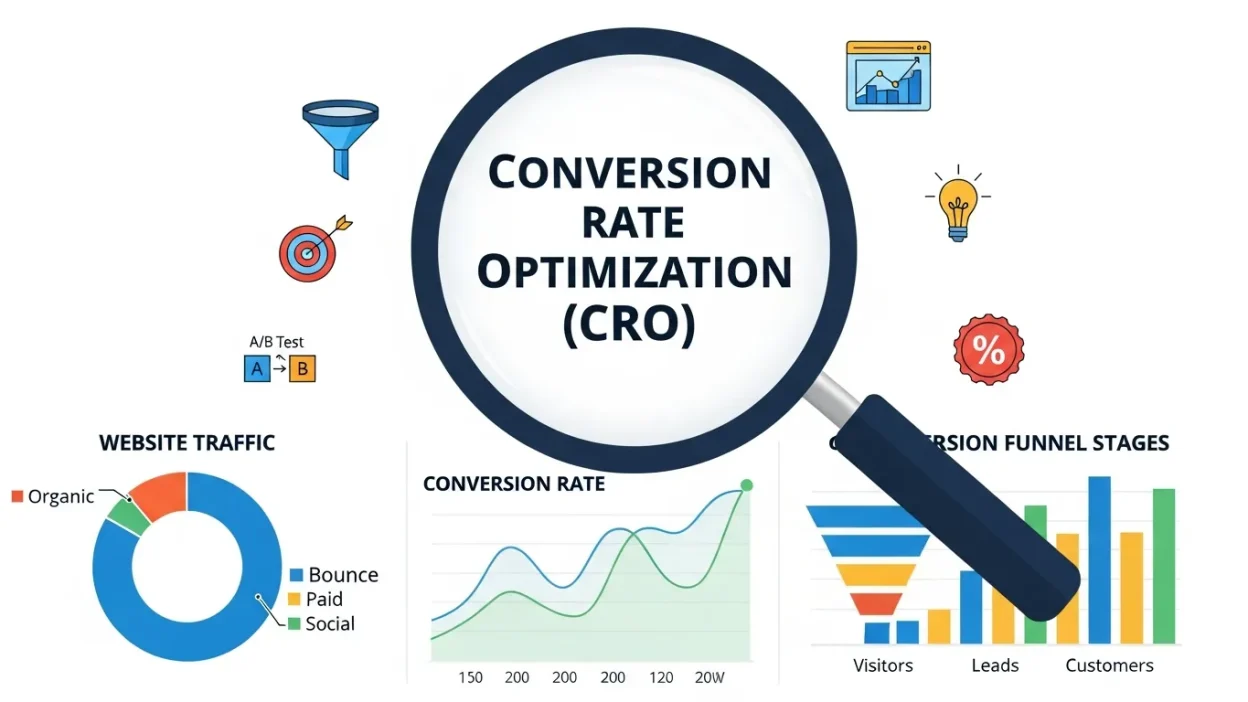
Conversion Rate Optimization (CRO) improves how effectively websites turn visitors into customers. By analyzing behavior, testing strategies, optimizing landing pages, leveraging media buying, email marketing, and voice search, businesses can increase conversions, enhance user experience, and maximize ROI.
Conversion Rate Optimization (CRO) is arguably the single-most important strategy for businesses that wish to get the most out of their web traffic. In essence, what CRO does is to raise collection rates. Using the analogy of a supermarket in the online world, it improves the percentage of users who do something you like (buy an e-book, sign up for your newsletter, or request a quote) . Whether you are a running-marketing strategies, managing your online store on your ow,n or making use of the tools to analyze user behavior as an analyst, being able to calculate and improve conversion rates will be extremely useful for success. The path-breaking short manual guides you step by step through this process, with examples and practical suggestions.
What is Conversion Rate Optimization?
Converting calls to action into paid sales is the overall process of Conversion Rate Optimization, or CRO. It is possible that advertising expenditures will not result in a direct increase in conversion rates:
- E-commerce sites: Conversions might be a sale, adding items to the basket, or signing up for future offers.
- B2B websites: Conversions could be getting leads from contact forms or booking demo appointments.
- Content-based websites: Conversions range from newsletter signups to time on the site.
CRO involves analyzing user behavior, identifying bottlenecks or friction points, and implementing changes to remove obstacles to conversions.
Why is CRO Important?
It’s essential to use CRO because it can help you get the best returns on your traffic investments. It does not matter whether you’re buying clicks from Facebook or getting traffic through SEO: unless you plan to fully optimize your website’s conversion rate, more results with the same amount of visitors are impossible. It means:
- Higher investment return from marketing activities
- Conversely, it lowers customer acquisition costs
- Enhances user experience
- Higher income and profit levels
How to Calculate Conversion Rate
The formula for conversion rate is straightforward:
Conversion Rate (%) = (Number of Conversions ÷ Total Visitors) × 100
This equation helps you identify how well your website or landing page is converting visitors into customers (or another intended action). Here’s a breakdown of the components:
- Number of Conversions: This is the total number of people who completed the desired action on your site. For example, the number of people who purchased a product or filled out a contact form.
- Total Visitors (or Sessions): This refers to the total number of visitors (or sessions, depending on the context) that arrived at your website or particular web page during a specific period.
Example 1:
Imagine you run an online store selling handmade accessories. During the month of October, 10,000 people visited your website, and 500 of them made a purchase.
- Number of Conversions: 500 (sales)
- Total Visitors: 10,000
Using the formula:
Conversion Rate = (500 ÷ 10,000) × 100 = 5%
Your conversion rate is 5%.
Example 2:
Now, let’s say you launched a marketing campaign driving 1,200 visitors to a dedicated landing page promoting your new e-book. Out of those, 250 people downloaded the e-book.
Conversion Rate = (250 ÷ 1,200) × 100 = 20.83%
This gives you a strong 20.83% conversion rate for the specific campaign.
Breaking Down CRO Metrics
To understand and optimize your CRO effectively, it’s essential to look beyond just the basic conversion rate calculation. Here are a few additional metrics to consider:
1. Micro Conversions vs. Macro Conversions
While the main conversion (e.g., purchase) is critical, there are often smaller conversions along the way, such as signing up for a newsletter or clicking through to a specific product page. These are called micro conversions and can indicate areas of strong engagement.
2. Bounce Rate
The bounce rate measures the percentage of visitors who leave your website after viewing only one page. A high bounce rate could indicate poor user experience or irrelevant content, both of which hurt conversions.
3. Average Order Value (AOV)
For e-commerce businesses, looking at your average order value can provide more context about how well you’re converting high-value customers.
4. Traffic Source Conversion Rates
Traffic sources (organic, paid, social media, email) may convert at different rates. Understanding which source brings the best traffic helps allocate budgets wisely.
Steps for Implementing CRO for Your Site
Now that you know how to calculate conversion rates, follow these practical steps to improve them:
Step 1. Establish Your Baseline
Before making changes, determine your current conversion rate. This baseline allows you to measure improvements and identify potential bottlenecks.
Step 2. Analyze Customer Behavior
Use tools like Google Analytics or Hot jar to analyze user behavior on key pages. Look for patterns such as high exit rates, low engagement, or customer drop-offs.
Step 3. Optimize Landing Pages
Landing pages are critical touchpoints in your sales funnel. Ensure clarity, fast load speeds, mobile-friendliness, and compelling calls-to-action (CTAs). A/B test variations of page designs to see which perform best.
Step 4. Strengthen Your Value Proposition
Clearly communicate what sets your business apart and why users should take action. Whether it’s exclusive offers, free shipping, or a money-back guarantee, highlight these value points.
Step 5. Simplify the Conversion Process
Reduce friction by making your sign-up or checkout process as straightforward as possible. Minimize form fields, offer guest checkouts, and provide multiple payment options to cater to user preferences.
Step 6. Test and Iterate
CRO is not a one-time task. Rather, it’s an ongoing process. Continuously A/B test new ideas, measure the results, and refine your strategies.
Common Challenges in CRO (and How to Overcome Them)
CRO isn’t without its challenges, and businesses often struggle to see immediate results. Here’s how to tackle common hurdles:
- Limited Traffic: Without enough traffic, it’s hard to collect statistically significant CRO data. Focus on attracting more visitors first.
- Ignoring Mobile Optimization: Many businesses prioritize desktop optimization, overlooking mobile users. Given that 56% of web traffic is mobile, ensure your site is optimized across devices. 3.
- Overcomplicated CTAs: Ambiguous or cluttered CTAs can confuse users. Keep CTAs bold and clear—for example, “Get your free guide” instead of “Submit.”
- Patience: CRO requires time and testing. Avoid rushing to conclusions based on limited data.
Leveraging Media Buying to Boost CRO
One of the most effective ways to drive conversions is through strategic media buying. Media buying allows businesses to place ads in front of the right audience at the right time, maximizing visibility and engagement. By targeting users who are already interested or likely to convert, you can increase the ROI of your campaigns while simultaneously improving your site’s conversion rates. Think of it as not just attracting traffic, but attracting qualified traffic that is more likely to take action.
Media buying is not just about paying for impressions; it’s a strategic approach that combines data analysis, audience research, and creative optimization. When done correctly, it ensures that every ad dollar contributes directly to higher conversions.
Key strategies for effective media buying include:
- Audience Segmentation: Divide your audience into segments based on demographics, interests, online behavior, and purchase intent. This allows you to tailor messaging and offers to the most relevant users.
- Retargeting Campaigns: Users who have already visited your website or engaged with your content are more likely to convert. Retargeting ensures your brand stays top-of-mind and encourages users to complete their journey.
- Budget Allocation: Assign ad spend based on which channels and campaigns are driving the highest conversions. A flexible budget that adapts to performance data prevents wasted spend.
- Creative Optimization: Test different ad creatives, headlines, and calls-to-action. Even minor adjustments can lead to significant improvements in click-through and conversion rates.
- Cross-Channel Integration: Coordinate campaigns across social media, search, and display networks to create a consistent, high-impact presence that guides users through the conversion funnel.
| Media Channel | Conversion Impact | Key Considerations |
|---|---|---|
| Paid Social Ads | High | Retarget engaged users; use lookalike audiences |
| Display Networks | Medium | Focus on visual appeal and brand recall |
| Search Ads | Very High | Optimize for high-intent keywords |
| Programmatic Ads | Medium | Use AI-driven bidding to reach the right audience |
For a more detailed guide on leveraging media buying for conversions, check out How Media Buying Services Drive Growth.
Optimizing Email Campaigns for Higher Conversions
Email marketing remains one of the most cost-effective strategies to drive conversions, particularly when you understand user behavior and engagement patterns. While many businesses send out regular newsletters, only a few optimize their email campaigns to convert clicks into meaningful actions. Optimizing emails for conversions involves not just reaching inboxes but compelling users to act immediately.
Practical tips to improve email conversions:
- Personalized Subject Lines and Messaging: Tailor subject lines and email content to the recipient’s past interactions or preferences. Personalization increases open rates and builds trust.
- Segmented Lists: Group subscribers based on factors like purchase history, location, or engagement levels. Relevant content for each segment ensures higher engagement and conversion potential.
- Clear and Compelling CTAs: Every email should have one primary goal—whether it’s to download an e-book, sign up for a webinar, or make a purchase. Make your CTA bold, clear, and impossible to miss.
- A/B Testing: Experiment with timing, subject lines, images, and CTA placement to identify what resonates best with your audience.
- Responsive Design: More than 60% of emails are opened on mobile devices. Ensure your emails look great and function perfectly across devices.
- Automated Workflows: Triggered emails (like abandoned cart reminders or post-purchase follow-ups) are highly effective for driving conversions and keeping users engaged.
| Metric | Benchmark | Optimization Strategy |
|---|---|---|
| Open Rate | 20–25% | Personalize subject lines & sender info |
| Click-Through Rate (CTR) | 2–5% | Use clear CTAs, engaging visuals, and concise text |
| Conversion Rate | 1–3% | Optimize landing pages and user journey |
| Bounce/Unsubscribe Rate | <1% | Avoid spammy content and maintain list hygiene |
B2B marketers, in particular, can benefit from understanding how open rates translate to conversions. Small improvements in email engagement can yield significant increases in sales. Explore more in B2B Email Marketing: Open Rates and Conversions.
Preparing for Voice Search to Capture Conversions

With the rapid adoption of smart speakers, mobile voice assistants, and AI-powered search tools, voice search is emerging as a critical channel for conversion optimization. Users engaging via voice tend to use natural, conversational language and often express higher intent than traditional text searches. Optimizing for voice search allows businesses to capture high-quality traffic and convert it more effectively.
Voice search optimization goes beyond traditional SEO. It requires understanding how people ask questions and what kind of content provides immediate value. Businesses that prepare early can position themselves as leaders in their niches and see a measurable uptick in conversions.
Tips for effective voice search optimization:
- Conversational Keywords: Incorporate natural, long-tail phrases that match how users speak. For example, “Where can I buy eco-friendly notebooks near me?” rather than just “eco-friendly notebooks.”
- Featured Snippets & Structured Data: Format your content to answer questions directly, making it eligible for voice assistant responses.
- Local SEO Optimization: Many voice searches are location-based. Keep your business address, hours, and contact information accurate in directories and Google My Business.
- Mobile Optimization: Voice searches are mostly conducted on mobile devices, so fast-loading, mobile-friendly pages are crucial.
- Content Readability: Provide concise, clear, and authoritative answers to questions. Use bullet points, tables, or numbered lists for easy consumption.
- FAQ Sections: Address common customer queries explicitly on your site to improve chances of being picked up in voice results.
| Optimization Area | Action Item | Conversion Benefit |
|---|---|---|
| Keywords | Add long-tail conversational phrases | Captures high-intent searchers |
| Content | Provide concise, direct answers | Improves user satisfaction |
| Local Listings | Update NAP & business info | Increases local conversions |
| Mobile Experience | Ensure fast loading & responsive design | Retains voice search traffic |
| FAQ Pages | Include structured answers | Enhances trust & engagement |
Voice search is rapidly becoming a major driver of website traffic and conversions. Early preparation ensures your brand captures this high-intent traffic before competitors. Learn more in Voice Search Optimization: Preparing Your Brand.
Tools to Help You Optimize Conversion Rates
Several tools can make CRO more effective and efficient:
- Google Analytics: Helps identify key conversion data and user behavior on your site.
- Hot jar or Crazy Egg: Visual heatmaps and session replays to understand user interactions.
- A/B Testing Software: Tools like Optimize or VWO allow you to test changes and measure the impact.
- Page Speed Testing Tools: Google’s Page Speed Insights can diagnose and fix loading issues that may hurt CRO.
Take the First Step Toward Higher Conversions
Conversion Rate Optimization is more than just a formula. It’s a mindset that needs to be continuously examined and tested with user behavior.
By doing CRO calculations and deploying data-driven strategies, more visitors can be converted into paying customers; your site’s earning power is only limited by the number of walk-ins off the street.
First, record your current CRO number and thoroughly audit site performance. Make small, measurable changes and watch everything improve over time. If you need analysis or strategy guidance, then let us help.
Conversion Rate Optimization (CRO) – FAQs
1. What is Conversion Rate Optimization (CRO)?
Conversion Rate Optimization (CRO) is the process of improving your website or landing page to increase the percentage of visitors who take a desired action — such as purchasing a product, signing up for a newsletter, or submitting a form. CRO focuses on understanding user behavior and removing obstacles that prevent conversions, ensuring your traffic generates measurable results.
2. Why is Conversion Rate Optimization important for businesses?
CRO allows you to get the most value from existing traffic. Even with high website visits, without CRO, many potential conversions are lost. Optimizing your conversion rate lowers customer acquisition costs, improves ROI, enhances user experience, and increases revenue.
3. How do I build a career in Conversion Rate Optimization?
A career in CRO involves mastering analytics, user behavior, A/B testing, and website optimization strategies. Professionals often start with practical projects, testing landing pages and analyzing results. For a structured career guide, check out Build a Career in CRO Strategies.
4. What are the key elements of a successful CRO strategy?
A strong CRO strategy includes:
- Understanding user behavior through analytics
- Clear and compelling call-to-actions (CTAs)
- A/B testing and continuous experimentation
- Mobile-friendly and fast-loading websites
- Iterative improvements based on data
5. What strategies can businesses use to take their CRO to the next level?
Businesses can improve CRO by optimizing landing pages, personalizing content, retargeting visitors, and leveraging social proof. These tactics guide users toward conversion more effectively. For detailed, actionable tactics, see CRO Strategies to Take Your Business to the Next Level.
6. How do advanced CRO strategies differ from basic ones?
Advanced CRO includes behavioral analysis, personalized content, dynamic landing pages, segmentation, and using psychological triggers. It focuses on converting not just more traffic, but higher-quality, motivated visitors. Learn more about advanced techniques in Advanced CRO Strategies for Business Growth.
7. How long does it take to see results from CRO?
Some improvements, like fixing usability issues or optimizing CTAs, can show results in weeks. Larger changes — such as personalization, segmentation, and content optimization — may take months. CRO is a continuous process requiring testing and iteration.
8. Can CRO help improve mobile conversions?
Yes. Mobile optimization is critical since most users browse on mobile devices. Improving page speed, navigation, touch-friendly design, and responsive layouts directly boosts mobile conversion rates.
9. Do I need CRO if I already get a lot of website traffic?
Even with high traffic, conversions can remain low if the site isn’t optimized. CRO shifts the focus from just acquiring visitors to converting them, ensuring that every visitor has a higher chance of completing desired actions.
10. How do I measure the success of my CRO efforts?
Key metrics include:
- Conversion rate (primary metric)
- Bounce rate
- Click-through rate (CTR) on key buttons
- Revenue per visitor or lead quality
Tracking these allows you to determine how effective your optimizations are and where further improvements are needed.