
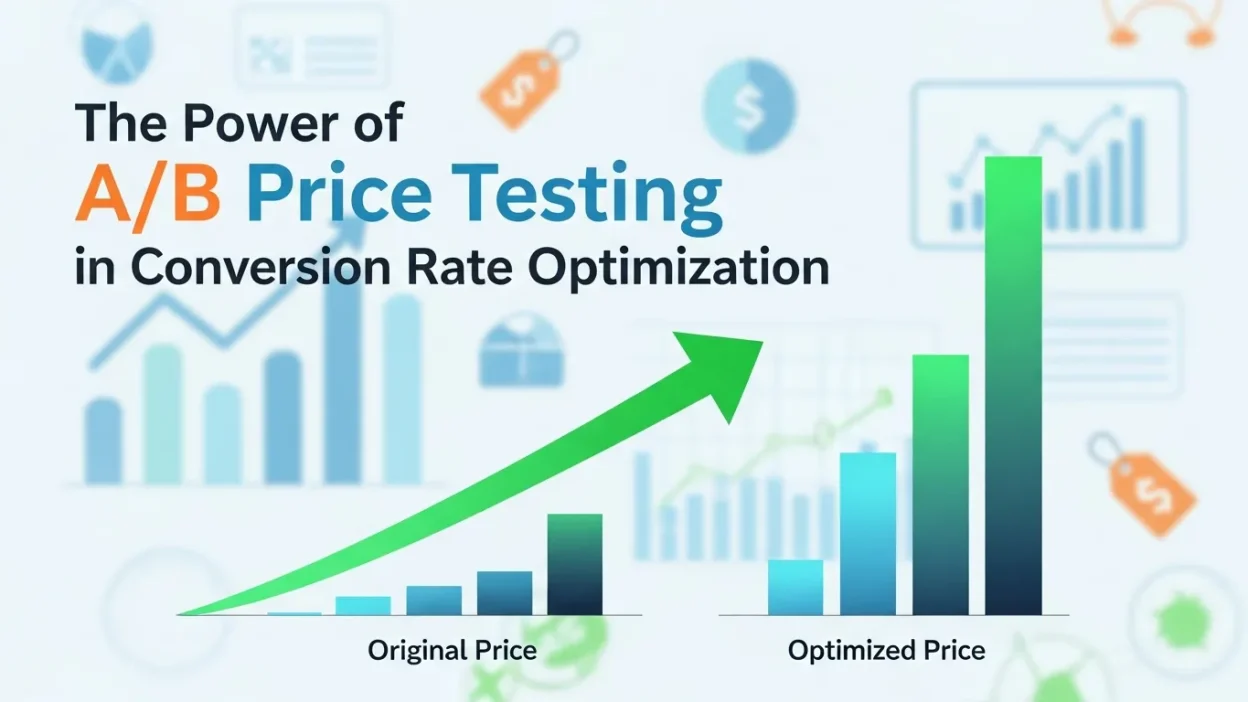
When it comes to Conversion Rate Optimization (CRO), most businesses invest heavily in improving visual design, perfecting call-to-action buttons, and crafting persuasive content strategies. These elements are indeed crucial—but there’s another powerful, often overlooked factor that can dramatically influence your success: A/B Price Testing.
While running price-based experiments can be more complex than testing visuals or headlines, the potential rewards are far greater. A/B Price Testing offers a window into real customer behavior—revealing how different pricing levels impact purchasing decisions, perceived value, and overall profitability.
By experimenting strategically and testing early and often, businesses can uncover valuable data that goes beyond guesswork. The insights gained from A/B Price Testing not only help optimize short-term conversions but also guide long-term pricing strategies that support sustainable growth. In short, this method doesn’t just boost conversion rates—it builds a stronger foundation for smarter, data-driven pricing decisions that enhance revenue and customer trust over time.
What Is A/B Price Testing?
A/B price testing, also known as split testing, is a method of comparing two or more price points for the same product or service to see which one yields better results, such as higher conversion rates or maximum revenue. The process involves dividing your audience into different groups and presenting them with varying prices to monitor how they respond.
For example:
- Group A sees the product listed for $20.
- Group B sees the product listed for $25.
At the end of the test, you analyze metrics like sales volume, total revenue, and conversion rates to determine which price performs better.
Unlike straightforward A/B testing for elements like button colors or headlines, price testing often comes with a higher level of risk. However, when executed strategically, it can reveal what your customers are really willing to pay.
Why A/B Price Testing Matters in CRO
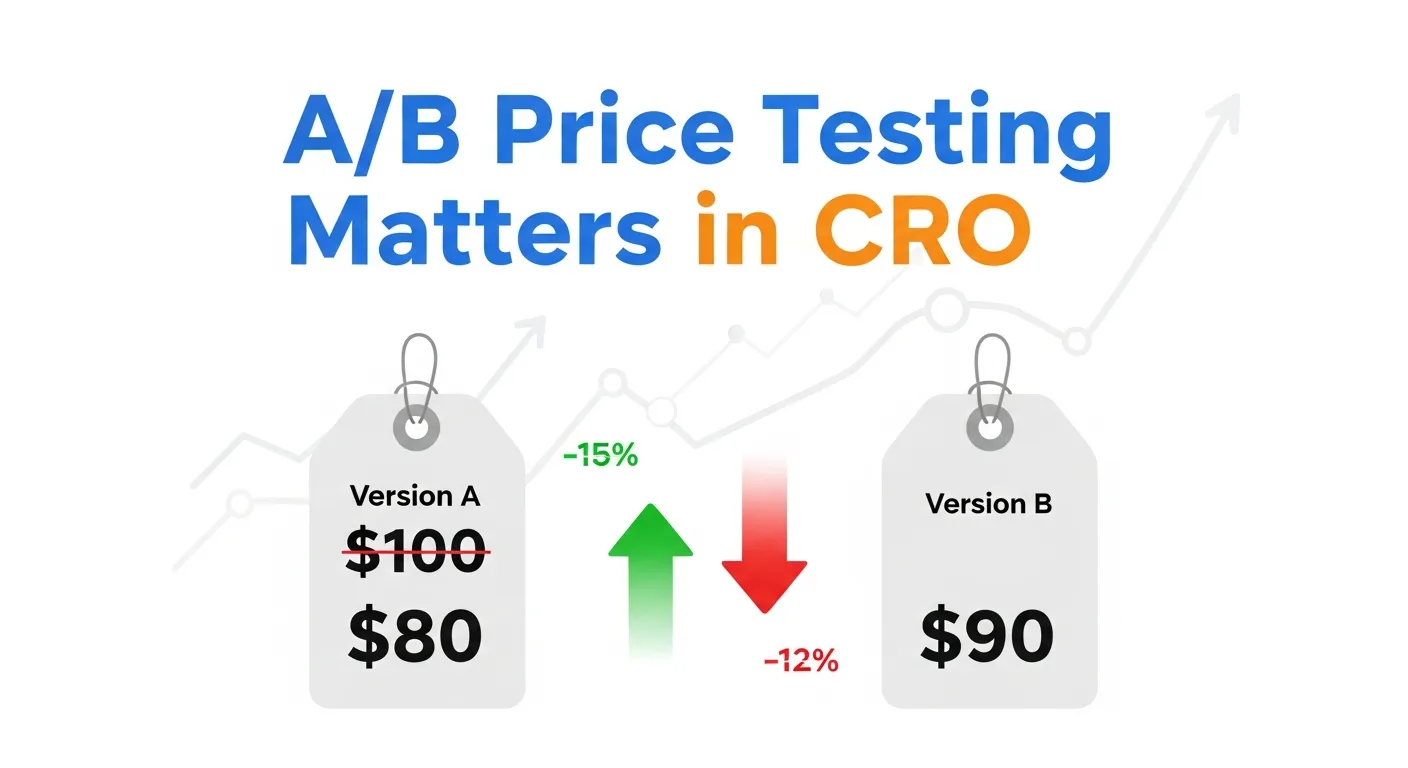
In the world of Conversion Rate Optimization (CRO), many businesses focus heavily on design elements, call-to-action buttons, or copywriting. Yet, one of the most influential factors in determining whether a visitor converts into a customer is pricing. A/B Price Testing bridges the gap between data-driven experimentation and real-world consumer psychology, helping you understand what your audience values most and how much they are willing to pay.
Here’s why A/B Price Testing is a critical component of a strong CRO strategy:
1. Discover the Sweet Spot for Pricing
Finding the perfect balance between affordability and profitability is one of the toughest challenges for any business. A/B Price Testing allows you to identify that “sweet spot” where your pricing feels fair to customers while still maximizing margins.
Example:
If your product sells at $30, you can test a $27 and a $33 version to see which price point generates more total revenue. Sometimes, a slightly higher price with fewer conversions can outperform a lower price with more volume.
Key Benefits:
- Prevents overpricing or underpricing errors.
- Identifies price elasticity across audience segments.
- Builds confidence in your long-term pricing strategy.
When you find that optimal point, you not only improve conversions but also strengthen your pricing foundation for future growth.
2. Understand Customer Behavior
One of the most powerful outcomes of A/B Price Testing is insight into customer psychology. Price is not just a number—it’s a reflection of perceived value, urgency, and trust. Different demographics, regions, and product types respond differently to pricing signals.
How A/B Price Testing Helps You Understand Behavior:
- Reveals price sensitivity among different customer groups.
- Uncovers whether buyers are value-driven or deal-driven.
- Highlights how price influences decisions such as upselling, bundling, or loyalty.
Example:
A fitness app may discover that younger customers prefer lower prices with flexible monthly options, while professionals are more likely to choose higher-priced annual plans for convenience.
Understanding these behaviors enables you to tailor pricing, promotions, and even messaging to better align with how your audience thinks and buys.
3. Maximize Revenue with Strategic Pricing
Sometimes, the best way to grow isn’t to sell more—it’s to sell smarter. A/B Price Testing helps uncover the relationship between conversion rate and total revenue, showing you when a higher price can deliver better financial outcomes despite a small drop in sales volume.
Example:
You might notice that when you raise your product price by 10%, conversions drop by 5%, but your total revenue still increases by 8%. This insight allows you to scale revenue without additional ad spend or traffic.
Benefits of Revenue-Driven Price Testing:
- Reveals pricing thresholds that maximize profit margins.
- Helps optimize upsell and cross-sell strategies.
- Supports long-term financial sustainability.
By analyzing both conversion rates and overall revenue, you ensure that your pricing strategy aligns with your business growth goals—not just short-term sales boosts.
4. Stay Competitive in a Dynamic Market
Today’s market changes fast—competitors launch new products, offer flash discounts, and adjust their pricing constantly. A/B Price Testing empowers you to stay agile by regularly experimenting with price positioning, allowing you to stay ahead without resorting to profit-draining price wars.
How It Keeps You Competitive:
- Let’s you test competitive pricing strategies without full commitment.
- Reveals how your target market reacts to small pricing shifts versus major drops.
- Helps refine your value proposition to justify premium pricing.
Example:
An e-commerce brand might test a slightly higher price while emphasizing quality and customer service. If conversion rates remain stable, it proves that the market supports the premium, strengthening the brand’s positioning.
A/B Price Testing ensures that your pricing evolves with the market rather than reacting to it, keeping you relevant, competitive, and profitable. A/B Price Testing is more than a CRO experiment—it’s a strategic advantage. It combines psychology, data, and economics to reveal how pricing influences purchasing decisions. By discovering your ideal price point, understanding customer motivations, maximizing revenue, and staying ahead of competitors, you can make smarter, evidence-based decisions that enhance both profitability and customer satisfaction.
Risks of A/B Price Testing
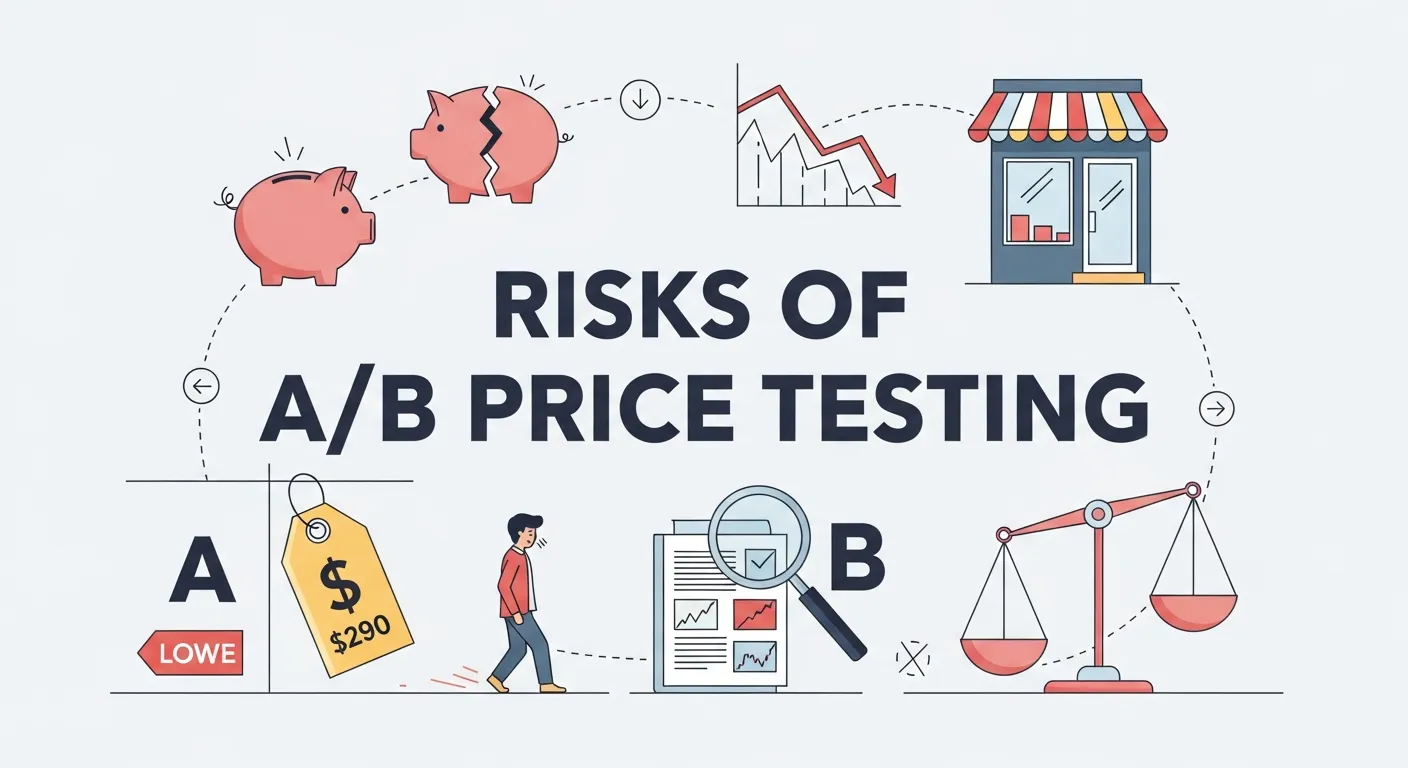
Before diving into the process of A/B Price Testing, it’s essential to recognize the potential risks that come with experimenting on one of the most sensitive aspects of your business — pricing. While this testing method can reveal valuable insights and boost long-term profitability, it also carries certain drawbacks if not handled carefully. Understanding these risks in advance will help you minimize negative outcomes and build a more reliable, ethical pricing strategy.
1. Risk to Customer Trust
One of the most common pitfalls of A/B Price Testing is the potential erosion of customer trust. If returning visitors or customers notice price discrepancies between visits—or worse, between their accounts and others—they may feel misled or treated unfairly. This perception can damage your brand’s reputation and reduce loyalty over time.
Imagine two customers discussing a recent purchase, only to discover they were charged different prices for the same product. Even if it was part of a legitimate test, it can create feelings of inequity and frustration.
How to Mitigate It:
- Keep price variations within a reasonable range.
- Avoid testing in the same geographic or demographic audience simultaneously.
- Use controlled environments such as email A/B campaigns or temporary landing pages.
- Communicate openly about promotions and limited-time offers to maintain transparency.
Maintaining trust is crucial — without it, even successful A/B Price Testing results can lead to long-term brand damage.
2. Risk of Lost Revenue
During testing, one version of your price will inevitably perform worse than the other. If one price point is set too low, you may experience a short-term dip in profits—even if the test ultimately identifies a better long-term strategy. This temporary loss is part of the cost of experimentation but should be carefully managed.
Testing a $15 product against a $25 version may show a higher conversion rate at the lower price but significantly reduce total profit. Without a clear plan, the business could lose more revenue than it gains in insight.
How to Mitigate It:
- Establish acceptable loss thresholds before launching the test.
- Keep the testing duration short and data-focused to minimize revenue exposure.
- Run tests on high-traffic, low-risk products first before applying findings to premium items.
- Use historical sales data to set realistic boundaries for price variation.
Strategically planned A/B Price Testing should always balance experimentation with financial prudence.
3. Risk of Sampling Errors
For A/B Price Testing to be accurate, your sample must be large enough and evenly distributed. Small or biased sample sizes can lead to misleading conclusions, causing you to make decisions based on incomplete or distorted data.
If one test group consists mainly of repeat customers and the other of new visitors, the results will be skewed — the difference in behavior may stem from loyalty, not pricing.
How to Mitigate It:
- Use analytics tools to ensure random audience distribution.
- Test during normal traffic periods (avoid holidays or major sales events).
- Wait until you’ve reached statistical significance before concluding.
- Re-test periodically to confirm consistency in results.
Proper planning and data discipline ensure that your A/B Price Testing results reflect reality, not coincidence.
4. Risk of Misinterpretation
Another subtle yet significant challenge in A/B Price Testing is misreading the data. Sometimes, a higher conversion rate might seem positive, but it could come at the cost of overall profitability. Similarly, a lower conversion rate could still yield higher revenue due to increased order value.
How to Mitigate It:
- Evaluate multiple metrics, including Revenue per Visitor (RPV), Average Order Value (AOV), and Customer Lifetime Value (CLV).
- Avoid making decisions based on early trends—wait for complete data cycles.
- Always analyze both conversion and revenue outcomes together.
Sound interpretation is what separates successful testing from misleading data.
5. Risk of Ethical and Legal Issues
Certain markets and industries have regulations about pricing transparency. If your A/B Price Testing inadvertently violates consumer protection laws or appears deceptive, it could result in compliance issues or public backlash.
How to Mitigate It:
- Familiarize yourself with local and international pricing laws.
- Ensure your terms of service or testing disclaimers cover experimental pricing.
- Avoid discriminatory pricing based on personal attributes (e.g., location, device type, or demographic).
Ethical testing isn’t just about avoiding fines—it’s about preserving brand integrity and customer loyalty.
A/B Price Testing can deliver exceptional insights when conducted strategically, but awareness of its risks is essential. By safeguarding customer trust, managing financial exposure, ensuring accurate sampling, and maintaining ethical transparency, you can minimize downsides while maximizing the benefits. Thoughtful preparation and responsible execution transform potential risks into opportunities for smarter, data-driven growth.
Steps to Conduct A/B Price Testing
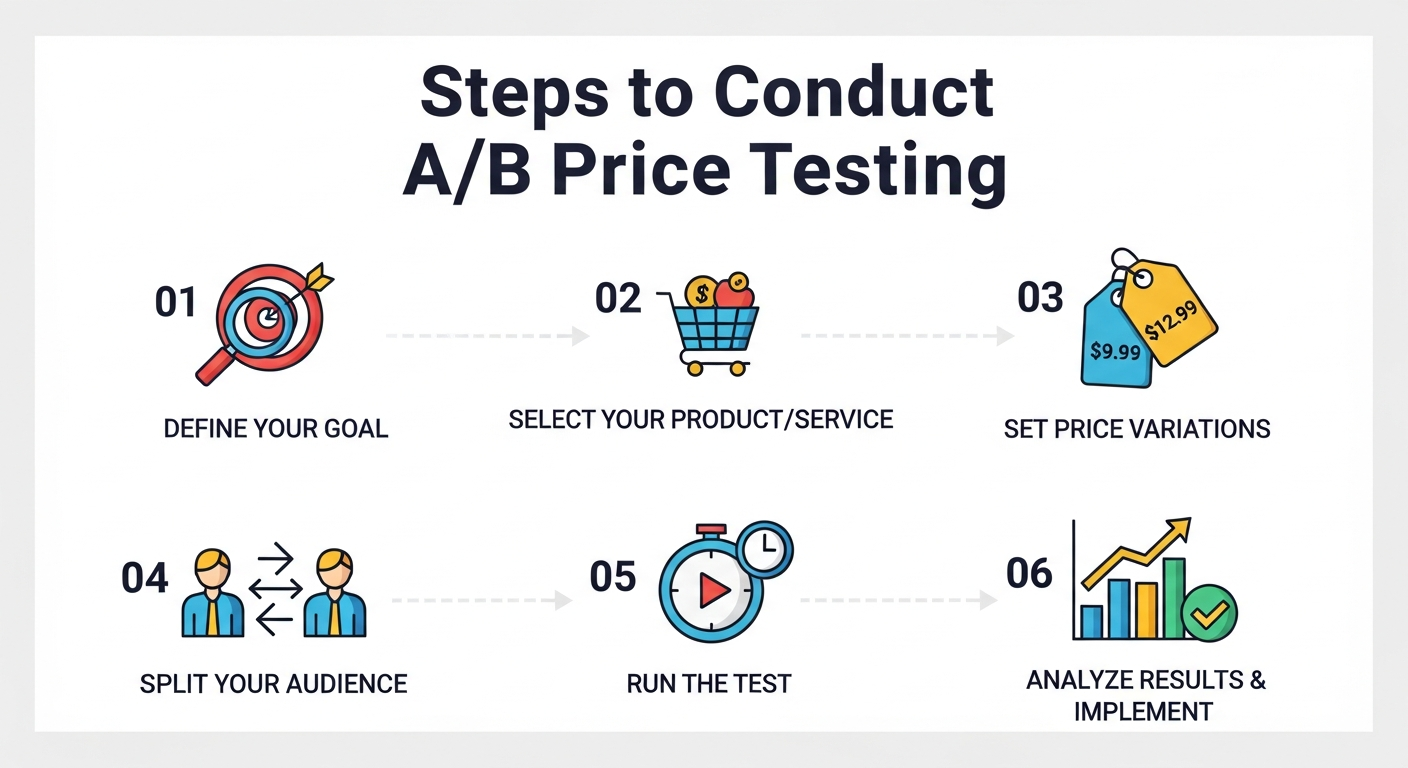
Executing A/B Price Testing effectively requires a structured, data-driven approach. The goal isn’t just to compare two prices but to uncover meaningful insights that help optimize your overall pricing and conversion rate optimization (CRO) strategy. Below is a proven step-by-step framework for designing, running, and analyzing your A/B price tests successfully.
1. Define Clear Goals
Before launching any test, you must have a precise objective. A/B Price Testing can serve several purposes—identifying the most profitable price point, understanding customer sensitivity, or balancing conversions with revenue. Defining your primary goal upfront keeps your test focused and interpretable.
Ask yourself:
- Are you trying to maximize total revenue or increase conversions?
- Do you want to attract new buyers or increase spending from existing customers?
- Is your pricing strategy aligned with brand perception and market positioning?
Clear goals help ensure that every decision—from selecting price points to interpreting outcomes—serves a strategic purpose.
2. Segment Your Audience
Accurate segmentation is vital to the success of A/B Price Testing. Randomly dividing your audience into two or more equal groups ensures that results aren’t biased by user behavior differences. When possible, further segmentation can reveal deeper insights.
Ways to Segment:
- By Demographics: Age, location, income level, or gender.
- By Behavior: First-time visitors vs. loyal customers.
- By Product Type: High-demand vs. niche offerings.
Example:
A SaaS company might show one price to new trial users and another to long-term subscribers to test sensitivity across customer types. Proper segmentation ensures that you’re testing pricing reactions, not external variables like marketing exposure or user familiarity.
3. Set Testing Parameters
Choosing the right price points is where strategy meets creativity. The goal of A/B Price Testing is not to shock your audience but to find small, meaningful differences that produce measurable results.
Guidelines:
- Avoid drastic gaps (e.g., $20 vs. $50) that might confuse or alienate customers.
- Test smaller, realistic increments (e.g., $20 vs. $25) to find elasticity without risk.
- Consider testing different formats, such as monthly vs. annual pricing, or bundled vs. individual pricing.
Pro Tip:
Always ensure your pricing still aligns with your perceived value. A test that sacrifices brand trust for short-term gains can hurt long-term success.
4. Run the Test Under Controlled Conditions
Consistency is key when performing A/B Price Testing. Each variation should be shown under identical conditions—same page design, same traffic source, same timeframe—to ensure fairness.
Best Practices:
- Keep all other variables constant except the price.
- Run your test long enough to gather statistically significant data—usually 10 to 14 days, depending on traffic.
- Avoid stopping the test prematurely; incomplete data can produce misleading insights.
Example:
If you’re testing a new pricing plan for an e-commerce product, make sure all product descriptions, images, and delivery options remain the same. The only element that should differ is the price displayed.
Running your test consistently allows you to draw accurate conclusions about how price alone influences user behavior.
5. Monitor Relevant Metrics
While conversion rate is the headline metric, true success in A/B Price Testing comes from understanding multiple key performance indicators (KPIs). Look beyond just “how many people purchased” and consider the overall impact on revenue and customer lifetime value.
Essential Metrics to Track:
- Conversion Rate (CR): Percentage of visitors who make a purchase.
- Revenue per Visitor (RPV): Total revenue divided by number of visitors.
- Average Order Value (AOV): Average spend per transaction.
- Customer Lifetime Value (CLV): Long-term profitability per customer.
Metrics to Monitor in A/B Price Testing
| Metric | What It Measures | Why It Matters |
|---|---|---|
| Conversion Rate | % of users completing a purchase | Indicates pricing appeal |
| Revenue per Visitor | Revenue earned per site visitor | Reflects pricing efficiency |
| AOV | Average transaction size | Reveals upsell or bundle potential |
| CLV | Long-term customer value | Evaluates retention profitability |
Evaluating all these metrics together provides a complete picture of how pricing changes affect not just short-term conversions but also long-term profitability.
6. Analyze Results and Iterate
After your A/B Price Testing period ends, it’s time to dive deep into the results. Look for patterns, not just winners. A higher price might reduce conversion rate slightly but boost total revenue, while a lower price might attract more new customers but reduce margins.
Steps to Analyze Effectively:
- Ensure you’ve gathered enough data for statistical significance.
- Compare performance across all key metrics (not just conversion rate).
- Identify whether pricing impacted specific segments differently.
- Document findings and use them to guide future pricing tests.
Pro Tip:
Treat each A/B Price Testing cycle as part of an ongoing improvement loop. Markets change, customer preferences evolve, and competitors shift their strategies. Retesting periodically ensures your pricing remains optimized and competitive.
Integrating A/B Price Testing with Customer Experience
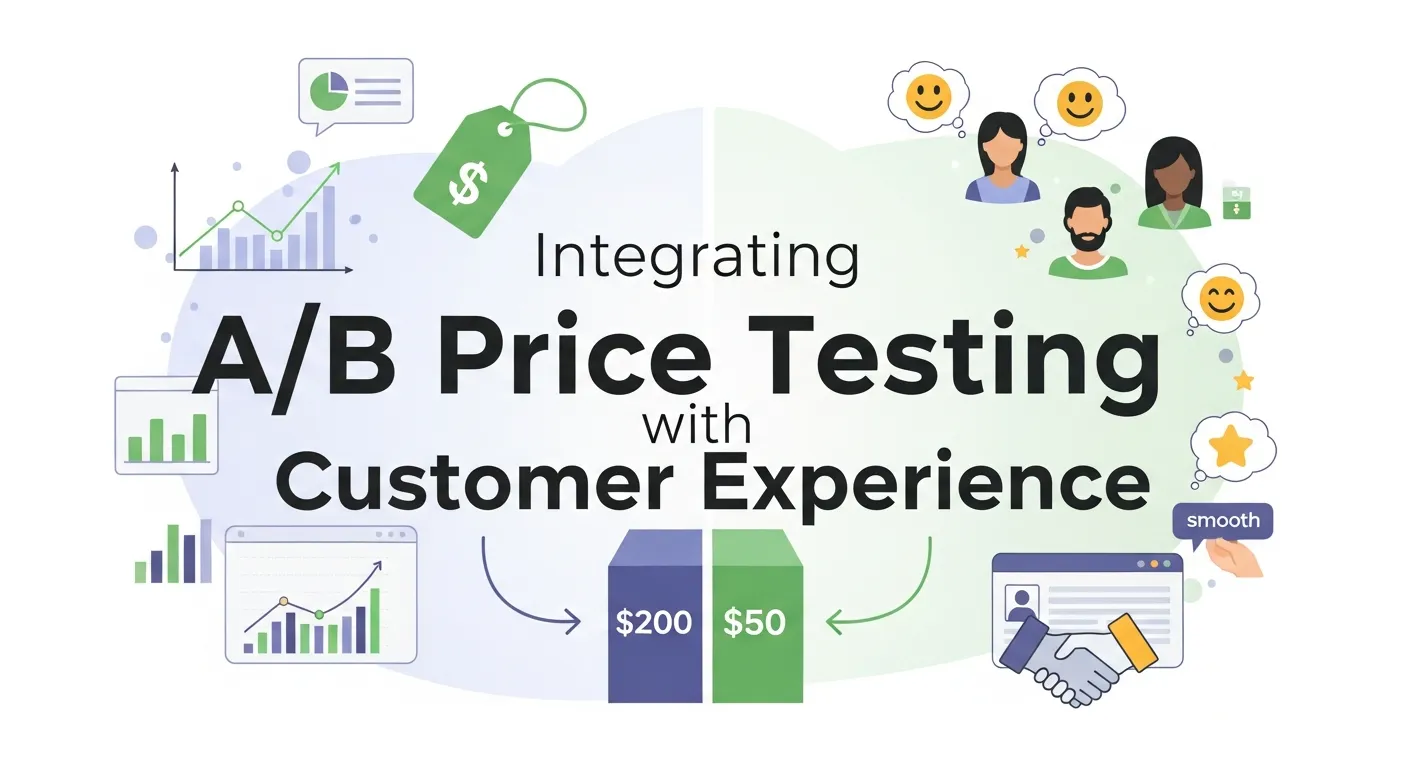
A/B price testing isn’t just about the numbers—it’s also about understanding how customers feel when they interact with your brand. Even the most data-driven pricing tests can fail if the customer experience is poor. To truly optimize results, you must connect your pricing strategy to user satisfaction, perceived value, and brand trust.
A smooth and transparent customer journey can make higher price points more acceptable. When customers feel confident about your website’s credibility, product quality, and post-purchase support, they are more willing to pay. Conversely, a confusing checkout process, unclear information, or slow load times can make even the best pricing strategy underperform.
Key Factors That Shape Price Perception
- Perceived Value: Customers are often willing to pay more when they understand the benefits, such as higher quality, faster delivery, or better support.
- Ease of Navigation: A well-structured and mobile-friendly site encourages more confident purchases.
- Trust Indicators: Security badges, testimonials, and refund policies build confidence, which makes customers less sensitive to price fluctuations.
- Support Systems: Automated tools like chatbots improve engagement, answer pricing questions instantly, and reduce drop-offs during decision-making.
Customer Experience Impact on Price Sensitivity
| Experience Factor | Impact on A/B Test Results | Optimization Tip |
|---|---|---|
| Website performance | Delays may cause cart abandonment regardless of price | Improve speed and reduce friction points |
| Product presentation | Poor visuals reduce perceived value | Use clear images and consistent layouts |
| Communication & support | Slow response times increase churn | Add chatbots for instant help |
| Transparency | Hidden fees cause distrust | Display all charges upfront |
A/B testing should always run alongside UX improvements. Businesses that combine both pricing insights and customer experience data often achieve sustainable growth.
Learn how e-commerce chatbots can increase sales efficiency: e-commerce conversion chatbots or higher sales.
Using Price Testing Insights for Marketing Strategy
Your A/B price testing results can transform your overall marketing strategy. Every pricing experiment reveals how your audience values your products—information that can be used to refine targeting, messaging, and promotional campaigns.
Understanding the relationship between price and customer motivation helps marketers build smarter campaigns. When a specific price point drives stronger engagement, you can replicate that success across different ad channels, email campaigns, and content marketing initiatives.
How to Leverage A/B Price Testing in Marketing
- Audience Segmentation: Use insights to segment your audience into groups such as “price-sensitive” and “premium buyers.”
- Dynamic Promotions: Run promotions at the optimal price point identified during testing for each customer group.
- Message Refinement: Emphasize value and quality in messaging when prices are higher; highlight affordability when targeting budget-conscious buyers.
- Retention Campaigns: If lower prices attract new customers, use email automation and loyalty rewards to retain them at future higher price points.
Applying A/B Price Test Learnings to Marketing
| Insight from Test | Marketing Use | Strategic Benefit |
|---|---|---|
| Price elasticity | Design targeted discounts | Improved conversion during slow seasons |
| Willingness to pay | Adjust ad copy tone and urgency | Stronger resonance with the target audience |
| Profit threshold | Optimize ad budget around high-performing SKUs | Better ROI across campaigns |
| Segment variation | Personalize offer placements | Increased lifetime customer value |
Your pricing data isn’t just a financial metric—it’s a marketing weapon. It allows you to speak directly to customer psychology, refine brand messaging, and position your offers competitively.
For tips on managing online perception and trust, visit mastering personal reputation management
Optimizing Paid Media with Price Testing
In digital advertising, knowing which price points convert best can dramatically improve your ad performance. A/B price testing provides powerful insights that help you allocate ad budgets more effectively, design better landing pages, and maximize ROI from every campaign.
When you test different prices and discover which one drives more conversions or revenue, that data can be integrated into your paid media channels—such as Google Ads, Meta Ads, or display retargeting campaigns. This ensures every dollar spent is supported by proven behavioral data rather than assumptions.
Steps to Align Price Testing with Paid Media
- Adjust CPC Bids: Focus your ad spend on the products or pricing tiers that deliver the highest returns.
- Match Landing Page Messaging: Make sure your ad copy and landing page display the same price to prevent confusion and drop-offs.
- Test Ad Copy Variations: Combine pricing language with urgency (“Limited-time price!”) or social proof to enhance ad click-through rates.
- Use Retargeting Data: Show returning visitors the price they interacted with previously to increase familiarity and conversion.
Price Testing Impact on Paid Media Campaigns
| Paid Media Element | A/B Testing Integration | Outcome |
|---|---|---|
| CPC Campaigns | Focus on the best-performing price | Lower CPA and higher CTR |
| Retargeting Ads | Display personalized tested prices | Increased conversions |
| Ad Copy | Integrate winning price points | Stronger engagement |
| Landing Pages | Align pricing across all campaigns | Reduced bounce rate |
Combining A/B price testing with paid advertising analytics turns your campaigns from experimental to highly strategic. It bridges the gap between pricing psychology and ad performance, leading to consistent revenue growth.
Learn more about boosting e-commerce sales through CPC advertising: cpc advertising for e-commerce boost sales fast
Key Tips for Successful A/B Price Testing
Running a successful A/B Price Testing campaign goes beyond setting two price points and waiting for results. To get accurate, reliable, and actionable data, you need to follow strategic testing practices that minimize errors, protect customer trust, and reveal genuine behavioral insights. Here are some expert tips to ensure your A/B Price Testing produces meaningful results:
1. Keep Variables Minimal
When performing A/B Price Testing, it’s essential to isolate the variable you’re testing — in this case, the price. If multiple elements (like layout, messaging, or discounts) change between versions, it becomes impossible to determine whether the difference in results came from the price or another factor.
Best Practices:
- Keep visuals, descriptions, and CTAs identical across test variations.
- Avoid running simultaneous tests that could overlap in the same audience.
- Document all changes made to maintain transparency in your testing process.
By keeping your test controlled, you can confidently attribute any change in conversion rate or revenue directly to the pricing variation itself.
2. Test Different Customer Journeys
Not all customers respond to prices the same way — and that’s why segmenting your audience is crucial in A/B Price Testing. For example, a first-time visitor may be more price-sensitive than a loyal returning customer. Testing across multiple customer journeys gives a more complete understanding of how price impacts conversion.
How to Apply This Tip:
- Segment tests based on customer behavior (e.g., new vs. repeat buyers).
- Try testing prices on different product categories or service tiers.
- Use analytics tools to track which journey stage influences price perception most.
This multi-dimensional approach ensures that your A/B Price Testing reflects real-world buying behavior, not just single-test outcomes.
3. Communicate Value Effectively
Higher prices often demand stronger perceived value. The secret isn’t just showing a bigger number — it’s justifying it. During A/B Price Testing, clearly communicate what makes the higher-priced version worth more. Customers don’t just pay for the product; they pay for assurance, experience, and trust.
Effective Value Communication Tactics:
- Highlight premium benefits like superior quality, warranties, or sustainability.
- Use trust-building signals such as “100% satisfaction guarantee” or “free returns.”
- Add product comparisons showing how your offer delivers more for the price.
When your messaging aligns with the perceived value, A/B Price Testing can uncover not just which price performs best—but why.
4. Follow Ethical and Transparent Practices
Ethics play a huge role in long-term success with A/B Price Testing. Customers appreciate honesty, and any perception of unfair pricing or manipulation can damage brand credibility. Always conduct tests transparently and ensure consistency for returning visitors whenever possible.
Ethical Testing Guidelines:
- Avoid showing drastically different prices to overlapping audiences.
- Be transparent about dynamic pricing policies, especially in e-commerce.
- Communicate any pricing changes clearly to maintain customer trust.
Responsible A/B Price Testing doesn’t just yield better data—it builds stronger customer relationships. When users feel respected, they’re more likely to stay loyal even when prices change.
5. Use Data to Continuously Improve
The goal of A/B Price Testing is not a one-time discovery but an ongoing optimization process. Even after identifying a winning price, continue to test periodically as markets, competitors, and customer expectations evolve.
Action Steps:
- Re-run tests quarterly or during major seasonal shifts.
- Track long-term metrics like Customer Lifetime Value (CLV) and repeat purchase rates.
- Integrate test insights into your overall pricing and marketing strategy.
By treating A/B Price Testing as a continuous learning process, your business stays agile and responsive to market dynamics—driving consistent growth over time.
When to Use A/B Price Testing
Not every business is immediately ready for A/B Price Testing — but for those that are, the timing and context of your tests play a major role in the accuracy and usefulness of your results. The best time to test is when your business is actively evolving or when customer behaviors are shifting. In these moments, A/B testing your pricing can reveal powerful insights that guide better decisions and maximize profitability.
Here are some of the most effective and strategic scenarios to implement A/B Price Testing in your business:
1. Launching a New Subscription Plan or Tier
When introducing a new subscription model, service level, or membership tier, you’re entering uncharted pricing territory. A/B Price Testing helps you identify the optimal price that encourages sign-ups without scaring away potential customers.
Example:
If you’re launching a premium “Pro” plan, test whether customers prefer $29/month or $35/month. Even a small variation can make a measurable difference in both conversion rate and overall revenue.
Pro Tip: Run tests over a full billing cycle to observe how retention and churn are affected by the chosen price.
2. Re-evaluating Pricing Strategy During Rebranding
A rebranding phase is a natural opportunity to reintroduce your product with updated value perception. Changing your logo, messaging, or brand positioning often allows you to test new pricing points without alarming existing customers.
Why it matters:
Your brand’s perceived value increases with a stronger identity, which may justify a higher price. Using A/B Price Testing during this phase can confirm whether your new positioning aligns with what customers are willing to pay.
Example:
After rebranding, a boutique clothing store tests a 10% higher price to see if enhanced branding supports premium pricing.
3. Optimizing Conversion Rates for High-Demand Products
When you already have a product that sells well, it’s easy to assume the pricing is perfect—but that’s not always the case. In many instances, slightly increasing or decreasing the price of a top-performing product can lead to even greater profits.
Use Case:
- If demand remains strong despite a small price increase, your business gains additional revenue without extra marketing spend.
- Conversely, lowering the price slightly might attract new customer segments, increasing total sales volume.
Through A/B Price Testing, you can fine-tune these high-demand items to achieve a balance between conversion rate and profit margin.
4. Testing Promotional Discounts or Seasonal Pricing
Holidays, limited-time promotions, and seasonal events present perfect opportunities for A/B Price Testing. You can test different discount levels or price reductions to see which yields the best balance of conversions and profitability.
Example:
During a Black Friday campaign, you might compare a 15% discount versus a flat $10 off deal. One offer may attract more clicks, while the other drives higher average order values.
Testing Tips:
- Keep timeframes consistent for fair comparisons.
- Avoid running conflicting promotions simultaneously.
- Analyze not just immediate conversions but post-purchase engagement and repeat rates.
5. Entering New Markets or Customer Segments
When expanding into new geographic regions or demographic groups, customer price sensitivity can differ dramatically. A/B Price Testing helps tailor your pricing to these unique audiences, ensuring your global or niche strategies remain competitive and profitable.
Example:
A SaaS company expanding into Asia tests lower introductory prices to match local purchasing power, while maintaining higher pricing for North American clients.
Unlock Better Conversion Rates Today
A/B Price Testing isn’t just a technical experiment—it’s one of the most powerful levers in your conversion rate optimization (CRO) strategy. By testing, learning, and adapting, you can transform your pricing from a guess into a proven profit-driving system. The key is not only to collect data but to act on it intelligently.
When performed strategically, A/B Price Testing helps uncover customer psychology, showing what your audience truly values and how much they are willing to pay. Each insight gained is an opportunity to refine your pricing model, enhance your marketing approach, and ultimately boost both revenue and customer satisfaction.
Why You Should Start Testing Now
- Data Beats Assumptions: Businesses that rely on intuition often miss opportunities hidden in plain sight. A/B Price Testing replaces guesswork with hard evidence.
- Small Tests, Big Impact: Even modest pricing experiments—like changing a $19 product to $21—can reveal patterns that shape future success.
- Customer-Centric Growth: By understanding how customers respond to price changes, you create a pricing structure that feels fair, transparent, and value-driven.
- Long-Term Profitability: Strategic testing not only increases short-term conversions but builds sustainable pricing models that scale with your business.
Benefits of Implementing A/B Price Testing in CRO
| Benefit | Description | Long-Term Impact |
|---|---|---|
| Data-driven decisions | Eliminate pricing guesswork | More confident marketing and product strategies |
| Higher revenue potential | Identify optimal price points | Boosts ROI without added traffic costs |
| Customer insights | Understand value perception | Stronger customer retention and loyalty |
| Continuous improvement | Ongoing testing and learning | Sustainable business growth |
Take Action Today
Don’t wait until competitors outprice or outperform you. Begin your A/B Price Testing journey today—start small, measure carefully, and scale intelligently. Whether you’re testing a new subscription model, adjusting seasonal pricing, or optimizing product tiers, each experiment moves you closer to mastering your pricing strategy.
Remember, success in CRO doesn’t come from guessing what your audience wants—it comes from testing, learning, and adapting. Trust the process, trust the data, and let A/B Price Testing guide you toward stronger revenue, higher conversions, and long-term business success.
Frequently Asked Questions (FAQ) About A/B Price Testing
1. What is A/B Price Testing, and why is it important?
A/B Price Testing is the process of comparing two or more price points for the same product or service to determine which generates the best conversion rate or revenue. It’s a crucial part of Conversion Rate Optimization (CRO) because pricing directly influences customer perception and buying behavior. Testing helps businesses uncover the most effective price that balances profitability with customer satisfaction, enabling smarter, data-driven decisions.
2. How is A/B Price Testing different from regular A/B Testing?
While traditional A/B testing focuses on website elements like headlines, button colors, or page layouts, A/B Price Testing deals specifically with varying product prices to measure performance. The main difference lies in risk and complexity—pricing experiments impact customer trust and perceived fairness, so they must be executed with precision and ethical transparency.
3. When should I perform A/B Price Testing in my business?
The ideal time for A/B Price Testing is during key decision points such as launching a new product, revising your pricing strategy, or entering new markets. It’s also highly effective when testing promotional discounts or subscription tiers. Timing your tests around consistent traffic periods ensures accurate, actionable insights.
4. What metrics should I track during A/B Price Testing?
To measure success, go beyond basic conversion rates. Track metrics such as:
- Revenue per Visitor (RPV): Total revenue generated per user.
- Customer Lifetime Value (CLV): The total profit expected from a customer over time.
- Average Order Value (AOV): The average amount spent per transaction.
- Profit Margin: Ensures revenue growth doesn’t come at the expense of profitability.
Together, these indicators provide a holistic view of how price adjustments influence both short-term and long-term performance.
5. How long should an A/B Price Test run?
There’s no universal duration—it depends on your traffic and sales volume. However, most A/B Price Testing experiments should run long enough to achieve statistical significance, typically between 10 to 14 days. Ending a test too early may result in misleading data. Consistency and patience are key to drawing reliable conclusions.
6. What are the common mistakes to avoid in A/B Price Testing?
Some frequent errors include:
- Testing price changes that are too extreme (e.g., $20 vs. $50).
- Running tests on audiences that overlap or aren’t randomized.
- Ignoring external factors such as holidays or promotional events.
- Focusing only on conversions without evaluating overall revenue.
By maintaining proper controls and clear objectives, you’ll prevent false insights and protect brand credibility.
7. How does A/B Price Testing affect customer trust?
If not handled carefully, price variation can make customers feel misled. Transparency is critical—avoid showing vastly different prices to the same customer group and communicate any pricing experiments ethically. Building trust ensures that testing efforts lead to sustainable growth rather than backlash.
For example, focusing on micro-conversions such as newsletter signups or trial activations can strengthen engagement while maintaining fairness in pricing. Learn more at boost engagement with micro conversions
8. Can I use A/B Price Testing on landing pages?
Absolutely. A/B Price Testing can be integrated into landing page optimization to test how price variations affect user response and conversions. You can experiment with pricing presentation (e.g., showing monthly vs. yearly pricing) or the placement of price details on the page. A well-structured landing page plays a major role in supporting these experiments.
Explore how to create optimized landing pages at how to create landing pages
9. How does A/B Price Testing fit into an overall CRO marketing strategy?
A/B Price Testing should work hand-in-hand with your broader CRO strategy. It complements other experiments like CTA design, content testing, and customer journey mapping. When pricing data is integrated with behavioral analytics, it provides a 360° view of what drives conversions. For a complete framework, visit the guide to cro marketing strategies
10. What’s the best way to scale A/B Price Testing for long-term growth?
Once you’ve identified winning prices, don’t stop testing—refine continuously. Re-run experiments periodically to account for market shifts, competitor actions, and evolving customer preferences. You can also scale your testing across different product lines, customer segments, or regions. Continuous A/B Price Testing ensures your pricing stays relevant, competitive, and profitable in a changing marketplace.