
Conversion Rate Optimization in Optimizely helps businesses turn visitors into customers by tracking goals, running experiments, and personalizing experiences. By testing variations, analyzing data, and refining UX, marketers can improve engagement, boost conversions, and maximize ROI effectively.
Effective digital marketing is not just a supporting activity—it’s an essential driver of business success. Whether your company manages multiple websites, a mobile application, or is developing the next breakthrough product, understanding how users interact with your digital platforms is critical. Tools like Optimizely provide a powerful suite of features, including A/B testing, personalized user journeys, UX improvements, and heatmaps, to help you optimize the digital experience.
Among all these capabilities, one metric stands out as a clear indicator of success: your conversion rate. It reveals how well your website or app is turning visitors into engaged users, leads, or customers. By leveraging Conversion Rate Optimization in Optimizely, you can test, analyze, and refine every element of your digital presence to maximize results and drive measurable growth.
What Is Conversion Rate?
Simply put, conversion rate is the percentage of users who complete a desired action on your website or app. A conversion could involve various actions such as making a purchase, signing up for a newsletter, completing a form, or downloading a resource. It’s calculated using this formula:
Conversion Rate = (Number of Conversions ÷ Total Visitors) × 100
For instance, if 100 users visit your website and 5 of them make a purchase, your conversion rate is:
(5 ÷ 100) × 100 = 5%
Conversion rate allows marketers, product managers, and developers to gauge how well a page or feature performs in driving user engagement and achieving goals.
How Does Conversion Rate Optimization in Optimizely Work?
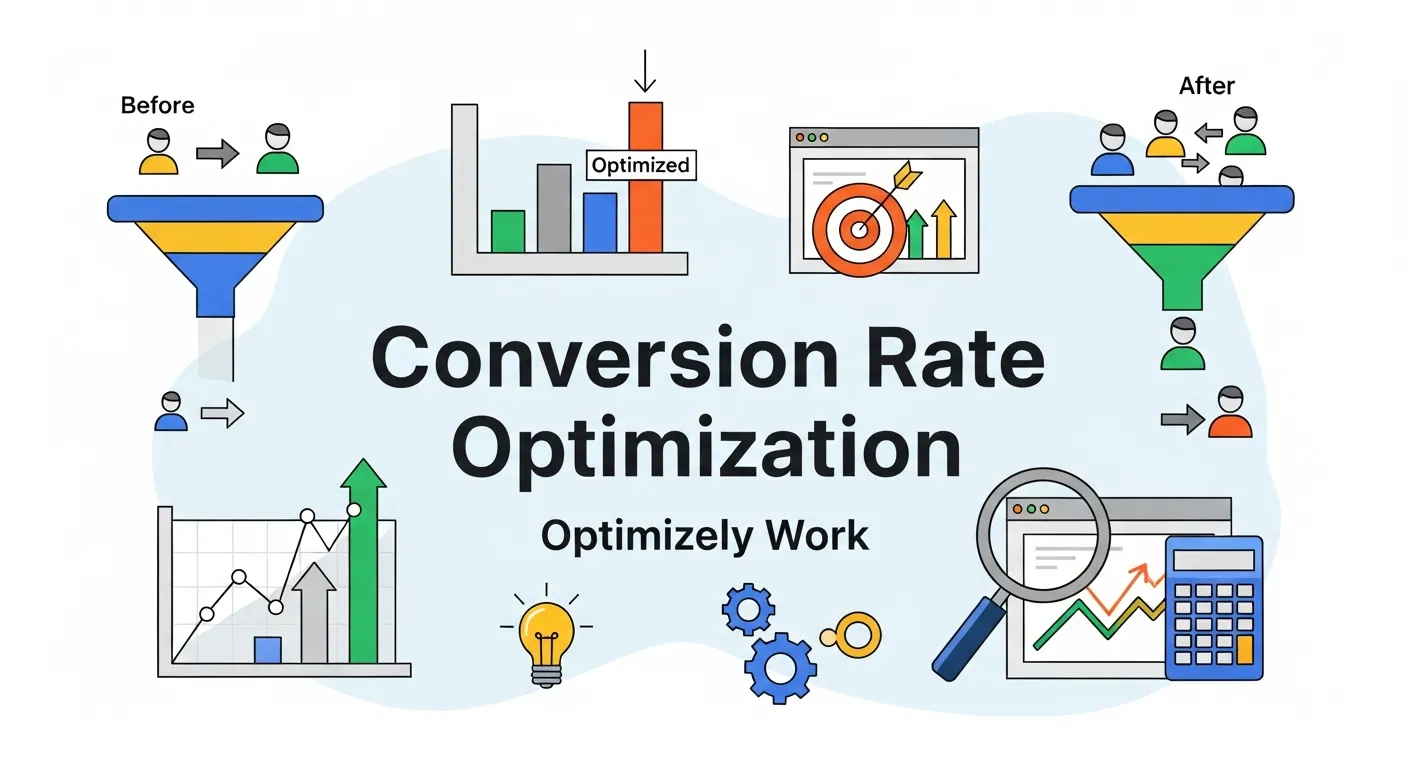
Conversion Rate Optimization in Optimizely is a systematic approach to improving the percentage of visitors who complete desired actions on your website or app. Within Optimizely, the conversion rate acts as a key performance metric that evaluates the success of experiments, personalization campaigns, and user experience improvements. By measuring conversions, you can determine which variations, messages, or designs drive the most impactful outcomes.
The process starts with setting up goals in Optimizely. Each goal corresponds to a specific conversion action, such as:
- Clicking a button or link
- Completing a purchase or subscription
- Submitting a registration or contact form
- Viewing high-value pages, like product details or pricing
Once these goals are defined, Optimizely tracks user interactions and calculates conversion rates for each experiment variation. This data allows you to see in real-time how users respond to different designs, content, and personalized experiences.
Conversion Rate Optimization in Optimizely also supports advanced testing, including A/B tests, multivariate tests, and personalization campaigns. For example, you might test two different CTA designs on your landing page while also serving personalized content to returning users. Optimizely automatically measures which combination leads to higher engagement and conversions, giving marketers and product teams actionable insights.
By leveraging these capabilities, Conversion Rate Optimization in Optimizely allows teams to make data-driven decisions rather than relying on assumptions. Over time, this leads to a continuous improvement cycle, where experiments are iteratively refined to maximize conversions and overall business impact.
Why Is Conversion Rate Important in Optimizely?
Optimizing your conversion rate within Optimizely offers multiple strategic benefits that directly impact business growth and ROI. Understanding why conversion rate matters is critical to successful Conversion Rate Optimization in Optimizely.
-
Measure Experiment Success
Conversion rate provides a clear, quantifiable way to assess which variation in an A/B or multivariate test is performing best. For example, if a new checkout flow increases purchase completion by 12%, you can confidently adopt that design across your website. -
Evaluate Personalization Impact
Optimizely allows marketers to deliver personalized user experiences based on behavior, location, or device. By tracking conversion rates for these personalized journeys, you can determine which segments respond best and further refine content or offers. This is a core part of Conversion Rate Optimization in Optimizely, ensuring personalization efforts are directly tied to measurable results. -
Enable Data-Driven Decisions
Conversion rate data helps teams make informed decisions on marketing campaigns, product design, and user experience improvements. Instead of guessing what works, you can test changes, measure impact, and roll out winning variations with confidence. This iterative testing is at the heart of Conversion Rate Optimization in Optimizely. -
Improve ROI and Reduce Costs
Focusing on conversion rate optimization allows businesses to maximize return on investment. By increasing conversions without necessarily increasing traffic or ad spend, you reduce cost per acquisition (CPA) and improve overall campaign efficiency. -
Identify Bottlenecks and Pain Points
Monitoring conversion rates in Optimizely helps uncover areas where users drop off or abandon tasks. Whether it’s a confusing checkout page, a complex form, or unclear messaging, these insights inform targeted Conversion Rate Optimization in Optimizely strategies to remove friction. -
Support Continuous Growth
Conversion Rate Optimization in Optimizely is not a one-time activity—it is a continuous process. By consistently analyzing conversion data, testing new variations, and refining your strategies, businesses can drive sustainable growth and maintain a competitive edge in digital marketing. -
Align Teams Around Goals
Clear conversion metrics unify marketing, product, and UX teams around measurable outcomes. Everyone can work toward the same target, whether it’s increasing sign-ups, purchases, or engagement, making Conversion Rate Optimization in Optimizely a collaborative and accountable process.
How to Measure Conversion Rate in Optimizely
Measuring conversion rates is a cornerstone of Conversion Rate Optimization in Optimizely. Accurately tracking conversions allows you to understand user behavior, evaluate the effectiveness of experiments, and make data-driven decisions that improve engagement and revenue. Optimizely provides robust tools to set goals, monitor performance, and analyze results. Here’s a comprehensive step-by-step guide to measuring conversion rates effectively:
Step 1: Define Your Goal
Before you can measure conversions, you must clearly define what constitutes a conversion in your experiment. Without a precise goal, your data will be ambiguous, and your optimization efforts may be misguided.
Common goals include:
- Completing a purchase: Track revenue-generating actions, such as product checkouts.
- Clicking on a call-to-action (CTA): Measure engagement with key buttons or links.
- Submitting a registration form: Ideal for lead generation campaigns or newsletter signups.
- Signing up for a free trial: Crucial for SaaS and subscription-based services.
- Viewing critical pages: Monitor user interaction with high-value content, such as pricing or product detail pages.
Clearly defining your goal ensures your Optimizely experiment aligns with your business objectives and provides meaningful data for Conversion Rate Optimization in Optimizely.
Step 2: Implement Optimizely’s Tracking Code
To track conversions accurately, you must install the Optimizely snippet on your website or app. This JavaScript code allows the platform to log user interactions, serve experiment variations, and calculate conversion rates reliably.
- Pro tip: Place the snippet on all pages relevant to your experiment to ensure complete data capture.
- Example: For a checkout optimization test, ensure the snippet is installed on product, cart, and payment confirmation pages to accurately track conversions across the user journey.
By implementing the tracking code correctly, you lay the foundation for data-driven optimization in Optimizely.
Step 3: Set Up Goals in Optimizely
Once the tracking code is in place, configure goals within Optimizely to measure the desired user actions.
- Log into Optimizely and navigate to your experiment settings.
- Create a new goal by selecting a metric, such as a button click, page view, or a custom event.
- Associate the goal with a specific element or action. For instance, if your goal is a newsletter signup, define the form submission button as the tracked event.
Optimizely will now monitor this action for all variations in your experiment, calculating the conversion rate for each variation.
-
Pro tip: Set multiple goals to track micro-conversions (like clicks on a CTA) alongside macro-conversions (like purchases) to gain a holistic view of performance.
Step 4: Run Your Experiment
With goals configured, launch your experiment using one or more variations:
- Alternative page designs: Test different layouts or visual hierarchies.
- CTA variations: Experiment with wording, colors, and placement.
- Headline or messaging tests: Determine which messaging resonates best with your audience.
By running these experiments, Optimizely will provide real-time data on how each variation influences your conversion rate, allowing you to identify high-performing elements.
Step 5: Analyze Results and Conversion Data
Once your experiment has collected sufficient traffic, it’s time to analyze the results:
- Identify the winning variation: Determine which design, CTA, or user pathway achieved the highest conversion rate.
- Check statistical significance: Ensure that observed differences are not due to random chance. Optimizely provides built-in significance testing to validate your results.
- Pinpoint optimization opportunities: Even the losing variations can provide insights into friction points, allowing you to iterate and improve continuously.
| Experiment Element | Metric Tracked | Conversion Insight Example | Action for Optimization |
|---|---|---|---|
| CTA Button Text | Click-through rate | Variation A: 12%, Variation B: 15% | Use text from higher-performing CTA |
| Landing Page Layout | Form submissions | Variant with simplified form had 20% higher completion | Apply simplified layout sitewide |
| Product Page Image | Add-to-cart clicks | New image increased clicks by 10% | Use image style for other products |
| Personalized Messaging | Newsletter signups | Personalized headline converted 8% more users | Test personalized messaging across campaigns |
Using Conversion Rate Optimization in Optimizely, this systematic approach ensures that every experiment is measurable, actionable, and directly linked to business results. Regularly tracking and analyzing conversion data allows marketers, developers, and product managers to make continuous improvements that drive higher engagement, better user experiences, and increased revenue.
Tips to Improve Your Conversion Rate with Optimizely
Achieving higher conversion rates requires a combination of strategic planning, consistent testing, and leveraging the right tools. With Conversion Rate Optimization in Optimizely, you can systematically improve your website or app’s performance by experimenting with user interactions, content, and design. Here’s a detailed guide on how to maximize the effectiveness of your Optimizely experiments:
1. Improve Your Call-to-Action (CTA)
The call-to-action (CTA) is one of the most influential elements in driving conversions. A well-designed CTA can guide users toward completing your desired action.
- Use contrasting colors: Make your CTA visually distinct from the rest of the page to grab attention.
- Write compelling copy: Clearly communicate the value users receive by clicking. For example, “Start Your Free Trial Today” is more persuasive than “Submit.”
- Position strategically: Place CTAs where users naturally engage with content, such as after product descriptions or key value points.
- Test variations in Optimizely: A/B test different wording, colors, and placements to see which combination drives the highest conversion rates.
2. Streamline the User Experience (UX)
A smooth, intuitive UX is essential for Conversion Rate Optimization in Optimizely. Friction points, confusing navigation, or overly complex processes can reduce conversions.
- Simplify navigation: Ensure users can easily find key pages or features without excessive clicks.
- Optimize checkout flows: Minimize steps in form submissions or purchases to reduce drop-offs.
- Use Optimizely insights: Heatmaps and session recordings can highlight areas where users struggle, allowing you to make targeted improvements.
3. Leverage Personalization
Personalized experiences can significantly boost engagement and conversions. Optimizely allows you to tailor content based on user behavior, device type, location, or past interactions.
- Segment users: Deliver different messaging to first-time vs returning visitors.
- Dynamic content: Show personalized recommendations or offers depending on browsing history or previous purchases.
- Test personalization impact: Use Optimizely to run experiments comparing generic vs personalized content to determine which drives higher conversion rates.
4. Test Visual Elements
Visual design heavily influences user behavior. Small changes in images, layouts, or typography can have a large impact on Conversion Rate Optimization in Optimizely.
- Experiment with layouts: Test variations of product pages, landing pages, or homepage sections.
- Optimize imagery: Use high-quality images, videos, or graphics that resonate with your audience.
- Design consistency: Ensure visual elements align with your brand, but don’t hesitate to test bold changes that may increase engagement.
5. Leverage Heatmaps and Analytics
Data-driven insights are the foundation of effective Conversion Rate Optimization in Optimizely. Heatmaps, session recordings, and analytics can reveal which parts of your website are underperforming.
- Identify drop-off points: See where users abandon forms or pages.
- Understand engagement: Determine which content attracts the most attention.
- Optimize experiment focus: Use insights to create targeted A/B or multivariate tests in Optimizely.
6. Simplify Forms
Forms are often a critical step in conversion, whether for lead generation, newsletter signup, or purchases. Simplifying forms can dramatically improve completion rates.
- Limit fields to essentials: Only ask for the information you truly need.
- Use progressive profiling: Collect additional information gradually over time rather than all at once.
- Test different layouts: Experiment with single-column vs multi-column forms, field labels, and button placement to see what drives higher conversions.
7. Create a Sense of Urgency
Psychological triggers, like urgency or scarcity, can prompt users to act quickly. Using these tactics in your CTA, messaging, or offers can positively influence Conversion Rate Optimization in Optimizely.
- Urgent language: Phrases like “Limited Time Offer” or “Only 3 Left in Stock” encourage immediate action.
- Countdown timers: Display time-sensitive promotions to motivate users.
- Test urgency messaging: Compare standard messaging vs urgent messaging in Optimizely experiments to see what boosts conversion rates.
8. Optimize Page Load Times
Page speed is a critical factor in user experience and conversions. Slow-loading pages frustrate users and increase bounce rates, directly affecting Conversion Rate Optimization in Optimizely.
- Compress images and assets: Reduce file sizes without compromising quality.
- Minimize third-party scripts: Remove unnecessary plugins or tracking scripts that slow down loading.
- Monitor performance: Use Optimizely’s analytics and third-party tools to identify slow pages and test improvements.
- Test impact on conversion: Experiment with optimized vs unoptimized pages to measure the effect of speed improvements on conversion rate.
Enhancing Conversions with AI Chatbots

Integrating AI-powered chatbots can be a transformative strategy for Conversion Rate Optimization in Optimizely. Chatbots serve as a bridge between your users and your business, guiding visitors, answering queries instantly, and personalizing experiences. By reducing friction in the customer journey, chatbots can increase engagement, reduce bounce rates, and boost conversions. In e-commerce and service industries, the use of intelligent chatbots has been shown to increase sales by up to 20%, especially when combined with A/B testing and personalization strategies in Optimizely.
How Chatbots Influence Conversion
Chatbots are not just a novelty—they are a strategic tool in driving conversions. Here’s how they make a difference:
- 24/7 Customer Support – Chatbots can handle inquiries around the clock, ensuring potential customers never leave with unanswered questions.
- Guided Product Selection – AI chatbots can recommend products based on user behavior, browsing history, or past purchases, increasing the likelihood of a sale.
- Personalized Promotions – Offer discounts, bundles, or limited-time offers dynamically based on user interaction.
- Proactive Engagement – Trigger chat conversations at critical moments (e.g., exit intent, cart abandonment) to recover lost opportunities.
- Seamless Integration with Experiments – Test different chatbot messages and flows in Optimizely to see which interaction style yields the highest conversion rate.
| Feature | Conversion Benefit | Example Use Case | Potential KPI Measured in Optimizely |
|---|---|---|---|
| Live product guidance | Increased sales | Recommend complementary items during checkout | Add-to-cart rate |
| Instant query resolution | Improved user experience | Answer FAQs instantly, reducing friction | Bounce rate |
| Personalized upselling | Higher average order value | Suggest premium versions or bundles | Average order value |
| Abandoned cart reminders | Reduced drop-offs | Send reminders or incentives for incomplete purchases | Cart completion rate |
| Dynamic promotions | Encourages faster conversions | Show limited-time deals based on browsing behavior | Conversion rate per user segment |
By integrating chatbots with Optimizely experiments, businesses can measure exactly how AI-driven interactions impact conversion rate, enabling smarter optimization decisions. For more on e-commerce chatbots that drive sales.
Building Trust Through Personal Reputation Management

A strong online reputation is critical to Conversion Rate Optimization in Optimizely, because users are more likely to convert when they trust a brand. Reputation management goes beyond reviews—it encompasses how users perceive your brand across landing pages, social media, and all touchpoints. Positive perceptions increase engagement, reduce hesitation, and drive measurable increases in conversions.
Key Steps to Reputation Management
- Monitor First Impressions – Ensure that landing pages, ads, and messaging create an immediate sense of credibility. Your first impression can significantly influence whether a user converts or leaves.
- Showcase Reviews and Testimonials – Highlight authentic customer feedback to establish social proof. Display these strategically on product pages, checkout pages, or signup forms.
- Respond to Feedback Promptly – Engaging with users who leave reviews or comments demonstrates responsiveness, building loyalty and trust.
- Maintain Consistent Messaging – A cohesive tone, visuals, and messaging across all touchpoints reassure users and reduce uncertainty.
- Highlight Achievements or Certifications – Display awards, industry recognition, or security badges to reinforce credibility.
- Leverage Personalized Content – Use Optimizely to deliver tailored messaging based on user behavior, location, or past interactions.
| Reputation Factor | Influence on Conversion | Practical Tip | Measurable Impact in Optimizely |
|---|---|---|---|
| Positive Reviews | Builds trust | Display prominently on product pages and checkout | Conversion rate uplift per page |
| Social Media Engagement | Enhances brand familiarity | Share user-generated content and testimonials | Engagement-to-conversion ratio |
| Professional Branding | Reduces hesitation | Maintain consistent visual and textual branding | Bounce rate reduction |
| Prompt Response to Feedback | Encourages repeat visits | Reply to inquiries and reviews within 24 hours | Repeat visitor conversion rate |
| Certifications and Awards | Boosts credibility | Show trust seals or industry recognition | Checkout completion rate |
Integrating reputation management into Optimizely experiments allows marketers to see how trust-building elements affect conversion rate. For more insights on personal reputation management.
Optimizing Paid Campaigns for Conversion Growth
Paid advertising is a major driver of traffic, but not all visitors convert equally. Leveraging Conversion Rate Optimization in Optimizely ensures that every paid click has the potential to become a meaningful conversion. By linking paid media campaigns with experiment-driven optimization, marketers can fine-tune campaigns, reduce wasted ad spend, and maximize ROI.
Paid Media Optimization Strategies
- Track Conversion by Channel – Analyze which ad networks, campaigns, or placements deliver the most conversions.
- Test Ad-to-Landing Page Match – Use Optimizely to experiment with landing pages corresponding to each ad variant to identify the highest-performing combination.
- Optimize CPC Campaigns – Adjust keyword bids, audience targeting, and creative assets to maximize return on ad spend.
- Retargeting for Higher Conversion – Re-engage users who previously visited your site but didn’t convert, showing personalized content or offers.
- Experiment with Messaging and CTAs – Test different ad copy, images, and calls-to-action in tandem with landing page variations.
- Segmented Campaigns for Personalized Experience – Target different audience segments with tailored messaging and measure performance separately in Optimizely.
| Metric | Description | Recommended Action | Optimizely Use Case |
|---|---|---|---|
| Cost Per Conversion (CPC) | Amount spent per successful conversion | Adjust bids to lower CPA | Test which landing pages reduce CPC |
| Conversion Rate by Landing Page | Evaluate page performance per ad | A/B test different page layouts and CTAs | Measure uplift per experiment |
| Ad Engagement Rate | Interactions with ad content | Optimize visuals, copy, and targeting | Track impact on post-click engagement |
| ROI per Campaign | Return on investment from ad spend | Allocate budget to the highest performing campaigns | Compare ROI across experiment variants |
| Bounce Rate from Paid Traffic | Percentage leaving without action | Test page layout, load time, and messaging | Identify page elements reducing retention |
Optimizing paid campaigns in tandem with Optimizely experiments allows marketers to see which ad strategies drive meaningful conversions and which don’t, ensuring your marketing dollars work efficiently. For actionable tips on maximizing e-commerce sales with CPC advertising.
Common Challenges with Conversion Rate in Optimizely
While Optimizely is a powerful platform for Conversion Rate Optimization, businesses often face challenges that can impact their ability to accurately track, measure, and improve conversions. Recognizing these hurdles and knowing how to overcome them is essential for achieving meaningful results.
1. Insufficient Traffic
Reliable conversion analysis requires a substantial volume of visitors. When traffic is low, the results of experiments or A/B tests may be statistically insignificant, making it difficult to identify which variations truly perform better.
- Why it matters: Low traffic increases the risk of random fluctuations appearing as meaningful differences, which can lead to incorrect conclusions about your website or app performance.
- Solution: Consider running longer experiments, focusing on high-traffic pages, or using segment-based analysis in Optimizely to aggregate more data without waiting excessively.
2. Improper Goal Setup
Misconfigured goals are one of the most common reasons for inaccurate conversion tracking. Goals define what counts as a conversion in Optimizely experiments, so any errors in setup can skew your results.
Examples of common setup mistakes:
- Tracking the wrong page as a conversion event.
- Forgetting to include a crucial click or form submission in the goal definition.
- Not configuring goal tracking for all relevant variations.
Solution: Before launching experiments, double-check that all goals are properly configured. Use Optimizely’s debugging and preview tools to confirm that every interaction is being recorded correctly.
3. Analysis Paralysis
With the abundance of data available in Optimizely, teams can become overwhelmed by metrics, charts, and reports. Analysis paralysis occurs when too many KPIs are tracked, making it difficult to prioritize actions.
Why it happens: Teams may track every metric—from page views to heatmaps—without focusing on the ones that truly drive conversions.
Solution: Identify and monitor the most impactful KPIs for your business, such as:
- Click-through rate on primary CTAs
- Checkout completion rate
- Lead form submission rate
- Experiment-specific goal conversion rates
Focusing on key metrics simplifies decision-making and ensures your Conversion Rate Optimization in Optimizely efforts are strategic rather than scattered.
4. External Factors Affecting Conversion
Sometimes, low conversion rates are influenced by factors outside the website or experiment itself, such as:
- Seasonal fluctuations in customer demand
- Changes in paid media performance
- Competitor promotions affecting user behavior
Solution: Always consider external trends and market conditions when analyzing your Optimizely conversion data. This ensures that experiment insights are contextualized and actionable.
5. Overlooking User Segmentation
Not all users behave the same way, and failing to segment your audience can mask important insights. For example, desktop and mobile users may respond differently to the same CTA.
Solution: Use Optimizely’s audience segmentation features to analyze conversion rates by:
- Device type (mobile vs desktop)
- Geographic location
- New vs returning users
- Traffic source
Segmented analysis allows for more precise optimization and a better understanding of which variations resonate with specific audiences.
Common Conversion Challenges
| Challenge | Impact on Conversion Rate Optimization in Optimizely | Recommended Solution |
|---|---|---|
| Insufficient Traffic | Statistically insignificant results | Run experiments longer, focus on high-traffic pages |
| Improper Goal Setup | Inaccurate data and misleading insights | Verify goals with Optimizely debugging tools |
| Analysis Paralysis | Difficulty prioritizing actions | Track key KPIs relevant to business objectives |
| External Factors | Skewed experiment results | Contextualize results with market/seasonal trends |
| Overlooking User Segmentation | Missed optimization opportunities | Analyze conversions by audience segments |
By understanding these common challenges, businesses can maximize the effectiveness of Conversion Rate Optimization in Optimizely, ensuring experiments yield actionable insights that truly improve user engagement and conversions.
Unlock the Full Potential of Your Conversion Rate in Optimizely
Understanding and optimizing your conversion rate in Optimizely goes far beyond simply collecting data—it is about unlocking the true potential of your website or app. Every click, form submission, or purchase represents an opportunity to engage users more effectively, improve their experience, and drive meaningful business outcomes. By leveraging Conversion Rate Optimization in Optimizely, you can identify what motivates your audience, remove friction from user journeys, and ensure that every interaction contributes to your goals.
A strategic approach to conversion optimization involves several layers. First, you need a clear understanding of your business objectives and the actions that define a successful conversion. Whether it’s completing a purchase, submitting a lead form, signing up for a newsletter, or interacting with key features of your app, defining these conversion points allows Optimizely to accurately measure performance. With this data in hand, you can experiment confidently, testing variations of landing pages, call-to-action buttons, forms, and personalized user pathways to determine what resonates best with your audience.
Consistent experimentation is a cornerstone of Conversion Rate Optimization in Optimizely. Even small adjustments—like changing the wording of a CTA, reorganizing a page layout, or modifying an image—can have a significant impact on conversions when tested systematically. Optimizely’s A/B testing, multivariate testing, and personalization features allow you to compare multiple variations simultaneously, giving you actionable insights that are backed by data. Over time, this approach builds a library of high-performing strategies that can be applied across your site or app.
Another critical element is understanding your audience on a deeper level. Using insights from Optimizely, including visitor segmentation, heatmaps, and session recordings, you can uncover behavioral patterns, pain points, and opportunities for engagement. For example, segmenting users by device type, traffic source, or location can reveal which experiences drive higher conversions for specific groups. Incorporating these insights into your testing strategy ensures that your Conversion Rate Optimization in Optimizely efforts are both precise and impactful.
Finally, optimizing your conversion rate is about maximizing ROI and achieving sustainable growth. With Optimizely, you can track conversions, measure the impact of experiments, and make data-driven decisions that improve the efficiency of your marketing spend. By continuously refining your user experiences, personalizing content, and testing new strategies, you can transform your website or app into a conversion powerhouse.
In short, unlocking the potential of your conversion rate in Optimizely is not just a technical exercise—it’s a strategic discipline. By combining clear goals, rigorous experimentation, audience insights, and data-driven decision-making, you can elevate your digital performance, enhance user satisfaction, and drive measurable business results. Start harnessing the full power of Conversion Rate Optimization in Optimizely today, and take your optimization strategy to the next level with confidence.
Frequently Asked Questions About Conversion Rate Optimization in Optimizely
1. What is Conversion Rate Optimization in Optimizely?
Conversion Rate Optimization in Optimizely (CRO) is the process of testing, measuring, and improving your website or app to increase the percentage of visitors who complete desired actions, such as purchases, form submissions, or signups.
2. How do I set up goals for CRO in Optimizely?
Goals in Optimizely define which user actions count as conversions. Identify key actions like button clicks, form submissions, or purchases, and configure them in the platform to track results accurately.
3. What are micro-conversions, and why are they important?
Micro-conversions are small actions showing engagement, like newsletter signups, video plays, or product view clicks. They indicate user intent before a major conversion. Example resource: Boost engagement with micro-conversions
4. How does A/B testing work in Optimizely?
A/B testing creates variations of a page or element to see which performs best against your defined goals. Optimizely calculates conversion rates for each variation, guiding data-driven decisions for CRO.
5. Can personalization improve conversion rates?
Yes. Personalized content, recommendations, or messaging tailored by behavior, location, or demographics can increase engagement. Optimizely lets you test personalized experiences to maximize conversions.
6. What role do landing pages play in CRO?
Landing pages guide users toward completing specific actions with clear CTAs, concise messaging, and relevant content. Example resource: How to create landing pages
7. How do heatmaps and session recordings help with CRO?
Heatmaps show where users click or scroll, while session recordings reveal navigation patterns. These insights highlight friction points and improve Conversion Rate Optimization in Optimizely.
8. How do I measure success in conversion experiments?
Measure success by comparing conversion rates across variations, checking statistical significance, and tracking KPIs. Include both macro- and micro-conversions for a complete view of CRO performance.
9. What are some effective CRO marketing strategies?
Effective strategies include testing CTAs, improving UX, optimizing forms, and using personalization. Example resource: Guide to CRO marketing strategies
10. How can I continuously improve conversion rates in Optimizely?
Continuous improvement involves iterative testing, monitoring user behavior, and refining experiments. Focus on high-impact pages, personalize content, and use insights from heatmaps and session recordings for ongoing optimization.